
Introduction: The Data Marketers Miss – ai-strategies
You’ve built customer avatars. You’ve profiled age, income, location, maybe even favourite coffee drinks. But when it’s time to write high-converting copy, something’s still missing. You’re stuck guessing what actually drives someone to click, buy, or bounce. You lack ai-strategies.
Here’s the truth: Demographics are static. Human decisions are not.
Understanding why your customer buys requires peeling back the layers to uncover motivations, fears, frustrations, and beliefs—things no spreadsheet can fully capture.
That’s where AI steps in as your unfair advantage.
Modern AI tools can analyse real customer conversations and surface insights you’d miss manually. What they reveal isn’t just interesting—it’s actionable.
Below, we dive into four transformative AI-powered strategies that take you from “sorta guessing” to “deeply knowing” your customers.
1. Go Deeper Than Demographics with Psychographic Intelligence
It’s time to stop treating your audience like a demographic checklist. Instead, ask:
-
What are they afraid of?
-
What have they already tried that didn’t work?
-
What would success feel like to them?
These are psychographic insights—deep emotional and behavioural cues that inform how people think, feel, and decide.
AI can scan conversations, reviews, or surveys to help you answer:
-
“What triggers their frustration?”
-
“What beliefs make them hesitate?”
-
“What would make this product feel like a no-brainer?”
When you use this data to write copy, it doesn’t just convert—it connects. Because now, you’re speaking to their inner world, not just their outer label.
2. Let AI Analyse the Words Your Customers Already Use
Marketing gold is hidden in the messages you’re already receiving—support emails, onboarding surveys, testimonials, reviews, and community comments.
But who has time to dig through thousands of entries?
AI does.
With natural language processing (NLP), AI can:
-
Find repeated objections
-
Surface common pain points
-
Identify emotionally charged phrases
-
Distil patterns from thousands of inputs
This transforms vague avatars into crystal-clear personas. For example:
Outdated Persona:
“Marketing Mary, 35, wants to grow her business.”
AI-Generated Insight:
“She’s burned out after trying 3 online courses to grow her email list. She’s overwhelmed by conflicting advice and secretly wonders if she’s just not cut out for this.”
Which one helps you write a better headline? Enough said.
3. Map the AI-Backed Customer Awareness Journey
People don’t buy just because your offer is good—they buy when they’re ready.
AI can help identify where customers are on the awareness journey so you can meet them with the right message at the right moment:
| Stage | What They Need |
|---|---|
| Unaware | Relatable stories that reveal the problem |
| Problem-Aware | Empathy + educational content |
| Solution-Aware | Product comparisons + social proof |
| Decision-Ready | Clear offer + low-friction CTA |
By feeding customer data into AI tools, you can classify users by awareness stage and serve targeted messaging instead of blanket promotions.
The result? More engagement, less wasted ad spend, and higher conversion rates.
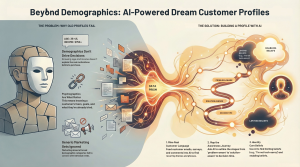
4. Uncover the Beliefs That Make or Break the Sale
Every potential buyer walks in with a set of beliefs. Some help you. Others block you.
Limiting beliefs are hidden objections that stall conversions. AI can detect them by analysing patterns in customer language:
🛑 “I’ve tried everything and nothing works for me.”
🛑 “This probably works for others, but my case is different.”
Rather than argue with these beliefs, use your marketing to gently neutralize them:
-
Show proof that similar customers succeeded.
-
Explain how your approach is different.
-
Simplify the process to remove intimidation.
Enabling beliefs, on the other hand, are green lights—mindsets that drive action:
✅ “Investing in expert help saves me time.”
✅ “I deserve to grow my business.”
Reinforce these beliefs in your copy, testimonials, and onboarding flows. When AI highlights these internal drivers, you’re not just selling a product—you’re aligning with a mindset.
From Mass Messaging to Mental Mirrors
Traditional marketing relies on “averages.” But real people are complex, emotional, and driven by internal narratives you can’t see on the surface.
Thanks to AI, you now have access to the emotional and psychological blueprints of your customers—at scale.
Here’s your action step:
Take real customer messages—emails, reviews, surveys—and feed them into an AI tool.
-
Ask it: “What are the 3 most common frustrations?”
-
Then ask: “What are the enabling beliefs of those who purchased?”
The next time you write copy, don’t write at your audience. Write with them in mind—using the very words they’ve already given you.
That’s how you create content that feels personal, not promotional.
That’s how you understand your customers better than ever before.
Want help turning customer data into emotionally engaging marketing?
Grab a free AI prompt template to get started.
Don’t miss our FREE AI-Powered Toolkit
