
AI Citation Optimization: How to Structure Blog Answers AI Can Quote
Ask an AI tool a question and look closely at the answer it gives you. You usually do not get a giant wall of information. You get a short, tidy response, often drawn from content the system has found useful and trustworthy. AI citation optimization is about structuring your content so those useful answers are easier for AI systems to identify, understand, and cite. The opportunity is not necessarily to write more. It is to make the strongest parts of what you already write clearer, more self-contained, and easier to extract.

You usually do not get a giant wall of information. You get a short, tidy response. Sometimes it is only one or two sentences. Sometimes that answer closely reflects wording from a webpage the AI has found useful.
That webpage could be yours.
The opportunity is not necessarily to write more content. It is to structure the useful parts of your existing content so clearly that an AI system can understand what answers a question, extract that answer cleanly, and use it without having to untangle half a paragraph first.
A beautifully written paragraph can still be difficult to reuse if the real answer is buried inside it.
A short, self-contained answer placed directly beneath the right heading is much easier to understand.
That gives smaller blogs an interesting opportunity.
You may not have the biggest website, the largest team, or years of search authority behind you. But if your page provides a clearer answer than a larger competitor’s page, your content can still become useful to an AI system.
The practical question is:
How do you use AI citation optimization to structure answers so they are easy for both people and AI systems to understand?
There are three places to start:
- Make the answer stand on its own.
- Give it the right amount of space.
- Put it where the question is answered.
1. Write an Answer That Can Stand on Its Own
Imagine someone removes one sentence from your article and pastes it somewhere else.
Would it still make sense?
That is one of the simplest tests you can use when writing important answer sentences.
Consider this:
It usually takes about a week.
That might make perfect sense inside the original paragraph.
But what does “it” mean?
Now compare it with:
A printable bundle usually takes about a week to put together.
The second version carries its own subject.
It can travel.
A reader does not have to search backwards through the paragraph to work out what you are talking about.
This matters because many of us naturally write in connected thoughts.
We introduce an idea in one sentence and refer back to it with words such as:
- it
- this
- that
- they
- this approach
- that method
That is perfectly normal writing.
The problem appears when the important answer depends too heavily on what came before it.
The Cover-Up Test
Here is a simple editing trick.
Cover everything above the sentence you want to test.
Then read only that sentence.
Ask:
Would a stranger understand exactly what this sentence is about?
If yes, you probably have a strong standalone answer.
If the reader would ask, “What does this mean?” or “What are they talking about?”, add the missing subject directly into the sentence.
Instead of:
This approach works especially well for beginners.
Try:
The 15-minute daily learning approach works especially well for beginners because it keeps the workload small and repeatable.
Now the idea survives outside its paragraph.
Do Not Make Every Sentence Sound Robotic
There is an important balance here.
You do not need every sentence in your article to behave like a dictionary definition.
Your stories can still flow.
Your examples can still be conversational.
Your personality can still show.
The trick is to make the sentences carrying the actual answer especially clear.
Think of the rest of the paragraph as the conversation around the answer.
Then plant one sentence inside it that is strong enough to stand alone.
Interestingly, this does more than improve structure.
It also improves thinking.
When you cannot explain an idea clearly in one or two sentences, there is a chance the idea itself still needs sharpening.
Clear writing often reveals clear thinking.
2. Give Your Answer the Right Amount of Room
An answer can be too short.
It can also be too long.
A sentence with almost no useful detail may feel incomplete.
A six-paragraph explanation may contain the answer, but someone has to dig through it to find the useful part.
For many direct questions, a useful starting point is one to three sentences.
That gives you enough room to answer properly without burying the point.
Think about the way you would answer a good question in a text message.
You would probably:
- Answer the question.
- Add the one important detail.
- Stop before it becomes a speech.
That is often a useful model for quotable content.
Remove the Padding
Writers naturally add softening phrases such as:
- It is worth noting that…
- In many cases…
- Generally speaking…
- It is important to remember that…
- As you may already know…
Sometimes those phrases help the tone.
Often they simply delay the answer.
Compare:
It is worth noting that in many cases a short standalone answer may make it easier for an AI system to understand the main point.
With:
A short standalone answer makes the main point easier to understand and extract.
The second version gets to work faster.
Answer First, Then Expand
Some topics genuinely need a longer explanation.
That is fine.
Do not squeeze an important subject into two sentences just because you want it to be concise.
Instead, use this structure:
Short answer first.
Then:
Detailed explanation underneath.
For example:
How long should a quotable answer be?
A quotable answer will often work well in one to three sentences, provided those sentences fully answer the question without relying on surrounding context.
Then you can explain why.
You can give examples.
You can add nuance.
You can discuss exceptions.
The short opening serves the reader who wants the answer quickly.
The explanation serves the reader who wants depth.
You are not choosing between useful short-form writing and comprehensive content.
You can provide both.
Match the Answer to the Question
Different questions need different answer shapes.
A definition may need one crisp sentence.
A how-to question may need one sentence describing the action and one explaining the result.
A yes-or-no question should usually answer yes or no quickly, then explain.
A comparison might need two short statements followed by the main difference.
The structure of the answer should match the structure of the question.
3. Put the Answer Where It Belongs
You can write a brilliant answer and still make it difficult to find.
This often happens because writers like introductions.
We build context.
We explain why the topic matters.
We set the scene.
Then several paragraphs later, we finally answer the question.
That can work beautifully in storytelling.
It is less useful when someone wants a direct answer.
Put the Answer Immediately Under the Heading
If a section is answering:
How long should a blog answer be?
then answer that question in the first sentence or two beneath the heading.
Do not spend three paragraphs explaining the history of blog writing first.
Give the payoff.
Then explain it.
This simple structure works well:
Question-style heading
Direct standalone answer
Supporting explanation
Examples
Nuance
Related advice
That gives the section a clear purpose.
Use the Questions People Actually Ask
Your headings can help readers and AI systems understand what each section answers.
Compare:
Some Thoughts About Answer Length
with:
How Long Should an AI-Friendly Answer Be?
The second heading tells us exactly what problem the section solves.
This does not mean every heading needs to be a question.
But when you are answering a specific question, using language close to the way your audience would naturally ask it can make the section much clearer.
Do Not Hide the Best Sentence in the Middle
Another common mistake is writing your strongest sentence halfway through a long paragraph.
If sentence five contains the real answer, consider moving it up.
Give it room.
You might even place it in its own short paragraph.
White space is not wasted space.
It helps show where one idea ends and another begins.
A clean answer surrounded by space feels like a distinct unit instead of one sentence trapped inside a pile of other thoughts.
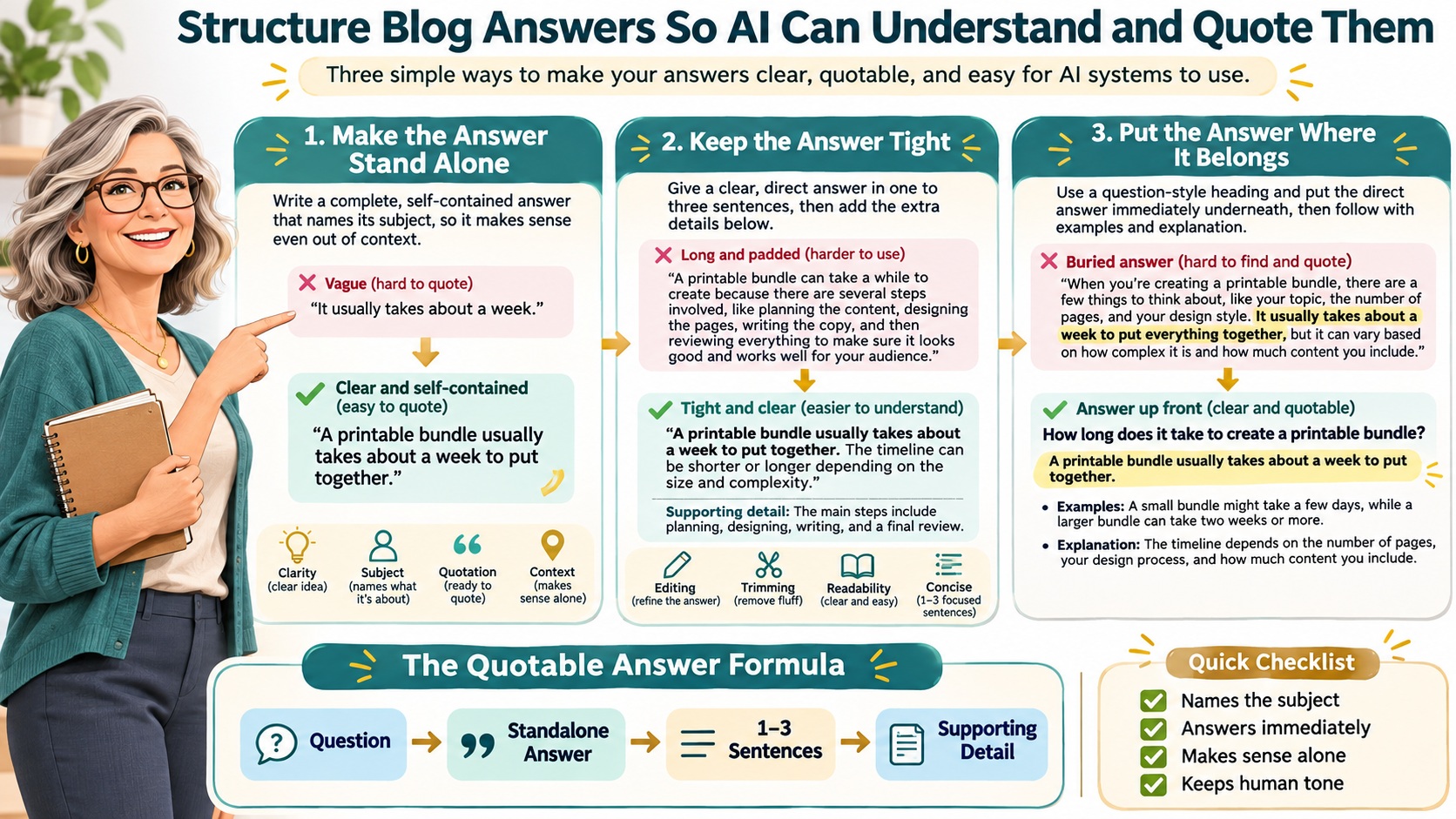
A Simple AI Citation Optimization Structure
Here is a practical format for question-based sections in your blog posts.
Question or Search Query
Direct answer: Write one to three complete sentences that make sense without the surrounding paragraph.
Explanation
Expand on the answer with context, reasoning, examples, or exceptions.
Example
Show how the idea works in practice.
Action Step
Tell the reader what to do next.
This format does not need to appear everywhere.
Use it where your content is genuinely answering something important.
A Quick AI Citation Optimization Editing Prompt
AI can also help you test sections you have already written.
Try a prompt like this:
Here is a section from my blog post. Identify the sentence or sentences that directly answer the main question. Rewrite that answer in one to three complete sentences that can stand on their own without surrounding context. Remove vague pronouns and filler, but keep my warm, conversational tone. Then explain what you changed and why.
Do not simply accept the rewrite automatically.
Read it aloud.
Check whether it still sounds like you.
Sometimes optimization can go too far and produce language that feels clipped, mechanical, or unnatural.
Your goal is not to create a search result.
Your goal is to create a useful human answer that happens to be easy for machines to understand too.
The Real Advantage Is Clarity
There is a bigger lesson underneath all of this.
Optimizing content for AI does not have to mean filling articles with strange formatting, robotic phrases, or technical tricks.
Much of the work comes back to very traditional writing principles:
Be specific.
Answer the question.
Remove unnecessary words.
Put important information where people expect to find it.
Use headings that communicate what a section is about.
Keep your examples useful.
Write clearly enough that the sentence does not collapse when removed from its surroundings.
Those principles help AI systems.
But they also help people.
That is why this approach is worth paying attention to.
Start With One Existing Article
You do not need to rebuild your entire blog.
Choose one article you already have.
Find three questions that article answers.
For each question:
- Create or improve the heading.
- Move the direct answer to the top of the section.
- Rewrite the answer so it stands alone.
- Keep it complete but concise.
- Add the detail underneath.
- Read it aloud to make sure it still sounds human.
Then repeat the process on another article.
Small structural improvements across your existing content can be far more practical than continually producing more pages.
Because sometimes the problem is not that your website lacks useful information.
The useful information is already there. At its core, AI citation optimization is simply the practice of making your strongest answers easier to identify, understand, and reuse.
It simply needs to be shaped so it is easier to find, understand, quote, and share.
 Join the Challenge: Access Classroom · The Opportunity Lab™ Today
Read:
Systeme.io Review: All-in-One Business Platform
Effective Strategies for Incorporating AI in Your Business Operations
Best AI Marketing Tools for Boosting Your Online Business
Ultimate Guide to Mastering AI Copywriting Techniques in 2026
Top 10 AI Content Creation Tips for High-Quality AI-Driven Content
Top 5 AI Copywriting Mistakes to Steer Clear Of
The 4 Cs of Better AI Copy / Mastering AI Copywriting: 7 Essential Frameworks Revealed
Improve AI Content Over Time / Top 10 AI Content Creation Tips
📅 Last updated:
