
Best AI Marketing Tools for Boosting Your Online Business
Running an online business today means staying ahead of the curve, and AI marketing tools have become game-changers in this journey. Whether you’re a solopreneur or leading a growing company, leveraging AI software can skyrocket your efficiency, customer engagement, and ultimately, your sales. In this article, I’ll take you through a detailed AI tools comparison, share real user reviews, and help you navigate cost and integration considerations. Ready to discover how AI marketing tools can transform your business success strategies? Let’s dive in.

AI Marketing Tools Overview
AI marketing tools refer to software platforms that use artificial intelligence to automate, optimize, and personalize marketing efforts. They help with tasks like content creation, customer segmentation, predictive analytics, and email marketing automation. With AI marketing tools, businesses can save time, reduce human error, and achieve higher ROI on campaigns.
Some of the most popular AI marketing tools include:
- HubSpot Marketing Hub: Offers AI-driven content strategy and lead scoring.
- Jasper AI: Known for its AI-powered copywriting capabilities.
- Drift: Specializes in AI chatbots for personalized customer conversations.
- Marketo Engage: Provides advanced AI for customer journey analytics.
- Hootsuite Insights: Uses AI to monitor social media sentiment and trends.
These tools vary widely in features and target audiences. For example, Jasper AI focuses on content creation, helping marketers generate blog posts, ads, and emails quickly. Drift, on the other hand, improves lead qualification and customer service through conversational AI chatbots. Choosing the right AI marketing tool depends heavily on your business goals and marketing channels.
In my experience, AI marketing tools are not just about automation but also about gaining insights. Predictive analytics, powered by AI, can forecast customer behavior, enabling smarter campaign targeting. This is a big shift from traditional marketing where decisions were often based on intuition or limited data.
For readers new to AI in marketing, understanding this landscape is the first step. I recommend exploring a few demo versions or free trials to see how these tools fit your workflow.
Features Comparison
When comparing AI marketing tools, the features they offer can vary dramatically. I’ve broken down some key categories that matter most to online businesses.
Content Generation
Tools like Jasper AI and Copy.ai excel here. They use natural language processing to produce blog posts, social media updates, and ad copy. Jasper AI, for example, can generate long-form content with tone customization, which is a huge time saver for content creators.
Customer Segmentation and Targeting
HubSpot and Marketo Engage use AI to analyze customer data and segment audiences based on behavior and demographics. This allows marketers to send highly personalized campaigns, which improves engagement rates significantly.
Chatbots and Conversational AI
Drift and Intercom are leaders in AI chatbots that provide instant customer support and lead qualification. These bots can handle FAQs, schedule meetings, and route complex queries to humans, improving response time and customer satisfaction.
Analytics and Reporting
Hootsuite Insights and Google Analytics 4 integrate AI to provide sentiment analysis and predictive insights. These tools help marketers understand audience sentiment in real time and predict campaign outcomes, allowing quick strategic adjustments.
Email Marketing Automation
Platforms like Mailchimp now incorporate AI to optimize send times, subject lines, and content personalization. This leads to higher open rates and conversions, as emails feel more relevant and timely to recipients.
Comparing these features side-by-side is crucial when selecting an AI marketing tool. For example, if your primary need is creating engaging content quickly, Jasper AI might be your best pick. But if you want an all-in-one marketing platform with strong CRM integration, HubSpot could provide more value.
User Reviews and Ratings
Nothing beats hearing from real users when evaluating AI marketing tools. I’ve gathered insights from diverse sources to give you a balanced perspective.
Jasper AI
Users praise Jasper AI for its intuitive interface and quality of generated content. Many highlight how it cuts down writer’s block and speeds up the content creation process. However, some mention it requires clear input prompts to avoid generic outputs.
HubSpot Marketing Hub
HubSpot gets high marks for its comprehensive features and customer support. Users appreciate its AI-powered lead scoring and the seamless CRM integration. On the downside, some find the pricing steep for smaller businesses.
Drift
Drift’s chatbot is lauded for improving lead engagement and automating customer service conversations. Several reviews mention its impact on reducing response times and increasing qualified leads. The learning curve for setup can be a hurdle for less tech-savvy teams.
Marketo Engage
Marketo is favored by enterprise users for its robust analytics and automation capabilities. Its AI-driven customer journeys help marketers automate complex campaigns effectively. The main critiques revolve around its complexity and cost.
Checking aggregated ratings on platforms like G2 and Capterra can also help. For example, Jasper AI holds an average rating of 4.7/5 on G2, indicating strong user satisfaction.
Integration Capabilities
One of the biggest considerations for AI marketing tools is how well they integrate with your existing systems. Integration can make or break your workflow efficiency.
CRM Integration
Tools like HubSpot and Marketo integrate seamlessly with popular CRMs such as Salesforce and Microsoft Dynamics. This ensures marketing data syncs smoothly with sales activities, creating a unified customer view. For example, Marketo’s Salesforce connector lets you automate lead nurturing based on sales pipeline activity.
Content Management Systems (CMS)
Many AI content generators offer plugins or APIs for CMS platforms like WordPress and Shopify. Jasper AI, for instance, can be used directly within WordPress to draft posts faster. This reduces the need to switch between tools, streamlining your content workflow.
Social Media Platforms
Hootsuite Insights and Buffer integrate with multiple social networks to analyze engagement patterns and schedule posts. AI integration here helps identify the best times to post and optimize messaging based on audience behavior.
Communication Tools
Drift and Intercom connect with email providers and calendar apps, enabling chatbots to schedule meetings automatically. This integration reduces manual coordination and accelerates lead qualification.
When evaluating integration capabilities, consider what tools your team already uses. A tool with robust API support or pre-built connectors will save you tons of time. You might also want to test how easy the setup process is with your current tech stack.
Cost Analysis
Understanding the pricing models of AI marketing tools is crucial for budgeting and ROI expectations. These tools usually come in tiered plans based on features, usage limits, or number of users.
Subscription Models
Most AI marketing tools operate on a monthly or annual subscription basis. For example, Jasper AI’s plans start at around $40/month for basic content generation, scaling up to $125/month for more advanced features and team access.
Enterprise Pricing
Platforms like HubSpot and Marketo offer custom pricing for enterprise clients, often exceeding several hundred dollars per month. These plans typically include personalized onboarding, dedicated support, and advanced AI capabilities.
Hidden or Additional Costs
Watch out for add-ons such as extra user licenses, premium integrations, or API access fees. Some tools charge based on data volume or number of contacts, which can increase costs as your business grows.
ROI Considerations
While the upfront cost might feel high, the efficiency gains and increased conversions from AI marketing tools often justify the investment. For example, companies using AI-driven email personalization report up to a 760% increase in revenue from segmented campaigns, according to Mailchimp’s benchmarks.
It’s wise to start with a free trial or basic plan to test the tool’s impact. Then, scale up once you see tangible improvements in campaign performance or time savings. Cost analysis should always be balanced against these benefits.
Decision-making Guide
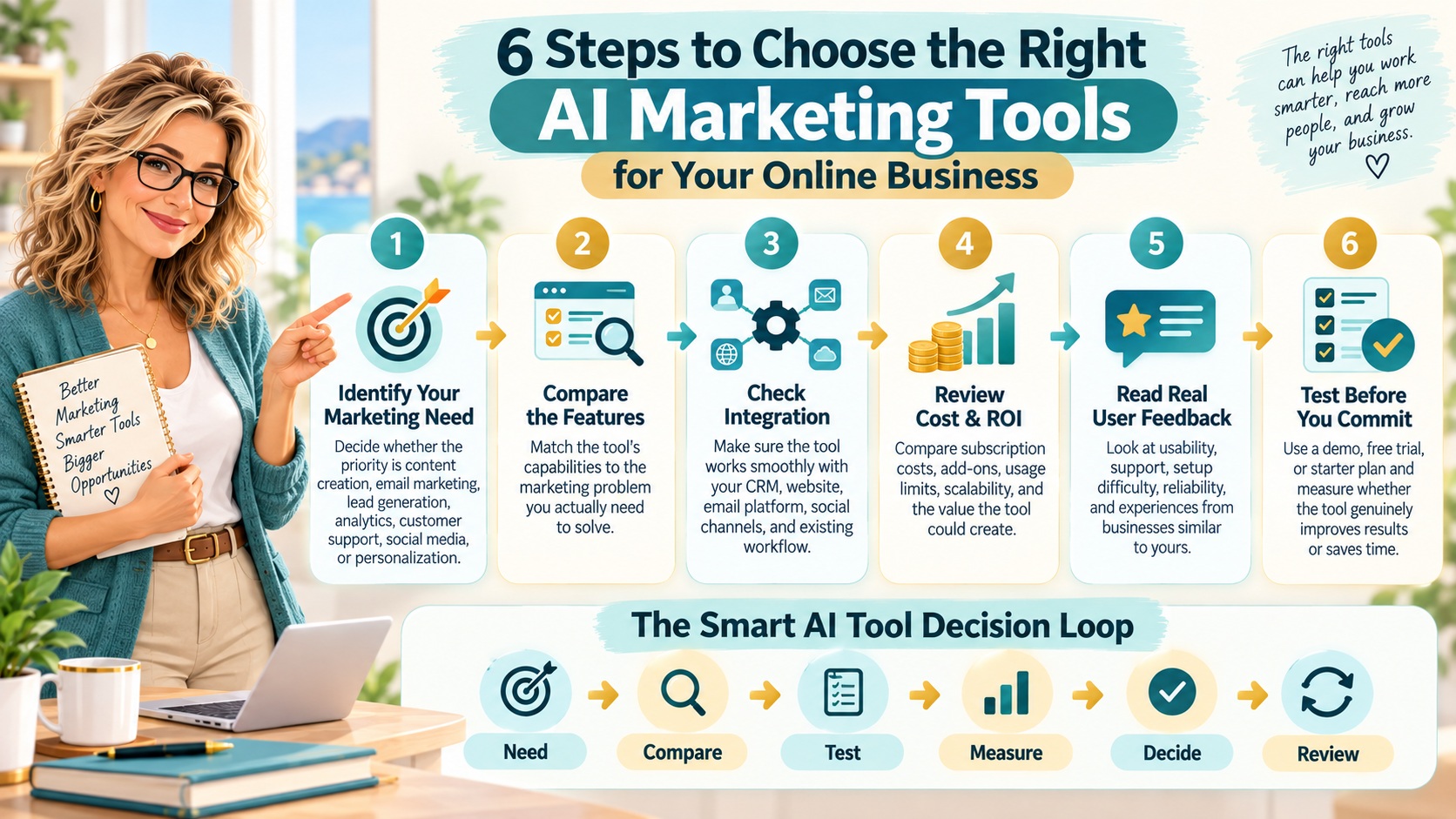
Choosing the right AI marketing tool can be overwhelming, but a structured approach helps.
- Identify Your Primary Needs: Are you focused on content creation, analytics, lead generation, or customer service?
- Evaluate Features: Match features against your goals. For example, if personalized email marketing is key, prioritize tools with strong automation capabilities.
- Consider Integration: Check compatibility with your existing tech stack to avoid workflow disruptions.
- Assess Budget: Balance cost with expected ROI and scalability.
- Read User Reviews: Look for feedback from businesses similar to yours for realistic expectations.
- Test the Tool: Use free trials or demos to get hands-on experience before committing.
For online business success strategies, combining multiple AI marketing tools often yields the best results. For example, pairing Jasper AI for content with Drift chatbots for lead qualification creates a powerful marketing funnel. Ultimately, the best tool is one that fits seamlessly into your processes and supports your growth objectives.
Case Studies
Real-world examples illustrate AI marketing tools’ impact best. Here are three case studies that demonstrate varied applications.
Case Study 1: E-commerce Brand Boosts Sales with AI Chatbots
A mid-sized fashion retailer integrated Drift’s AI chatbot on their website. The bot handled FAQs, offered personalized product recommendations, and scheduled appointments with stylists. Within six months, the brand saw a 30% increase in qualified leads and a 15% boost in online sales. The chatbot reduced customer response times from hours to seconds, improving overall user experience.
Case Study 2: SaaS Company Improves Content Efficiency
A SaaS startup adopted Jasper AI to assist their marketing team with blog posts and email campaigns. The team saved 50% of their content creation time, allowing them to publish more frequently and maintain consistent messaging. The startup reported a 25% increase in website traffic and higher email open rates thanks to AI-optimized subject lines and content.
Case Study 3: B2B Enterprise Leverages Predictive Analytics
A B2B software company used Marketo Engage’s AI-powered analytics to map customer journeys and predict churn risks. This enabled proactive outreach campaigns tailored to at-risk customers. The company reduced churn by 18% and increased upsell conversions by 12%, showcasing how AI tools can drive customer retention and revenue growth.
These case studies show the versatility of AI marketing tools across industries and business sizes. Their ability to automate, personalize, and analyze marketing efforts translates into measurable business outcomes.
Future Trends in AI Marketing
The AI marketing landscape continues evolving rapidly, and staying updated on future trends can prepare your business for long-term success.
Hyper-Personalization
Going beyond basic segmentation, AI will enable hyper-personalized marketing messages crafted for individual preferences and behaviors in real time. This means dynamic content delivery that adapts on-the-fly to the user’s context.
Voice and Visual Search Optimization
AI-powered voice assistants and visual search tools are becoming mainstream. Marketers will need AI tools that optimize content for these channels, driving discovery through smart search technologies.
AI-Driven Creative Design
We’ll see more AI software capable of generating not just text but also images, videos, and interactive content. Tools like DALL·E and Runway ML are pioneering this space, allowing marketers to create multimedia assets without heavy design expertise.
Ethical AI and Data Privacy
As AI marketing tools collect more consumer data, ethical use and compliance with privacy regulations will become critical. Expect AI platforms to incorporate stronger transparency and consent management features.
Integration of AI with Marketing Automation Platforms
AI capabilities will be embedded more deeply into existing marketing automation suites, making advanced analytics and personalization accessible even to small businesses with limited resources.
Keeping an eye on these trends will help you select AI marketing tools that not only meet current needs but also future-proof your online business strategies.
Conclusion
AI marketing tools are revolutionizing how online businesses operate by enhancing efficiency, personalization, and analytics. From content creation with Jasper AI to customer engagement via Drift chatbots, these tools offer diverse benefits tailored to different business needs. Comparing features, reading user reviews, and considering integration and cost factors are essential steps toward choosing the right AI marketing tool for your company.
Successful online business strategies increasingly rely on a smart combination of AI software to automate routine tasks and unlock valuable customer insights. By embracing AI marketing tools today, you position your business for greater growth and competitive advantage tomorrow.
Visit our GPT, Prompt & Skills Site – The AI Knowledge Vault
To see the full system:
 Read:
Read:
Systeme.io Review: All-in-One Business Platform
AI Business Strategies for Beginners: How to Implement AI for Growth
Mastering AI-Powered Business Techniques for Future Success
Effective Strategies for Incorporating AI in Your Business Operations
Mastering the Art of Evaluating AI Business Performance with AI Business Audit Tactics
Leveraging AI for Enhanced Online Sales Performance
Your AI Business Model Optimization Enhancement: 5 Expert Tips
Optimizing Recurring Revenue Generation Using AI Tools
📅 Last updated:
