
Enhance Your AI Business Model: 5 Expert Tips
Building a successful AI business model optimization is an exciting journey, but it requires careful refinement to unlock its full potential. Whether you’re a beginner exploring AI strategies or a retiree looking to optimize online income streams, knowing how to enhance your AI business model is crucial. In this article, I’ll share five expert tips that helped me and countless others improve our AI ventures. From identifying optimization opportunities to leveraging the latest AI tools, you’ll gain practical insights to boost efficiency, profitability, and long-term sustainability. Let’s dive in and transform your AI business model into a thriving success story.

Understanding AI Business Model Optimization
Before optimizing your AI business model, it’s essential to understand what it entails and how it functions in today’s digital economy. An AI business model typically combines artificial intelligence technologies with a value proposition that addresses specific market needs. This can range from AI-powered analytics platforms to automated content creation tools.
One way to frame your AI business model is by identifying the core AI strategies it employs. These may include machine learning algorithms, natural language processing, or computer vision techniques tailored to serve your niche. For example, an AI-driven marketing platform may use predictive analytics to target customers more effectively.
Another important aspect is the revenue generation method embedded in your AI model. Common approaches include subscription-based services, pay-per-use models, or licensing AI software. Understanding this helps clarify how your AI business creates value and sustains itself financially.
In my experience, knowing your model’s structure allows you to spot bottlenecks and areas ripe for optimization. For instance, if your AI tools require manual intervention at certain stages, automating those can reduce costs and improve user experience. Additionally, studying competitors’ AI business models can reveal gaps or opportunities you might have missed.
AI business models can also vary widely depending on the target audience. Beginners might focus on simple AI applications that automate routine tasks, while retirees may prefer AI solutions that generate passive income with minimal management. Tailoring your model to fit the needs of your audience is a foundational step toward effective AI business model optimization.
In summary, a clear understanding of your AI business model’s components and market positioning sets the stage for meaningful improvements that can boost profitability and scalability.
Identifying Optimization Opportunities
Once you understand your AI business model, the next step is to identify where optimization can make the biggest impact. Optimization means enhancing efficiency, reducing costs, or increasing revenue without compromising quality or user satisfaction.
Analyzing Workflow and Processes
I suggest conducting a thorough review of your AI workflows. Map out every step—from data collection and processing to model training and deployment. Look for repetitive tasks that could be automated or simplified using AI tools. For example, automating data preprocessing reduces human error and speeds up model updates.
Consider the data your AI system uses. Is it clean, relevant, and comprehensive? Poor data quality can lead to subpar AI performance, which in turn affects customer trust and retention. Investing time into improving data pipelines often yields significant returns.
Evaluating User Feedback and Behavior
Your customers’ experience provides critical clues about areas needing improvement. Use analytics to track how users interact with your AI product. Are there features they rarely use or complaints about system accuracy? Incorporating this feedback into your optimization plan ensures your AI business stays user-centric.
For example, an AI chatbot might struggle with certain queries. By analyzing chat logs, you can retrain the model or add fallback mechanisms to enhance performance. This reduces frustration and improves customer satisfaction.
Benchmarking Against Competitors
Knowing where your AI business stands in the market can reveal untapped opportunities. Study competitors’ offerings, pricing models, and technology stacks. If they leverage newer AI tools or offer more flexible pricing, consider adapting similar strategies to stay competitive.
For instance, switching from a one-time license fee to a subscription model may increase recurring revenue and customer loyalty. Similarly, integrating advanced AI libraries like TensorFlow or PyTorch could improve model accuracy and speed.
Finally, don’t overlook the importance of cost analysis. Examine your operational expenses to identify where you can cut costs without sacrificing quality. Cloud computing costs, for example, can balloon if not managed carefully. Using cost-efficient AI platforms or optimizing your infrastructure can save money.
By investing time in these analyses, you create a solid foundation for effective AI business model optimization that aligns with both market demands and operational realities.
Implementing AI Tools Effectively
Choosing and using the right AI tools is a game-changer in optimizing your AI business model. Tools dictate how well your AI systems perform and how efficiently they integrate into your workflow.
Selecting the Right AI Platforms
There’s an abundance of AI platforms available, each with unique strengths. For beginners, user-friendly platforms like TensorFlow or Microsoft Azure AI offer excellent documentation and community support. These platforms help you build and deploy AI models without extensive coding knowledge.
For more advanced users, platforms like AWS AI services or Google Cloud AI offer scalable infrastructure and pre-built AI services like vision, language, and forecasting APIs. Selecting a platform that fits your technical skills and business needs is crucial.
Integrating AI Tools into Existing Workflows
Effective integration means your AI tools should seamlessly fit into your current systems. For example, if you run an online store, integrating AI chatbots to handle customer service queries directly via your website can improve response times and reduce labor costs.
Automation tools like Zapier or custom APIs can connect different software solutions, enabling your AI models to communicate with databases, CRM systems, or marketing platforms. This reduces manual tasks and accelerates decision-making.
Training and Updating AI Models
AI tools don’t remain effective without regular updates. AI models require continuous training with fresh, relevant data to adapt to changing market conditions or user behavior. Implementing a schedule for model retraining and validation ensures your AI remains accurate and reliable.
Many AI platforms offer automated retraining pipelines, which can be set up to refresh models periodically. This reduces operational overhead and keeps your AI business agile.
Moreover, investing in training yourself or your team on AI tool capabilities can unlock new features and optimization strategies. Platforms often release updates with enhanced functions that can boost your AI business performance.
By carefully selecting, integrating, and maintaining AI tools, you build a solid technological backbone that supports scalable and sustainable AI business model optimization.
Maximizing Online Income Streams
One of the main goals of AI business model optimization is increasing online income streams. AI opens multiple avenues to generate revenue, but it requires strategic planning to maximize these opportunities.
Diversifying Revenue Channels
Relying on a single income stream can be risky. I recommend exploring multiple online income streams powered by AI technologies. For example, besides selling AI software, you could offer AI consulting services, online courses, or affiliate marketing of AI tools.
Many AI entrepreneurs create content that educates others about AI strategies and monetize this through ads, sponsorships, or memberships. This diversifies income and builds brand authority.
Optimizing Pricing Models
Pricing can significantly impact your revenue. Experiment with different pricing strategies like freemium models that attract users with free basic features while charging for premium capabilities. Subscription pricing often creates steady cash flow and better customer retention compared to one-time payments.
Offering tiered pricing based on usage or features helps cater to various customer segments, from beginners to enterprises. This flexibility can increase conversions and overall earnings.
Leveraging Affiliate and Partnership Opportunities
Affiliate programs allow you to earn commissions by recommending AI tools or services. I’ve found that partnering with reputable AI platforms not only adds income but also enhances your credibility.
Additionally, forming partnerships with complementary businesses can expand your reach. For instance, collaborating with a content creation agency to integrate your AI tools into their offerings creates mutual benefits.
Utilizing Data Monetization
If your AI business collects valuable anonymized data, there may be opportunities to monetize it ethically. Many companies pay for insights derived from consumer behavior or market trends. Ensure compliance with data privacy regulations while exploring this revenue stream.
Maximizing online income streams requires a blend of creativity and strategic thinking. Experimentation combined with data-driven decisions will reveal the most profitable paths for your AI business.
Tailoring Strategies for Beginners and Retirees
AI business model optimization isn’t one-size-fits-all. Beginners and retirees often have distinct needs and constraints that call for customized strategies.
For Beginners
Beginners typically face challenges like limited technical knowledge and budget restrictions. I suggest starting with simple AI tools that automate routine tasks, such as AI-powered email marketing or social media scheduling. These tools offer quick wins without steep learning curves.
Focus on building foundational AI skills through free or affordable online courses. Platforms like Coursera’s Machine Learning course make AI accessible even if you’re new.
Beginners should also prioritize scalable AI business models that can grow with experience. Subscription-based services with clear value propositions work well here.
For Retirees
Retirees often seek AI business models that generate passive income and require minimal hands-on management. Automation and outsourcing become crucial for them to reduce workload.
Implementing AI tools that monitor and adjust operations automatically helps retirees maintain income streams without constant attention. For example, AI-powered affiliate marketing platforms can handle product recommendations and tracking with little input.
Retirees should also focus on AI strategies that leverage existing knowledge or hobbies, such as creating AI-curated content around their interests or investing in AI-driven stock analysis tools to inform portfolio decisions.
Both beginners and retirees benefit from community support and mentorship. Joining AI forums or local tech groups provides encouragement and problem-solving assistance, accelerating their AI business success.
Leveraging AI Technologies for Success
Advancements in AI technologies continually open new doors for optimizing your business model. Staying informed and adopting cutting-edge tools can set you apart from competitors.
Embracing Automation and AI-Driven Analytics
Automation is key to reducing operational overhead and scaling efficiently. AI-driven automation tools can handle repetitive tasks like customer inquiries, data entry, or social media posting. This frees time to focus on growth and innovation.
Additionally, AI-powered analytics provide deep insights into customer behavior, market trends, and operational performance. These insights enable smarter decisions that improve targeting, product development, and pricing.
Exploring Emerging AI Trends
Technologies like generative AI, reinforcement learning, and edge AI are transforming industries. For example, generative AI can create unique content, designs, or code, which is valuable for content creators and developers.
Edge AI allows processing data locally on devices, enhancing privacy and reducing latency. This is useful for applications in healthcare, IoT, and mobile services.
Experimenting with these trends can uncover innovative revenue streams and efficiency gains. However, align adoption with your business goals and customer needs to avoid unnecessary complexity.
Investing in AI Security and Ethics
As AI systems handle sensitive data and decision-making, prioritizing security and ethical AI practices builds trust. Implement robust data protection measures and transparent algorithms to comply with regulations and customer expectations.
Ethical AI also means avoiding biases and ensuring your models serve all users fairly. This not only prevents legal issues but enhances brand reputation.
Leveraging these AI technologies thoughtfully creates a competitive advantage and fosters sustainable growth.
Ensuring Long-Term Sustainability
Sustainability is about maintaining your AI business success over time. This involves continuous improvement, adaptability, and responsible management.
Continuous Learning and Adaptation
The AI landscape evolves rapidly. Staying updated through courses, webinars, and industry news allows you to adapt your AI business model proactively. Regularly revisit your strategies and tools to incorporate innovations or address emerging challenges.
For example, as customer expectations shift towards personalization, integrating AI-powered recommendation engines can enhance engagement and loyalty.
Building Strong Customer Relationships
Long-term success depends on loyal customers. Use AI to personalize communications and offers, creating meaningful experiences. Collect and act on feedback to refine your products continually.
Offering outstanding customer support, possibly augmented by AI chatbots, ensures users feel valued and supported.
Financial and Operational Planning
Careful budgeting and resource allocation prevent financial strain. Monitor key performance indicators like customer acquisition cost and lifetime value to guide investments.
Operationally, scale your AI infrastructure in line with demand to avoid overpaying or facing capacity issues.
Fostering a Culture of Innovation
Encourage experimentation within your team or network. Trial new AI applications and business ideas on a small scale to discover promising directions without significant risk.
This culture keeps your AI business model dynamic and resilient against market disruptions.
By focusing on these sustainability practices, your AI business model optimization efforts will yield lasting rewards.
Conclusion
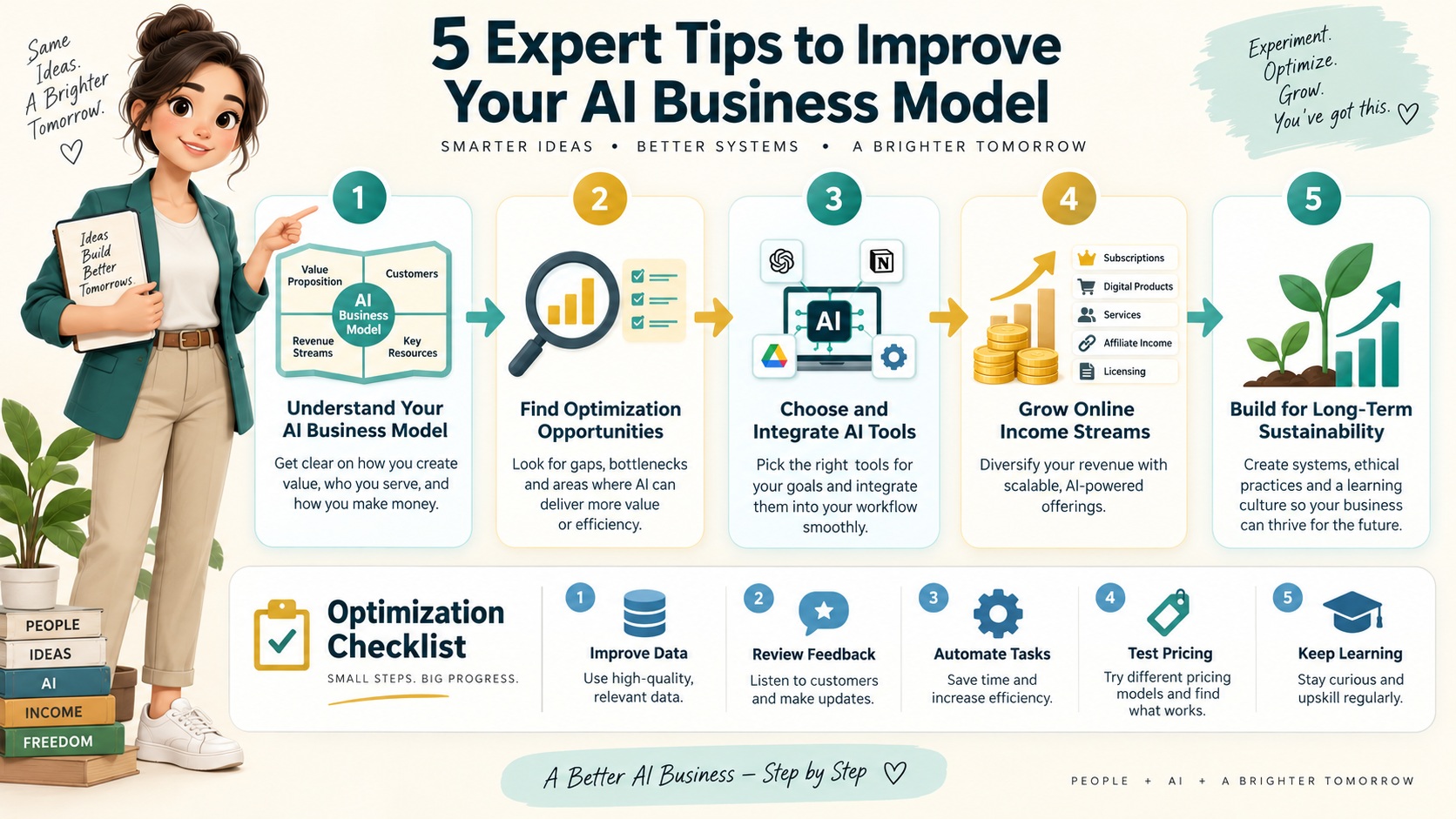
Enhancing your AI business model requires a clear understanding of its structure, identifying optimization opportunities, and effectively implementing AI tools. Maximizing online income streams through diversified strategies and tailoring your approach for beginners and retirees ensures inclusivity and growth. Leveraging cutting-edge AI technologies and prioritizing long-term sustainability solidifies your success in a competitive market.
Remember, AI business model optimization is an ongoing process. By embracing continuous learning, strategic experimentation, and customer-centric practices, you’ll unlock new potentials and secure a thriving future for your AI venture.
Visit our GPT, Prompt & Skills Site – The AI Knowledge Vault
To see the full system:
 Read:
Read:
Systeme.io Review: All-in-One Business Platform
AI Business Strategies for Beginners: How to Implement AI for Growth
Top AI Business Models for Beginners: A Comprehensive Guide
Discover 6 Cutting-Edge AI Business Models
Top AI Development Tools for Entrepreneurs: A Comparative Guide
Exploring Top AI Tools for Enhanced Business Automation
Selecting the Ideal AI Business Model for Your Needs
Top Techniques for Excelling in an AI Side Hustle
📅 Last updated:
