
Top AI Development Tools for Entrepreneurs: A Comparative Guide
If you’re an entrepreneur looking to leverage artificial intelligence, choosing the right AI development tools for entrepreneurs can feel overwhelming. There are so many options, each promising unique features and advantages. But not every tool suits every business. That’s why I’ve put together this comprehensive guide to help you identify the best AI tools tailored for entrepreneurs. Whether you want to automate processes, enhance customer experience, or build intelligent products, this comparison will clarify which AI software fits your needs. Let’s dive into the world of AI development platforms and find the ideal solution to boost your business.

Comparing AI Development Platforms: An Overview
When it comes to AI development platforms, the market is vast and varied. From cloud-based solutions to specialized frameworks, entrepreneurs have access to tools that range from beginner-friendly to highly technical. To get started, it’s important to understand the key players and how they differ.
Among the top AI platforms are Google Cloud AI, Microsoft Azure AI, IBM Watson, Amazon SageMaker, and open-source frameworks like TensorFlow and PyTorch. Each offers unique capabilities and caters to different business needs.
Google Cloud AI stands out with its powerful pre-trained models and AutoML tools, making it easier for entrepreneurs without deep data science expertise to build models. Microsoft Azure AI integrates seamlessly with other Microsoft services, which is a big plus if your business already uses Office 365 or Dynamics 365.
IBM Watson is known for advanced natural language processing and enterprise-level solutions. Amazon SageMaker provides a robust environment for building, training, and deploying machine learning models quickly. Meanwhile, TensorFlow and PyTorch are favored by developers who want more control and customization over their AI projects.
Choosing the right AI development platform depends on your technical skills, budget, and the specific problems you aim to solve. For example, if you need quick deployment with minimal coding, Google AutoML or Azure Cognitive Services might be ideal. However, if you want full control for complex AI models, open-source platforms could be preferable.
In addition to these giants, emerging platforms like DataRobot and H2O.ai offer automated machine learning (AutoML) capabilities that reduce manual effort. They are gaining traction among entrepreneurs who want to accelerate AI adoption without building everything from scratch.
It’s also valuable to consider the ecosystems around these platforms. For instance, Google Cloud AI benefits from Google’s vast data infrastructure, while AWS offers a wide range of complementary cloud services. Integration options, scalability, and community support all play crucial roles in your experience.
Overall, this overview sets the stage for a deeper dive into key features, pricing, usability, and real-world applications of these AI development platforms. By the end, you’ll have a clear picture of what each platform brings to the table and which best fits your entrepreneurial goals.
Key Features and Benefits of Top AI development tools for entrepreneurs
Understanding the core features of the best AI tools helps entrepreneurs decide which platform aligns with their business objectives. Let’s break down some of the most valuable features offered by leading AI development platforms.
Pre-Built AI Models and APIs
Many platforms provide pre-built AI models and APIs that handle common tasks like image recognition, speech-to-text, sentiment analysis, and translation. Google Cloud AI offers Vision API, Speech-to-Text, and Natural Language API, enabling businesses to add smart features without developing models from scratch.
Similarly, Microsoft Azure’s Cognitive Services allow entrepreneurs to integrate AI capabilities like face recognition, anomaly detection, and language understanding into apps quickly. These ready-to-use APIs reduce development time and lower barriers for non-technical users.
Automated Machine Learning (AutoML)
AutoML tools simplify the process of training and deploying AI models by automating data preprocessing, feature selection, and model tuning. Google’s AutoML and DataRobot excel here, making it possible to create custom models with minimal coding.
AutoML benefits entrepreneurs who want to experiment with AI without hiring a full data science team. It enables rapid prototyping and iteration, which is essential for startups testing product-market fit.
Customization and Flexibility
For businesses requiring highly tailored AI solutions, platforms like Amazon SageMaker, TensorFlow, and PyTorch are excellent choices. They offer flexibility to build models from the ground up, allowing deep customization for specific industry applications.
Entrepreneurs with technical expertise or access to AI developers appreciate these platforms because they support complex workflows and cutting-edge research models.
Integration and Scalability
Top AI platforms provide robust integration with existing business systems, databases, and cloud services. Azure AI integrates well with Microsoft’s ecosystem, while AWS offers extensive integration with cloud infrastructure and IoT devices.
Scalability is critical for growing businesses; platforms like IBM Watson are designed to handle enterprise-scale workloads, ensuring that AI applications perform reliably as demand increases.
Security and Compliance
Security is a top priority when working with sensitive data. Leading AI development platforms comply with industry standards such as GDPR, HIPAA, and SOC 2. IBM Watson and Microsoft Azure are known for strong security protocols, reassuring entrepreneurs in regulated sectors.
Choosing a platform with robust security features helps protect your business and customers while meeting legal requirements.
Community and Support
Platforms backed by active developer communities provide rich resources, tutorials, and forums that accelerate learning. TensorFlow and PyTorch benefit from large open-source communities, while cloud providers like Google and AWS offer extensive documentation and support.
Access to training and community support can save entrepreneurs time and reduce frustration during development.
Pricing Comparison of AI Software Solutions
Budget is a crucial factor for entrepreneurs when selecting AI development platforms. Pricing models vary widely, so understanding the cost structure of each solution helps avoid surprises.
Most cloud-based AI platforms use a pay-as-you-go pricing model, charging based on compute time, API calls, or data storage. For example, Google Cloud AI charges per 1,000 units for APIs like Vision or Natural Language, while Amazon SageMaker bills hourly for training and deployment instances.
Microsoft Azure AI offers a free tier for several cognitive services, which is handy for startups testing features. However, as usage grows, costs can escalate quickly, especially for high-volume applications.
IBM Watson uses a subscription-based pricing model for many services, which can be more predictable but may require higher upfront investment.
Open-source frameworks like TensorFlow and PyTorch are free to use but require infrastructure investment. Entrepreneurs must factor in costs for cloud hosting, GPU instances, and ongoing maintenance.
Automated machine learning platforms such as DataRobot typically charge monthly or annual subscription fees, often based on the number of users or data volume. While these can be pricier, they reduce the need for a large AI team, balancing out costs.
Here’s a quick pricing comparison overview:
- Google Cloud AI: Free tier available, pay per API call or training hour.
- Microsoft Azure AI: Free tier with limits, then pay-as-you-go.
- Amazon SageMaker: Pay per instance hour for training and hosting.
- IBM Watson: Subscription-based pricing.
- TensorFlow/PyTorch: Free, but infrastructure costs apply.
- DataRobot/H2O.ai: Subscription-based on usage and users.
Entrepreneurs should carefully estimate their usage patterns and potential growth when choosing a platform. Many providers offer pricing calculators to model costs based on expected workloads.
Balancing features with pricing ensures you get the best AI software without breaking the bank.
User-Friendly Interface and Integration Capabilities for AI development tools for entrepreneurs
For entrepreneurs, ease of use and seamless integration are often decisive factors when selecting AI platforms. Complex interfaces or difficult integration can stall projects and drain resources.
Intuitive Dashboards and Visual Tools
Platforms like Google AutoML and Microsoft Azure AI offer user-friendly dashboards that allow non-experts to build and deploy AI models using drag-and-drop interfaces. This lowers the learning curve and speeds up development.
Visual tools for data labeling, model evaluation, and performance monitoring are valuable for entrepreneurs managing AI projects without a dedicated data science team.
API and SDK Support
Robust APIs and software development kits (SDKs) facilitate integration of AI capabilities into existing apps and systems. For example, AWS provides SDKs for Python, Java, and other languages, making it easier to embed AI into diverse platforms.
Microsoft Azure’s Cognitive Services also offer REST APIs that support a wide range of programming environments, helping entrepreneurs integrate AI seamlessly.
Compatibility with Popular Business Tools
Integration with CRM systems, marketing platforms, and analytics tools is crucial for maximizing AI’s business impact. Microsoft Azure AI’s compatibility with Dynamics 365 and Power BI is a prime example, enabling smooth data flow and actionable insights.
Likewise, Google Cloud AI can connect with BigQuery and Google Workspace, supporting data-driven decision-making across teams.
Customization and Extensibility
While user-friendly tools are great for beginners, entrepreneurs with technical support might want platforms that allow custom integrations and extensions. Open-source frameworks like TensorFlow offer this flexibility, supporting custom layers and advanced model architectures.
Choosing a platform that balances ease of use with extensibility ensures your AI solutions can evolve with your business.
Customer Support and Training Resources
Reliable customer support and quality training resources significantly affect your success with AI development platforms. Entrepreneurs often juggle multiple roles, so having access to expert help and learning materials is invaluable.
Support Channels and Responsiveness
Top AI platforms provide multiple support channels, including live chat, email, phone, and community forums. For instance, Amazon SageMaker offers premium support plans with 24/7 access to AI experts, which is beneficial for mission-critical projects.
Microsoft and Google also have extensive support ecosystems, including dedicated account managers for enterprise clients. Fast and knowledgeable support helps resolve issues quickly, keeping your AI initiatives on track.
Comprehensive Documentation and Tutorials
Platforms like TensorFlow and PyTorch have extensive documentation, tutorials, and example projects available online for free. This encourages self-learning and allows entrepreneurs to deepen their AI knowledge at their own pace.
Google Cloud AI and Microsoft Azure provide official training courses, webinars, and certification programs, which are great for entrepreneurs looking to upskill or train their teams.
Community Forums and User Groups
Active communities foster knowledge sharing and troubleshooting. TensorFlow’s GitHub and Stack Overflow communities are vibrant hubs where developers exchange tips and solutions.
Similarly, Google Cloud and AWS host user groups and forums where entrepreneurs can connect with peers, share experiences, and learn best practices.
Onboarding and Custom Training
Some AI platforms offer personalized onboarding and custom training sessions for business clients. IBM Watson, for example, provides tailored consulting and training to help enterprises integrate AI smoothly.
For entrepreneurs investing heavily in AI, this level of support can accelerate adoption and maximize ROI.
Case Studies: Successful Implementations of AI Platforms
Real-world examples demonstrate how entrepreneurs have successfully leveraged AI development platforms to transform their businesses.
Google Cloud AI in Retail
A mid-sized e-commerce startup used Google Cloud AutoML Vision to automate product image tagging. This reduced manual labor by 80% and improved search accuracy on their site, leading to a 15% sales increase within six months.
By choosing a platform with pre-trained models and easy integration, the team avoided the need for in-house AI experts.
Microsoft Azure AI for Customer Support
A SaaS company integrated Azure Cognitive Services to build an intelligent chatbot that handles common customer queries. The chatbot reduced support tickets by 40%, freeing up the support team to focus on complex issues.
The seamless integration with Microsoft Teams and Dynamics 365 allowed the company to streamline workflows and improve customer satisfaction.
Amazon SageMaker in Healthcare
A health tech startup utilized Amazon SageMaker to develop predictive models for patient readmission risks. The models improved hospital resource allocation and patient care, helping the startup secure a major partnership with a healthcare provider.
The flexibility and scalability of SageMaker supported rapid model iteration and deployment in a regulated environment.
Open-Source AI for Fintech Innovation
A fintech entrepreneur used TensorFlow to create a fraud detection system tailored to their platform. The open-source framework enabled deep customization and integration with existing infrastructure, detecting fraudulent transactions with over 95% accuracy.
This approach required technical expertise but resulted in a competitive advantage in a crowded market.
Future Trends in AI Development Technology
Looking ahead, several trends promise to shape the evolution of AI development platforms and impact entrepreneurs.
Increased Automation and No-Code Solutions
No-code and low-code AI platforms will become more sophisticated, empowering entrepreneurs to develop AI applications without writing extensive code. This trend democratizes AI, making it accessible to non-technical founders.
Edge AI and On-Device Processing
AI processing on devices rather than cloud servers will grow, enabling faster responses and improved privacy. Entrepreneurs building IoT products or mobile apps will benefit from platforms supporting edge AI capabilities.
Explainable AI and Ethical AI
Platforms will increasingly offer tools to interpret AI decisions, addressing transparency and trust concerns. For entrepreneurs, this means building products that comply with ethical standards and regulatory requirements.
Integration of AI with Other Emerging Technologies
AI development tools will more tightly integrate with blockchain, augmented reality, and 5G networks. This convergence opens new business opportunities for innovative entrepreneurs.
More Specialized AI Platforms
We’ll see growth in niche AI platforms targeting specific industries like legal tech, agriculture, and manufacturing. Entrepreneurs in these sectors can leverage tailored tools optimized for their unique challenges.
Making the Right Choice: Factors to Consider
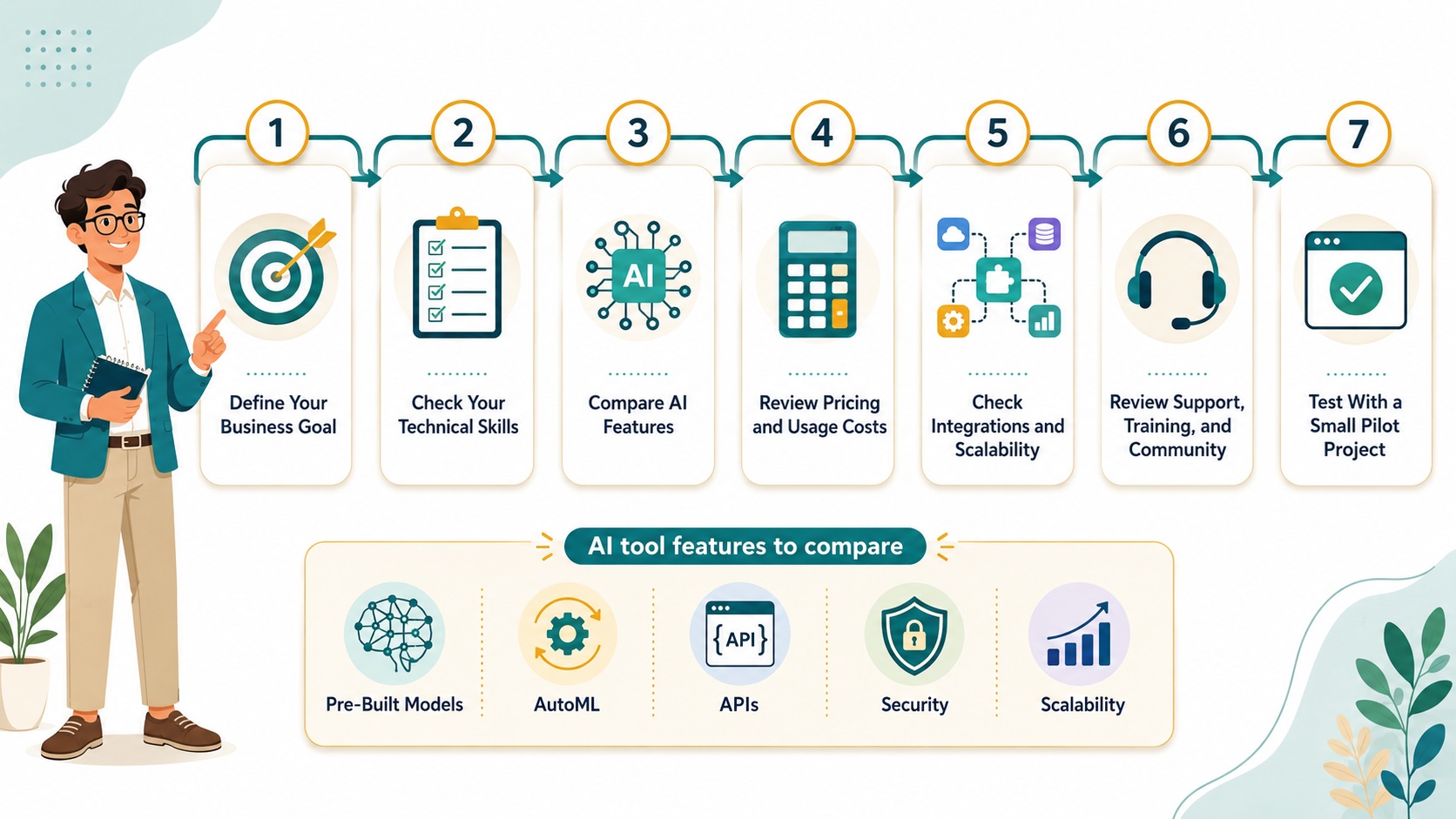
After exploring features, pricing, usability, support, and future trends, how do you choose the best AI development platform for your entrepreneurial journey? Here are key factors to guide your decision.
- Business Goals: Define what you want to achieve with AI—automation, customer engagement, product innovation, etc. Match platforms to those objectives.
- Technical Expertise: Assess your team’s skills. If you lack data scientists, favor platforms with robust AutoML and pre-built models.
- Budget: Consider upfront and ongoing costs. Don’t forget infrastructure expenses if using open-source tools.
- Integration Needs: Ensure the platform works smoothly with your existing systems and software.
- Scalability: Choose platforms that can grow with your business to avoid migration headaches later.
- Support and Training: Evaluate availability of customer support and learning resources to shorten your AI learning curve.
- Security and Compliance: Prioritize platforms with strong data protection and adherence to applicable regulations.
Taking time to pilot a few platforms through free tiers or trials can reveal which one fits your workflow best. Remember, the ideal AI software is the one that empowers you to innovate efficiently and deliver value to your customers.
For more insights on AI development platforms and tools, check out resources like Google Cloud AI Platform, Microsoft Azure Cognitive Services, and Amazon SageMaker.
Conclusion
Choosing the right AI development platforms can transform how entrepreneurs build and scale their businesses. From easy-to-use tools like Google AutoML to highly customizable frameworks like TensorFlow, each solution offers unique strengths. By comparing features, pricing, usability, and support, you can find the best AI tools that align with your goals and resources.
Remember to consider your technical skills, integration needs, and future growth when selecting a platform. With the right AI software, you can automate processes, create smarter products, and gain a competitive edge. Dive in, experiment, and harness the power of AI to drive your business forward.
Visit our GPT, Prompt & Skills Site – The AI Knowledge Vault
To see the full system:
 Read:
Read:
Systeme.io Review: All-in-One Business Platform
AI Business Model – A Comprehensive Guide to Development
A Comprehensive Guide to Beginner AI Automation Tools
How to Develop AI-Powered Apps Without Coding Experience
Developing AI Apps Without Coding Knowledge Beginners Guide
📅 Last updated:
