
Mastering AI Copywriting: 7 Essential Frameworks Revealed
AI copywriting frameworks are transforming the way we create content. If you’ve ever struggled with writer’s block or wanted to speed up your writing process, then using AI tools for writers can be a game-changer. In this article, I’ll walk you through seven proven frameworks that make AI copywriting not only efficient but also creative and personalized. These frameworks are designed to help anyone—from marketers to coaches—produce compelling copy that converts. Whether you’re new to AI-assisted writing or looking to refine your copywriting strategies, this guide will unlock powerful techniques for you.

Understanding AI Copywriting and Its Benefits
AI copywriting blends artificial intelligence with the art of crafting persuasive and engaging text. At its core, AI copywriting uses algorithms to generate or assist in writing content, which can range from blog posts to sales emails. The benefits go far beyond just automating writing tasks. For starters, AI can analyze vast data sets and audience behavior to tailor messages effectively.
One of the biggest advantages is speed. AI tools for writers can produce drafts in seconds, saving hours of brainstorming and typing. This allows writers and marketers to focus more on strategy and creativity rather than getting stuck on the first sentence. Additionally, AI offers consistency in tone and style, especially when managing multiple campaigns or platforms.
Another benefit is scalability. When managing content for various channels, AI copywriting frameworks streamline the production process without sacrificing quality. This can be crucial for businesses that need to maintain a steady flow of fresh content. Plus, AI can help uncover new angles or ideas by analyzing competitor content and trending topics.
For example, a marketing agency using AI can quickly generate personalized email sequences for different customer segments, improving open rates and conversions. The agency saves time and delivers more relevant messages, boosting client satisfaction. On the flip side, AI copywriting also helps reduce costly errors and inconsistencies by providing grammar checks and style suggestions.
As AI technology advances, the integration with human insight becomes vital. The best results come when AI tools support human creativity rather than replace it. This collaborative approach ensures copywriting remains authentic and engaging while leveraging the efficiency of AI.
Exploring the 7 Proven Frameworks for AI-Assisted Writing
There are specific AI copywriting frameworks that consistently deliver results. Each framework guides the structure and tone of your content, making it easier to generate persuasive copy with AI tools. Let’s break down the seven essential frameworks you should master.
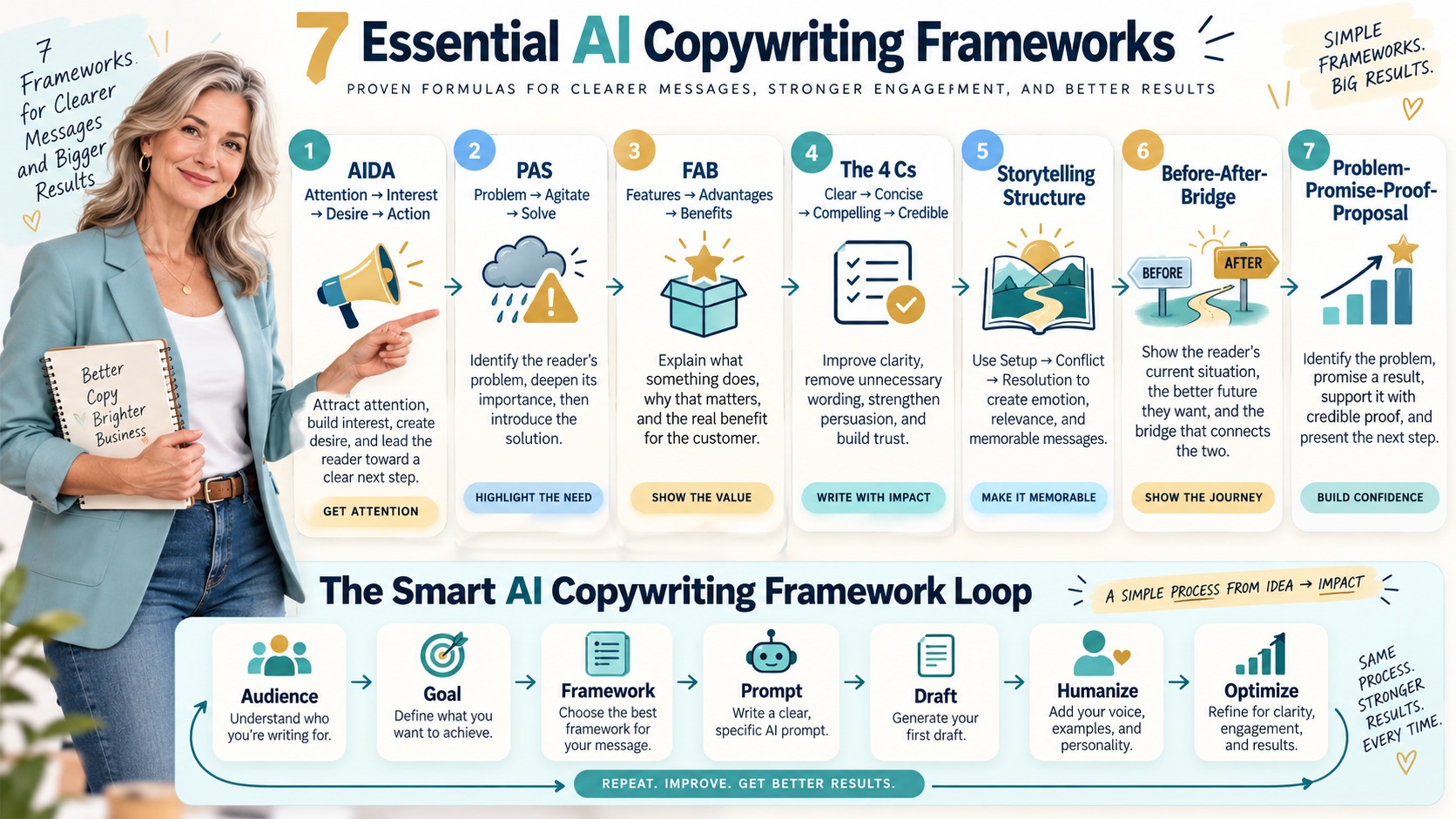
1. AIDA (Attention, Interest, Desire, Action)
AIDA is a classic marketing formula adapted perfectly for AI copywriting. It starts by grabbing attention, builds interest through benefits, creates desire by addressing pain points, and ends with a clear call to action. AI tools can generate each section rapidly, allowing you to customize the message for different audiences.
2. PAS (Problem, Agitate, Solve)
This framework focuses on identifying a problem, intensifying the emotional impact, and offering a solution. AI can help you research common customer pain points and craft emotive language that resonates deeply. For example, in coaching copywriting, PAS can highlight the struggles clients face before introducing your service as the solution.
3. FAB (Features, Advantages, Benefits)
FAB centers on presenting product features, explaining their advantages, and translating those into benefits for the user. AI copywriting frameworks can generate detailed feature lists and then pivot to benefits that appeal to customer motivations.
4. The 4 Cs (Clear, Concise, Compelling, Credible)
This framework emphasizes clarity and trustworthiness. AI tools can rewrite content to be more concise and compelling while ensuring credibility through fact-checking and tone adjustments. It’s ideal for business content that requires professional polish.
5. Storytelling Structure
Storytelling remains a powerful copywriting strategy. AI can help you outline stories using a beginning (setup), middle (conflict), and end (resolution). This framework humanizes your message and creates emotional connections with readers.
6. Before-After-Bridge
This simple but effective framework contrasts the reader’s current situation with a better future state, then builds a bridge showing how your product or service can get them there. AI can craft vivid scenarios and persuasive transitions to make this compelling.
7. Problem-Promise-Proof-Proposal
This framework starts by identifying a problem, promising a solution, providing proof (testimonials or data), and concluding with a proposal or call to action. AI tools can aggregate reviews and statistics, helping you build trust quickly.
Mastering these AI copywriting frameworks will improve your ability to generate targeted, high-converting content quickly. They provide a roadmap for your writing, minimizing guesswork and maximizing impact.
Implementing AI Tools in Your Copywriting Process
Knowing the frameworks is one thing, but integrating AI tools into your workflow makes all the difference. There are many AI-powered writing assistants available, each with unique features tailored for different copywriting needs.
First, choose a tool that aligns with your goals. For example, Jasper AI is popular for marketing copy and blog posts, while Writesonic offers versatility across formats. These platforms use AI copywriting frameworks to generate outlines, headlines, and full drafts.
When implementing AI tools, start by feeding them detailed input about your audience, product, and tone. The better the input, the more relevant the output. For instance, specifying the target demographic and desired emotional tone helps AI craft copy that resonates.
Next, use AI as a collaborative partner rather than a replacement. I recommend generating multiple drafts or variations using AI, then editing and personalizing the content. This not only enhances creativity but also ensures your brand voice stays authentic.
Consider embedding AI tools in different stages of your copywriting process:
- Research: Use AI to gather insights on keywords, competitor content, and trending topics.
- Drafting: Generate initial content drafts based on chosen frameworks.
- Editing: Employ AI grammar and style checkers to polish your copy.
- Optimization: Utilize AI SEO tools to refine keyword usage and readability.
For example, a content creator might use AI to brainstorm blog topics, draft an outline with AIDA, write the first draft, and then optimize it for SEO—all within a single platform. This integrated approach can reduce turnaround time from days to hours.
Finally, track the performance of AI-generated content. Use analytics to see what resonates with your audience and adjust your input accordingly. Continuous feedback loops improve the quality and effectiveness of AI-assisted copywriting over time.
Enhancing Creativity and Personalization with AI
One myth about AI copywriting is that it produces generic, robotic content. But in reality, AI tools can enhance creativity and personalization when used correctly. AI algorithms analyze vast amounts of data, enabling them to suggest fresh ideas and personalized messages tailored to individual preferences.
Personalization is crucial in today’s marketing landscape. Consumers expect brands to speak directly to their needs and interests. AI copywriting frameworks like PAS and Before-After-Bridge excel at crafting messages that feel relevant and empathetic.
For instance, AI can segment email lists based on behavior and then generate personalized subject lines and body copy for each group. A fitness coach might send different motivational messages to beginners versus advanced clients, increasing engagement.
Creativity also benefits from AI’s ability to mix and match styles, tones, and formats. You can instruct AI to write in a humorous, formal, or conversational tone depending on your audience. AI tools often come with creative prompts and brainstorming features that help break writer’s block.
Moreover, AI can assist in generating multimedia content ideas such as video scripts, social media captions, or infographics text. This broadens your content strategy and keeps your brand voice consistent across channels.
To maximize creativity, I recommend experimenting with different AI-generated outputs. Don’t hesitate to combine multiple frameworks or add your unique flair during editing. AI is a tool to amplify your voice, not replace it.
The key is balancing AI’s data-driven insights with your intuition and storytelling skills. This partnership results in copy that is both impactful and authentic, helping you build stronger connections with your audience.
Avoiding Common Pitfalls in AI Copywriting
While AI copywriting frameworks and tools offer many advantages, there are common pitfalls you should watch out for. Knowing these helps you avoid mistakes and maintain high-quality content.
One major risk is over-reliance on AI-generated content without human review. AI can sometimes produce inaccurate facts, awkward phrasing, or irrelevant information. Always proofread and fact-check AI output before publishing.
Another issue is lack of originality. AI models are trained on existing data, so they might unintentionally create content that feels repetitive or cliché. To counter this, customize and personalize AI drafts with your unique perspectives and examples.
Also, avoid using AI to mimic a competitor’s tone or copy too closely. This can dilute your brand identity and hurt credibility. Instead, use AI frameworks as guides but infuse your brand’s distinct voice.
It’s important to maintain ethical standards by disclosing when AI is involved if required by your industry or platform policies. Transparency builds trust with your audience.
Beware of keyword stuffing when optimizing AI-generated copy for SEO. Overusing keywords can harm readability and search rankings. Use AI SEO tools to balance keyword density naturally within engaging content.
Lastly, don’t ignore user intent. AI can sometimes focus too much on keywords or formulas and miss the deeper needs and questions of your audience. Regularly revisit customer feedback and analytics to keep your copy aligned with real user interests.
By combining AI’s strengths with careful editing, originality, and strategy, you can avoid these pitfalls and produce high-quality content that drives results.
Optimizing Content for SEO with AI Techniques
Optimizing your content for SEO is essential to maximize visibility and drive organic traffic. AI copywriting frameworks can be powerful allies in this process. AI tools analyze search intent, keyword trends, and competitor performance, helping you create content that ranks well.
One effective approach is to use AI for keyword research. Tools like Ahrefs or Moz integrate AI algorithms that identify relevant keywords with high search volume and low competition. Incorporate these keywords naturally into your copy using frameworks such as AIDA or FAB.
AI can also help optimize meta descriptions, titles, and headers by suggesting variations that improve click-through rates. For example, AI might generate multiple headline options emphasizing urgency or benefits, which you can test for performance.
Content length and readability are other areas where AI shines. AI tools assess your draft’s readability score, sentence length, and paragraph structure, helping you make content easier to digest. Clear, concise, and well-structured copy appeals to both users and search engines.
Internal linking suggestions from AI can boost SEO by improving site navigation and distributing page authority. AI can recommend relevant pages or blog posts to link within your content, enhancing user experience and time on site.
Moreover, AI-driven content audits identify gaps or outdated information in your existing content. This insight allows you to refresh articles or update keywords, keeping your site competitive.
To illustrate, a business blog using AI tools can optimize an article by including semantically related keywords, restructuring paragraphs for clarity, and adding compelling meta tags—all based on AI recommendations. This leads to higher rankings and more targeted traffic.
In summary, AI copywriting frameworks combined with SEO techniques create content that is both user-friendly and search-engine friendly, driving sustainable growth for your online presence.
Conclusion
Mastering AI copywriting frameworks unlocks incredible potential for faster, more creative, and personalized content creation. The seven essential frameworks I shared provide clear blueprints for crafting persuasive copy that resonates with your audience. Integrating AI tools thoughtfully into your process enhances efficiency while maintaining authenticity.
By avoiding common pitfalls and leveraging AI’s SEO capabilities, you can produce high-quality content that drives engagement and conversions. Remember, AI is a powerful partner—not a replacement—for human creativity and strategy. Embrace these frameworks and watch your copywriting efforts transform.
For further reading, explore Content Marketing Institute’s insights on AI content strategy for deeper dives into optimizing AI in marketing and content creation.
Visit our GPT, Prompt & Skills Site – The AI Knowledge Vault
To see the full system:
 Read:
Systeme.io Review: All-in-One Business Platform
Effective Strategies for Incorporating AI in Your Business Operations
Mastering the Art of Evaluating AI Business Performance with AI Business Audit Tactics
Leveraging AI for Enhanced Online Sales Performance
Best AI Marketing Tools for Boosting Your Online Business
Ultimate Guide to Mastering AI Copywriting Techniques in 2026
Top 10 AI Content Creation Tips for High-Quality AI-Driven Content
Top AI Copywriting Tools Reviewed: 2026 Guide
Top 5 AI Copywriting Mistakes to Steer Clear Of
📅 Last updated:
