
A Guide to AI Automation Strategies for Newcomers
Welcome to your first step into the world of AI automation. If you’re new to this, you might feel a mix of excitement and overwhelm, and that’s completely normal. I remember when I first explored AI automation strategies, I was like discovering a superpower I never knew I had. This guide is designed to walk you through everything you need to know, from the basics to advanced tips, all in a friendly, easy-to-follow manner. We’ll cover key concepts, practical steps, and real-world examples to help you implement AI automation effectively. Whether you’re a small business owner, a marketer, or just curious, you’ll find actionable insights here. Let’s dive in and demystify AI automation together, making it accessible and beneficial for your goals.

Exploring the Basics of AI Automation
Before we jump into complex strategies, it’s crucial to understand what AI automation actually means. At its core, AI automation combines artificial intelligence with automated processes to perform tasks without constant human intervention. Think of it as teaching a computer to handle repetitive or data-heavy jobs, learning from patterns to improve over time. For instance, when you use a chatbot that answers customer queries instantly, that’s AI automation in action. It’s not just about robots; it’s about smart systems that make life easier. I’ve seen many beginners confuse AI with simple automation, but the key difference is intelligence—AI can adapt and make decisions based on data. This beginner’s AI guide will help clarify these distinctions, setting a solid foundation for your journey.
Key Components of AI Automation
To grasp AI automation fully, let’s break down its main components. First, there’s machine learning, which allows systems to learn from data and improve without being explicitly programmed. Then, natural language processing enables machines to understand and respond to human language, like in customer service bots. Computer vision is another part, letting AI interpret visual data from images or videos. Lastly, robotic process automation handles rule-based tasks, such as data entry. Together, these elements form a powerful toolkit. For example, in e-commerce, AI can analyse customer behaviour to recommend products, automating personalized marketing. Understanding these pieces helps you choose the right AI automation tools later on.
Another aspect to consider is the data pipeline. AI systems rely on high-quality data to function effectively. This involves collecting, cleaning, and processing data before feeding it into models. Without good data, even the best AI can underperform. I often advise newcomers to start with small, clean datasets to avoid overwhelm. Tools like Google’s AI features or CRM integrations can simplify this process. By mastering these basics, you’ll be better equipped to explore more advanced AI automation strategies, ensuring a smooth learning curve and practical applications from day one.
Understanding the Benefits of AI Automation
Now that we’ve covered the basics, let’s talk about why AI automation is such a gamechanger. The benefits are vast and can transform how you operate, whether in business or personal projects. First off, efficiency skyrockets. By automating repetitive tasks, you free up time to focus on creative or strategic work. For instance, I used to spend hours sorting emails, but with AI filters, it’s done in seconds. Cost savings are another huge advantage; reducing manual effort cuts down on labour expenses and errors. Studies show that businesses using AI automation see up to a 40% increase in productivity, according to a report by McKinsey. That’s a tangible impact you can’t ignore.
Beyond efficiency, AI automation enhances accuracy. Humans make mistakes, especially with monotonous tasks, but AI consistently performs with precision. In fields like finance or healthcare, this can prevent costly errors. Moreover, scalability becomes effortless. As your operations grow, AI systems can handle increased workload without proportional costs. For example, an online store can use AI to manage inventory and customer inquiries during peak seasons, ensuring smooth operations. Personalization is another benefit; AI analyses user behaviour to deliver tailored experiences, boosting engagement and loyalty. These advantages make AI automation strategies essential for staying competitive in today’s fast-paced world.
Real-World Examples of AI Automation Benefits
To make this concrete, let’s look at some real-world scenarios. Take Netflix’s recommendation engine—it uses AI to suggest shows based on viewing history, keeping users engaged and reducing churn. Another example is in manufacturing, where AI-powered robots assemble products with minimal defects, improving quality control. In marketing, tools like HubSpot automate email campaigns, sending personalized messages at optimal times. I’ve seen small businesses thrive by implementing these AI automation tools, often seeing a 20-30% boost in customer satisfaction. These examples show that the benefits aren’t just theoretical; they’re achievable and impactful, motivating newcomers to dive deeper into this AI automation strategies guide.
Choosing the Right AI Automation Tools
Selecting the appropriate tools is a critical step in your AI automation journey. With so many options out there, it can feel overwhelming, but focusing on your specific needs simplifies the process. Start by identifying the tasks you want to automate. Are you looking to streamline customer support, enhance marketing, or optimize operations? For beginners, I recommend starting with user-friendly platforms that offer tutorials and support. Tools like Zapier or Integromat are great for automating workflows between apps without coding. If you’re into content creation, AI writing assistants like Jasper can automate drafting and editing. The key is to match the tool to your goals and skill level.
When evaluating AI automation tools, consider factors like cost, integration capabilities, and scalability. Free trials are your best friend here; they let you test drive before committing. Also, look for communities or forums where users share experiences—this can provide valuable insights. For instance, if you’re in e-commerce, Shopify’s AI apps might be perfect for automating inventory and sales analytics. According to Gartner, by 2025, over 50% of enterprises will use AI-powered automation tools, highlighting their growing relevance. By choosing wisely, you set yourself up for success, making your implementation of AI automation strategies smoother and more effective.
Top AI Automation Tools for Beginners
To help you get started, here’s a list of some beginner-friendly AI automation tools. First, Chatfuel for building chatbots—it’s intuitive and doesn’t require coding. Next, Canva’s AI features for automating design tasks, making graphic creation a breeze. For data analysis, Google Analytics with AI insights can automate report generation. I’ve personally found these tools invaluable in my projects, reducing time spent on manual work. Additionally, IBM Watson offers robust AI services for more advanced needs, though it might require a steeper learning curve. Remember, the goal is to start small and scale up as you gain confidence, ensuring a solid foundation in your AI automation strategies.
Implementing Step-by-Step AI Automation Processes
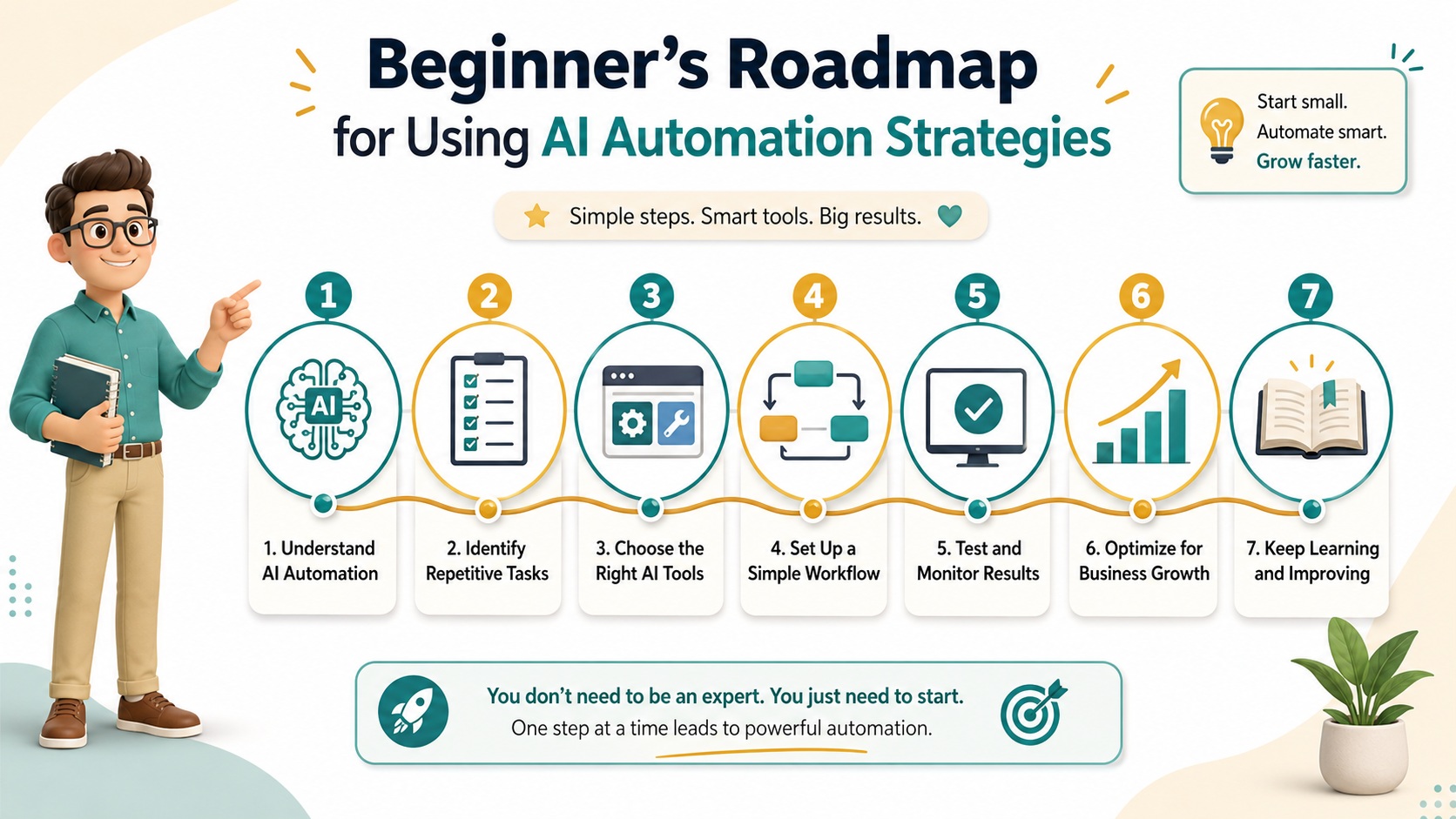
Once you’ve chosen your tools, it’s time to put them into action. Implementation might seem daunting but breaking it down into steps makes it manageable. First, define clear objectives. What do you want to achieve with automation? Maybe it’s reducing response time in customer service or automating social media posts. Next, map out your current processes to identify automation opportunities. For example, if you’re handling manual data entry, note each step involved. Then, select and set up your chosen AI automation tools, configuring them to fit your workflow. I always advise starting with a pilot project—a small, low-risk task to test and refine before full deployment.
After setup, train your team or yourself on using the tools effectively. Many platforms offer resources, so take advantage of them. Monitor the automation closely initially, checking for errors or areas of improvement. Use metrics like time saved or error rates to measure success. For instance, if you automated email responses, track how many queries are handled without human input. Iteration is key; based on feedback, tweak your setup for better results. This step-by-step approach ensures a smooth transition, minimizing disruptions. By following these steps, you’ll build confidence and see tangible benefits, making your journey with AI automation strategies rewarding and effective.
Common Pitfalls to Avoid During Implementation
While implementing AI automation, beginners often encounter common mistakes. One is over-automating trying to automate everything at once, which can lead to chaos. Start with one process and expand gradually. Another pitfall is neglecting data quality; garbage in, garbage out, as they say. Ensure your data is clean and relevant. Also, avoid ignoring human oversight; AI isn’t perfect and may need occasional intervention. I’ve seen cases where lack of monitoring caused issues, like automated responses giving incorrect information. By being aware of these pitfalls, you can navigate implementation more smoothly, maximizing the effectiveness of your AI automation strategies and tools.
Optimizing AI Automation for Business Growth
After implementation, the next step is optimization to drive business growth. AI automation isn’t a set-it-and-forget-it solution; it requires ongoing refinement. Start by analysing performance data. Look at key metrics like conversion rates, customer satisfaction, or operational efficiency. For example, if you’re using AI for lead generation, track how many leads convert to sales. Use this data to identify bottlenecks or areas for improvement. A/B testing different automation rules can reveal what works best. I’ve optimized campaigns by tweaking AI parameters, resulting in a 15% increase in engagement. This continuous improvement cycle ensures your AI automation strategies evolve with your business.
Scaling your automation is another aspect of optimization. As your business grows, your AI systems should too. Integrate more tools or expand automation to new departments. For instance, if you started with marketing automation, consider applying it to HR for recruiting or onboarding. Leveraging AI for predictive analytics can also fuel growth by forecasting trends and informing strategic decisions. According to a study by Deloitte, companies that optimize AI automation see up to a 30% higher growth rate. By focusing on optimization, you turn automation from a efficiency tool into a growth engine, making your investment in AI automation strategies truly pay off.
Case Study: Optimizing with AI Automation
To illustrate optimization, consider a case study of a small online retailer. They implemented AI for inventory management, automating restocking alerts. Initially, it reduced stockouts by 20%. By analysing sales data, they optimized the AI to predict demand spikes during holidays, further improving efficiency. This led to a 25% increase in sales during peak seasons. Such real-world examples show how optimization amplifies benefits, making this AI automation strategies guide practical and inspiring for newcomers looking to achieve similar results.
Best Practices for Successful AI Automation Integration
To ensure long-term success with AI automation, adopting best practices is essential. First, foster a culture of adaptability within your team. Change can be resisted, so communicate the benefits and provide training to ease the transition. In my experience, involving team members in the selection and implementation process increases buy-in and effectiveness. Next, prioritize security and ethics. AI systems handle sensitive data, so ensure compliance with regulations like GDPR. Use encryption and regular audits to protect information. Additionally, maintain transparency in how AI makes decisions, especially in customer-facing applications, to build trust.
Another best practice is to stay updated with AI trends and advancements. The field evolves rapidly, and new tools or techniques emerge frequently. Subscribe to newsletters or join communities like those on Forbes AI section for insights. Regularly review and update your automation setups to incorporate improvements. For example, if a new AI tool offers better integration, consider switching to enhance efficiency. Lastly, measure ROI consistently. Calculate the time and cost savings against investments to justify and guide future expansions. By following these practices, you’ll integrate AI automation strategies seamlessly, ensuring sustainable growth and innovation.
Leveraging External Resources for Continuous Learning
Continuous learning is vital in the dynamic world of AI automation. Utilize high-quality resources to stay ahead. For instance, Coursera’s AI courses offer structured learning paths for beginners. Engaging with these resources helps you deepen your understanding and apply advanced techniques. I often recommend setting aside time weekly for learning, ensuring you’re always improving your skills. This proactive approach complements the practical steps in this AI automation strategies guide, empowering you to harness AI’s full potential for years to come.
Conclusion
We’ve covered a lot in this comprehensive guide, from the basics of AI automation to optimization and best practices. Remember, starting small and focusing on clear goals is key to success. AI automation strategies can transform how you work, saving time, reducing costs, and driving growth. As you embark on this journey, keep learning and adapting. The tools and tips shared here will help you navigate the process with confidence. Embrace the power of AI automation and watch your efficiency and innovation soar. Thank you for reading, and I wish you the best in implementing these strategies.
Also recently launched – AI-Powered Business Launch
To see the full system:
 Read:
Read:
Systeme.io Review: All-in-One Business Platform
A Comprehensive Guide to Developing Your AI Business Model
A Comprehensive Guide to Implementing AI-Powered Online Business Models
5 Easy AI Business Models for New Entrepreneurs
AI business models for beginners – An Implementation Guide
Avoid These 5 Errors When Selecting an AI Business Model
📅 Last updated:
