
Avoid These 5 Errors When Selecting an AI Business Model
Hey there! If you’re diving into the world of AI and thinking about starting your own venture, you’re in the right place. I’ve been exploring AI business models for a while now, and I’ve seen too many smart people stumble over the same pitfalls. Selecting an AI business model can feel exciting, but it can also become confusing when there are so many tools, trends, and income ideas competing for your attention. In this guide, we will look at five common errors to avoid when selecting an AI business model so you can choose a path that fits your skills, resources, audience, and long-term goals. Whether you’re a beginner just getting your feet wet or a retiree looking for a new online income stream, choosing the right model can make or break your success. In this guide, I’ll walk you through the common mistakes to avoid, so you can build something sustainable and profitable. Let’s get started on this exciting journey together!

Understanding and selecting an AI Business Models
Before we jump into the errors, it’s crucial to grasp what AI business models actually are. At their core, these models leverage artificial intelligence to create, deliver, and capture value. They’re not just about cool tech; they’re about solving real problems in smarter ways. For instance, some models focus on predictive analytics, helping businesses forecast trends, while others might offer personalized recommendations to users. The key is aligning the AI capabilities with a viable revenue strategy.
One common type is the subscription-based AI service, where users pay a monthly fee for access to intelligent tools. Another is the transaction-based model, where AI facilitates sales or processes, earning a commission or fee per use. Then there are hybrid approaches, blending multiple revenue streams. Understanding these basics helps you see the landscape clearly and avoid picking a model that doesn’t fit your goals or resources.
Types of AI Business Models
Let’s break it down further. Subscription models are great for steady income but require ongoing value delivery. Transaction models can scale quickly but might be volatile. Freemium models attract users with free features and upsell premium AI capabilities. Each has its pros and cons, and your choice should depend on your target audience and long-term vision.
Why AI Models Differ from Traditional Ones
Unlike traditional businesses, AI models often involve continuous learning and adaptation. They thrive on data, so your model must account for data acquisition, processing, and ethical use. This dynamic nature means you can’t just set it and forget it; you need a plan for iteration and improvement. Recognizing this early prevents the mistake of treating your AI venture like a static business.
Importance of Choosing the Right Model
Selecting the right AI business model isn’t just a detail; it’s the foundation of your entire venture. A poor choice can lead to wasted resources, missed opportunities, and even failure. I’ve seen startups with brilliant AI tech fail because they picked a model that didn’t resonate with their market or scale with their growth. On the flip side, the right model can accelerate success, attract investment, and create lasting impact.
For beginners and retirees, this is especially critical. You might have limited time or capital, so efficiency is key. A well-chosen model maximizes your efforts and minimizes risks. It aligns with your skills, audience, and goals, making the journey smoother and more rewarding. Think of it as choosing the right vehicle for a road trip; the destination might be amazing, but the wrong car can make the ride miserable.
Impact on Scalability and Sustainability
A good model supports growth without constant overhaul. For example, a subscription model might start small but can scale as you add features and users. In contrast, a one-time purchase model might hit revenue caps quickly. Sustainability also ties into market trends; AI evolves fast, so your model should be flexible enough to adapt to new technologies and consumer behaviours.
Aligning with Personal Goals
Your model should reflect what you want to achieve. If passive income is your aim, a model with automated AI services might be perfect. If you enjoy hands-on work, a consulting-based AI model could be better. This personal fit reduces burnout and increases satisfaction, which is crucial for long-term commitment, especially if you’re balancing this with other life priorities.
Before selecting an AI business model, it helps to pause and look at the decision carefully. The wrong model can lead to wasted time, unnecessary costs, and frustration, while the right model gives you a clearer path to build, test, and grow.
Common Mistakes to Avoid
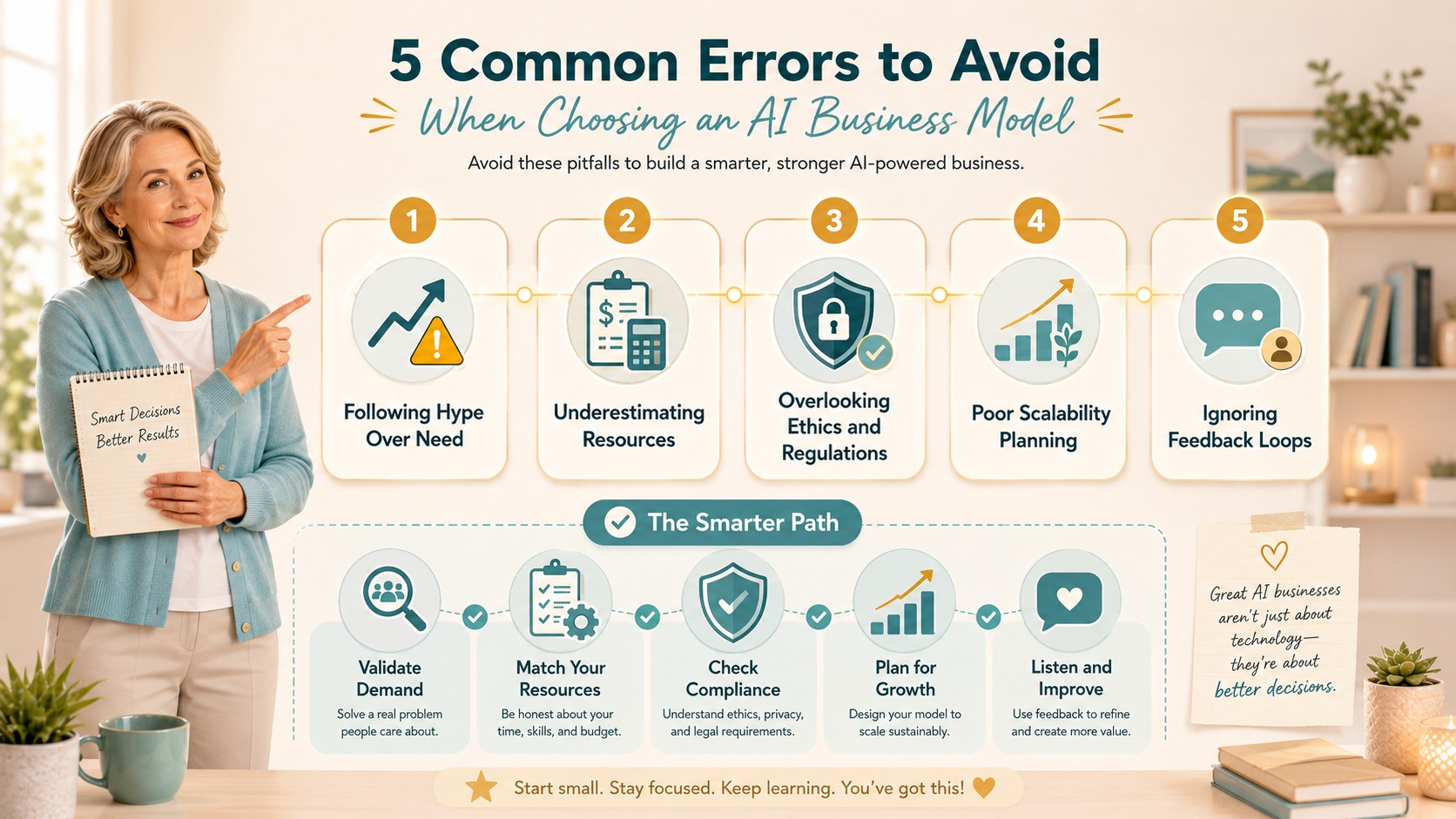
Now, let’s dive into the five big errors I see people make when selecting an AI business model. Avoiding these can save you time, money, and frustration. First up is choosing a model based on trends rather than genuine need. It’s easy to get excited about the latest AI buzzword, but if there’s no real demand, you’ll struggle to find customers.
Second, underestimating the resources required is a common pitfall. AI isn’t cheap or easy; it needs data, computing power, and expertise. Picking a model that demands more than you can handle sets you up for failure. Third, ignoring regulatory and ethical considerations can backfire badly, especially with data privacy laws tightening globally.
Fourth, failing to plan for scalability limits your growth potential. You might start small, but your model should allow for expansion without complete redesign. Fifth, neglecting customer feedback and iteration means you miss out on improvements that could make your offering stronger. Let’s explore each in detail with examples.
Mistake 1: Following Hype Over Need
I once worked with a client who jumped on the AI chatbot trend because it was hot. They built a fancy bot but realized their target audience preferred human interaction for their niche. Result? Low adoption and wasted development costs. Always validate demand first through market research or MVP testing.
Mistake 2: Resource Mismanagement
Another friend chose a data-intensive AI model without budgeting for cloud computing costs. They burned through savings quickly. Estimate all costs—data storage, processing, maintenance—before committing. Tools like AWS Pricing Calculator can help plan expenses.
Mistake 3: Overlooking Ethics and Regulations
With laws like GDPR and CCPA, using AI without compliance can lead to fines. I’ve seen a health AI startup face legal issues for mishandling patient data. Incorporate ethical guidelines early, using resources like FTC’s AI Guidelines to stay informed.
Mistake 4: Poor Scalability Planning
A common error is building a model that works for 100 users but crashes at 1000. Plan architecture that grows with you. Cloud services like Azure or Google Cloud offer scalable solutions, but you need to design for it from day one.
Mistake 5: Ignoring Feedback Loops
AI improves with data and user input. I advised a company that launched an AI tool and never updated it; users drifted away as it became outdated. Build feedback mechanisms into your model to continuously refine and enhance your offering.
Key Factors to Consider
When selecting an AI business model, several factors should guide your decision. Start with your target market: Who are they, what problems do they have, and how can AI solve them? Understanding your audience ensures your model meets real needs. Next, assess your technical capabilities. Do you have the skills in-house, or will you need to partner or outsource?
Financial considerations are huge. How will you fund development and operations? Bootstrapping, investors, or grants? Also, think about data sources. AI needs quality data to function well. Where will you get it, and how will you ensure its reliability and ethics? Lastly, consider the competitive landscape. What models are others using, and how can you differentiate?
Market Demand and Validation
Before committing, validate your idea. Conduct surveys, interviews, or run a pilot. For instance, if targeting retirees for online income streams, test if they’re comfortable with AI tools. Resources like SurveyMonkey can help gather insights affordably.
Technical and Resource Alignment
Match the model to your resources. If you’re a solo entrepreneur, a lightweight SaaS model might be better than a heavy infrastructure project. Use tools you’re familiar with to reduce learning curves and costs.
Regulatory and Ethical Compliance
Factor in laws from the start. For data handling, follow best practices outlined by organizations like ISO standards for AI. This builds trust and avoids legal troubles down the road.
Step-by-Step Selection Process
Here’s a practical step-by-step process to help you choose the right AI business model without those common errors. First, define your goals clearly. What do you want to achieve? Profit, impact, lifestyle flexibility? Write it down to stay focused. Second, research your market thoroughly. Identify pain points and how AI can address them uniquely.
Third, brainstorm potential models that fit your findings. List options like subscription, transaction, or hybrid, and weigh their pros and cons. Fourth, assess your resources realistically. Can you handle the technical, financial, and time demands? Adjust your model choice based on this honesty. Fifth, prototype and test. Build a minimal version and get feedback from real users.
Sixth, iterate based on insights. Use the feedback to refine your model before full launch. Seventh, plan for scalability and compliance from the outset. Finally, launch with a clear roadmap for growth and adaptation. This methodical approach reduces risks and increases your chances of success.
Example: A Retiree’s Journey
Imagine a retiree wanting an online income stream. They might start with goal setting: passive income with low maintenance. Research shows demand for AI-powered fitness coaching for seniors. They choose a subscription model, assess they can use no-code AI tools, prototype with a small group, iterate based on feedback, and plan for gradual scaling. This avoids overcommitment and aligns with their capabilities.
Tips for Beginners and Retirees
If you’re new to this or in your retirement years, here are some tailored tips. Start small and simple. Don’t try to build the next big thing overnight. Focus on a niche you understand and where AI can add clear value. For beginners, leverage educational resources to build skills. Platforms like Coursera’s AI Courses offer great starting points.
For retirees, consider models with lower time demands. Subscription services or affiliate marketing with AI tools can provide steady income without daily hustle. Network with others in similar situations; communities like online forums or local groups can offer support and ideas. Always prioritize learning and adaptation; the AI field changes fast, so stay curious and open to new approaches.
Budgeting and Risk Management
Keep costs low initially. Use free trials, open-source tools, and bootstrap where possible. Set a budget and stick to it, avoiding debt for unproven ideas. This cautious approach minimizes financial stress, which is especially important if you’re on a fixed income or just starting out.
Case Studies and Examples
Let’s look at some real-world examples to illustrate these points. First, consider a success story: a company that used a subscription model for an AI-based content creation tool. They validated demand with a beta group, scaled gradually, and now serve thousands of users. Their key was starting small and iterating based on user feedback.
On the flip side, a failure case involved a startup that chose a transaction model for an AI health app without considering regulatory hurdles. They faced compliance issues and had to pivot late, costing time and money. Another example is a retiree who built an AI-powered gardening advice service using a freemium model. They started with free tips, upsold personalized plans, and now enjoy a steady side income.
These cases show the importance of model selection aligned with goals and constraints. Learn from others’ experiences to avoid repeating their mistakes.
Resources for Further Learning
To deepen your understanding, here are some valuable resources. For AI fundamentals, check out Udacity’s Intro to AI Course. For business model insights, books like “AI Superpowers” by Kai-Fu Lee offer great perspectives. Online communities on Reddit or LinkedIn groups focused on AI entrepreneurship can provide ongoing support and updates.
Additionally, stay updated with industry news through sites like MIT Technology Review’s AI Section. These resources help you continue learning and adapting, which is essential in the fast-evolving AI landscape.
Putting It All Together
Remember, selecting an AI business model is a journey. Use these resources to build your knowledge and confidence, and don’t hesitate to seek mentorship or partnerships if needed. The key is to start, learn, and grow iteratively.
Use Coupon – Monthly $10 – ABGAFOUNDER
Use Coupon – Annual $100 – ABGA-A-FOUNDERS
Conclusion
Selecting an AI business model is not about chasing the newest trend. It is about choosing a model that fits your resources, solves a real problem, and gives you room to grow. Start small, validate demand, listen to feedback, and keep improving as you learn. Selecting the right AI business model is a critical step that can define your success. By avoiding common mistakes like following hype or underestimating resources, and by considering factors like market demand and scalability, you can build a sustainable venture. Whether you’re a beginner exploring new opportunities or a retiree seeking online income streams, take a methodical approach, start small, and keep learning. The AI world is full of potential—go out there and make the most of it!
Also recently launched – AI-Powered Business Launch
To see the full system:
 Read:
Read:
Systeme.io Review: All-in-One Business Platform
A Comprehensive Guide to Developing Your AI Business Model
A Comprehensive Guide to Implementing AI-Powered Online Business Models
5 Easy AI Business Models for New Entrepreneurs
AI business models for beginners – An Implementation Guide
Selecting the Ideal AI Business Model for Your Needs
📅 Last updated:
