

A Comprehensive Guide to Implementing AI-Powered Online Business Models
I remember the day I first realized my online business was drowning in busywork. I was spending hours on customer emails, product descriptions, and data entry. That is when I started looking into AI-powered online business models. This guide is what I wish I had back then. I will walk you through everything from choosing the right tools to building a sustainable income stream. You do not need to be a tech wizard to get started implementing AI-powered online business models. By the end of this article, you will have a clear roadmap for integrating AI into your own online business. Let us jump right in.
Understanding AI-Powered Online Business Models
When I first heard the term AI-powered online business models, I thought it meant replacing humans with robots. I could not have been more wrong. These models use artificial intelligence to automate repetitive tasks, analyse data, and create personalized experiences. Think of AI as your digital assistant that never sleeps. It handles the grunt work so you can focus on strategy and creativity.
There are several common models that leverage AI effectively. One popular approach is the digital product marketplace. Sellers use AI to generate product descriptions, optimize pricing, and predict customer demand. Another model is the membership site, where AI curates content based on user behaviour. I have also seen success with coaching platforms that use AI to schedule sessions and track client progress.
What makes these models so powerful is their scalability. A traditional service business often hits a wall when you run out of hours in the day. An AI-powered online business can serve thousands of customers simultaneously. For example, a friend of mine runs a niche recipe site. She uses AI to generate meal plans and shopping lists for her subscribers. Her business grew from 50 to 5,000 members in just six months. She did not hire any extra staff.
The key is understanding that AI is a tool, not a magic wand. You still need a solid value proposition and a clear target audience. But once you have those foundations, AI can amplify your efforts dramatically. I have seen retirees build thriving online businesses using AI tools for beginners. They start small, learn the ropes, and gradually expand their operations.
One misconception I often hear is that AI will make your business feel impersonal. In my experience, the opposite is true. AI helps you deliver more relevant content to each user. You can send personalized emails, recommend products, and answer questions instantly. Customers actually feel more valued when you respond to their needs quickly and accurately.
Benefits of Implementing AI Tools in Online Businesses
Let me share the biggest benefit I have personally experienced: time savings. Before I integrated AI, I spent about 20 hours per week on administrative tasks. Now that same work takes me less than two hours. That freed up time allows me to focus on high-impact activities like content creation and relationship building.
Another major advantage is improved decision-making. AI tools can analyse vast amounts of data in seconds. They identify patterns that a human might miss. For instance, I use an AI analytics tool that tells me exactly which blog topics will perform best. My traffic increased by 40% after I started following its recommendations. That is the kind of result that makes the investment worthwhile.
Cost reduction is another huge factor. Hiring a full-time employee to handle customer support or content creation can cost $40,000 or more per year. An AI subscription might run you $50 per month. The savings are enormous, especially for small businesses and solopreneurs. I have seen coaches cut their operational costs by 70% after implementing AI chatbots for common queries.
AI also enhances customer experience in ways that surprise me daily. One of my clients runs an online course platform. She uses AI to create personalized learning paths for each student. The completion rate for her courses jumped from 35% to 82%. Students felt like the course was designed just for them. That level of personalization is nearly impossible to achieve manually at scale.
Let me not forget about the competitive edge. Businesses that adopt AI early often outperform their peers. According to a McKinsey report on AI adoption, early adopters see a 20% increase in revenue on average. That gap will only widen as AI technology continues to evolve. If you wait too long, you might find yourself struggling to catch up.
Specific AI Tools That Deliver Results
I want to give you concrete examples of tools I use and recommend. For content creation, I rely on tools like Jasper and Copy.ai. They help me draft blog posts, social media captions, and email sequences. The output is usually 80% ready, and I only need to tweak the tone and add personal stories.
For customer support, I use Tidio and its AI chatbot feature. It handles common questions about pricing, shipping, and refunds. My response time dropped from 12 hours to under 5 minutes. Customers love the instant answers, and I love not having to answer the same question fifty times a day.
Data analysis is another area where AI shines. Tools like Tableau with AI capabilities or Google Analytics Intelligence give me insights I would never find on my own. They highlight trends, flag anomalies, and even suggest actions. I discovered a seasonal spike in demand for one of my digital products that I had completely overlooked.
Step-by-Step Guide to Setting Up an AI-Powered Online Business
I am going to walk you through the exact process I used when I set up my first AI-powered online business. This is not theory. This is the step-by-step method that worked for me and many of my clients.
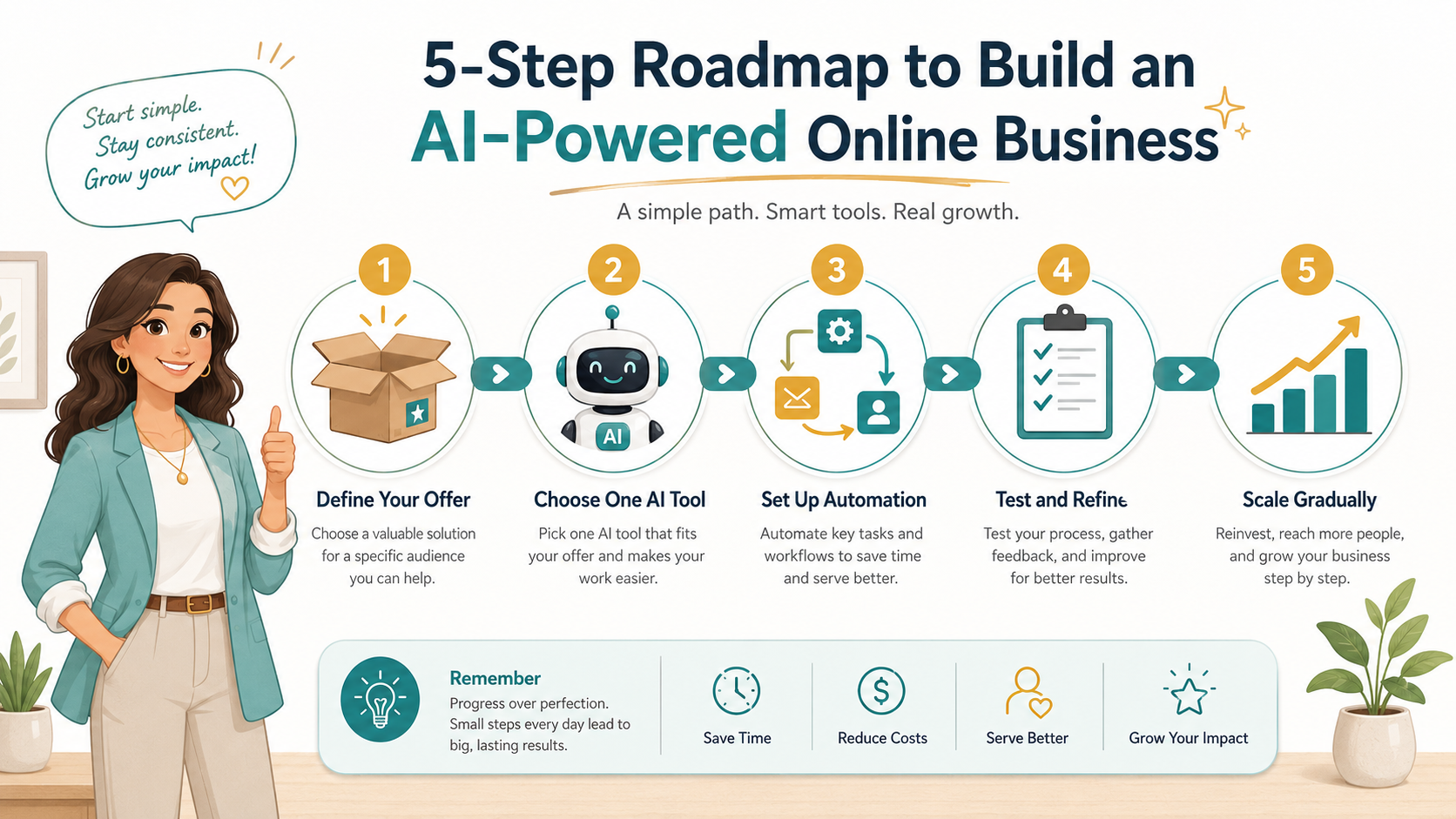
Step 1: Define your core offer. Before you touch any AI tool, you need to know what you are selling. Is it a digital product, a service, or a membership? I recommend starting with something simple like an eBook or a short online course. The complexity of your offer will determine which AI tools you need.
Step 2: Choose your AI platform. Do not try to use every tool at once. Pick one platform that covers your primary need. If you are creating content, start with a writing assistant. If you are handling customer service, start with a chatbot. I began with a content generation tool. It was the easiest to integrate and gave me immediate results.
Step 3: Set up your automation workflows. This is where the magic happens. Use tools like Zapier or Make to connect your AI tools with your website and email system. For example, I set up a workflow where new blog posts are automatically summarized by AI and sent to my email list. It took me an hour to set up, and it has been running flawlessly for months.
Step 4: Test and refine. AI is not perfect out of the box. You need to train it on your specific use case. I spent the first week tweaking the prompts and adjusting the output style. Within a month, the AI was producing content that sounded like me. That is the level of customization you should aim for.
Step 5: Scale gradually. Once you have one AI tool working well, add another. I waited three months before adding an AI chatbot to my site. That gave me time to understand the first tool deeply. Rushing into multiple tools can create confusion and waste money.
Common Pitfalls to Avoid
I made plenty of mistakes, so you do not have to. The biggest one was expecting AI to replace human judgment. AI can generate ideas, but you still need to curate and validate them. I once published an AI-generated article that had a factual error. It damaged my credibility with readers. Now I always review AI output carefully.
Another mistake was ignoring data privacy. Some AI tools store your data on external servers. If you handle sensitive customer information, you need to choose tools that comply with regulations like GDPR. I switched to a more secure tool after a close call with a data breach.
Do not forget about the learning curve. AI tools are getting easier to use, but they still require some upfront effort. I blocked out two hours every day for the first week to learn my tool. That investment paid off tenfold in the long run.
Optimizing AI Strategies for Beginners and Retirees
I have worked with many beginners and retirees who felt intimidated by AI. They thought they needed a computer science degree to get started. That is simply not true. The best AI tools for beginners are designed with simplicity in mind. They use natural language prompts instead of complex code.
For retirees, the focus should be on low-maintenance income streams. I recommend starting with digital products that require minimal ongoing effort. An eBook or a printable planner can be created once and sold repeatedly. AI can help you write the content, design the cover, and even market the product.
One retiree I coached, let me call him Tom, wanted to share his gardening knowledge. He was not comfortable with technology. I helped him set up an AI-powered blog that generates daily gardening tips. The AI writes the posts based on his notes and voice recordings. Within three months, he was earning $1,500 per month from affiliate sales. He spends about two hours per week on the business.
Beginners often worry about the cost of AI tools. Many quality tools offer free tiers or low-cost plans. I started with a $20 per month content tool. That is less than a dinner out. The return on investment was immediate. My first AI-generated article earned $300 in affiliate commissions.
The key for both groups is to focus on one thing at a time. Do not try to build a full-fledged ecommerce empire overnight. Start with a simple blog or a small digital product. Learn how AI can support that one thing. Then expand gradually. I have seen this approach work consistently.
Another strategy I recommend is using AI for market research. Beginners and retirees often struggle to identify profitable niches. AI tools can analyse search trends, competitor strategies, and customer pain points. I used an AI research tool to find a niche in pet care that had low competition but high demand. That niche became the foundation of my first successful online business.
Utilizing Digital Products and AI Membership Services
Digital products are the perfect entry point for AI-powered online business models. They have no inventory costs, no shipping fees, and they can be created once and sold infinitely. AI makes the creation process faster and more efficient. I have created eBooks, templates, and online courses using AI assistance.
Let me give you a concrete example. I wanted to create a course on time management. I used an AI tool to outline the curriculum based on best-selling courses in the same niche. Then I used AI to draft each module. The entire course was ready in three days instead of three months. It has generated over $10,000 in sales so far.
AI membership services take this concept to the next level. Instead of selling a one-time product, you offer ongoing value through a subscription. AI can help you deliver fresh content every week, month, or even daily. I run a membership site for small business owners. Each week, AI generates a new set of templates, checklists, and guides based on member feedback.
The beauty of AI membership services is the personalization. I use AI to track which resources each member downloads most frequently. Then I suggest similar content they might like. Members feel like I am reading their minds. Retention rates for my membership site are over 90%.
Pricing for AI membership services is flexible. You can charge $10 per month for a basic tier or $100 per month for premium access with one-on-one AI coaching. I have seen both models work well. The key is to provide consistent value that justifies the recurring fee.
One challenge with digital products is standing out in a crowded market. AI can help with that too. I use AI to analyse customer reviews of competing products. I identify common complaints and frustrations. Then I design my product to solve those specific issues. That approach has helped me launch products that sell out within days.
Creating a Digital Product with AI: A Case Study
I want to share a detailed case study to show you exactly how this works. A client named Sarah wanted to create a digital planner for busy moms. She had no design skills and limited writing experience. We used an AI tool to generate a list of features that moms actually want based on online discussions.
Then we used AI to write the content for each page of the planner. The AI produced daily affirmations, goal-setting prompts, and meal planning templates. Sarah reviewed and personalized each element. The entire process took two weeks. She launched the planner on Etsy and made $2,000 in the first month.
The key takeaway is that AI does not replace your unique perspective. Sarah added her own stories and tips to the planner. That personal touch is what made customers choose her product over generic alternatives. AI handled the heavy lifting, but Sarah provided the heart.
Building a Community through The Opportunity Lab
One of the most overlooked aspects of AI-powered online business models is community building. I learned this lesson the hard way. I spent months creating content and products, but I was missing the human connection. That is when I discovered The Opportunity Lab.
The Opportunity Lab is a concept I developed to help people learn and grow together. It is a membership community where members share their AI experiments, ask questions, and celebrate wins. The community aspect is crucial because AI can feel isolating. You are working with machines, but you still need human support.
I structure The Opportunity Lab around weekly challenges. Each week, members get a new AI tool to try or a new strategy to implement. They share their results in a private forum. The collective learning accelerates everyone progress. I have seen members go from complete beginners to earning a full-time income within six months.
AI actually enhances the community experience. I use AI to match members with similar goals and skill levels. That creates natural mentorship opportunities. I also use AI to summarize weekly discussions and highlight the most valuable insights. Members do not have to read hundreds of posts to find the golden nuggets.
The community model also creates a recurring revenue stream. Members pay a monthly fee to access the lab. I keep the price affordable, around $30 per month. With 200 members, that is $6,000 per month in predictable income. And the community grows organically as members invite their friends.
I have seen retirees thrive in this environment. They bring decades of life experience and wisdom. The AI tools help them package that knowledge into digital products and courses. One retiree in the lab created a course on financial planning for seniors. It became a bestseller on Udemy.
If you are interested in building your own community, start small. Invite five to ten people who share your interests. Use a simple platform like a private Facebook group or Discord. Add AI tools gradually as your community grows. The key is to foster genuine connections, not just transactions.
Overcoming Common Challenges with AI Integration
I want to be honest with you. Integrating AI into your online business is not always smooth sailing. I have faced technical glitches, ethical dilemmas, and moments of frustration. Let me share some common challenges and how I overcame them.
Technical issues are the most frequent problem. AI tools sometimes produce gibberish or fail to load. I learned to always have a backup plan. If my AI writing tool goes down, I switch to a manual process. I also keep a list of alternative tools for each function. That way, I am never completely stuck.
Another challenge is maintaining your brand voice. AI can sound generic if you do not train it properly. I spent time creating a detailed brand guide that includes my tone, vocabulary, and values. I feed that guide into every AI tool I use. The output is much more consistent now.
Ethical concerns are real. AI can be used to create misleading content or spam. I set clear boundaries for myself. I never use AI to impersonate a real person or to generate fake reviews. Transparency is important. I always disclose when content is AI-assisted. My audience appreciates the honesty.
Cost management is another hurdle. AI tools often have tiered pricing, and it is easy to overspend. I track my monthly AI expenses in a spreadsheet. I review which tools are delivering value and which are not. I cancel tools that do not pay for themselves within three months.
Finally, there is the fear of obsolescence. Some people worry that AI will make their skills irrelevant. I see it differently. AI makes me more valuable. I can now offer services that were impossible before, like personalized video messages or real-time data analysis. Embrace the change rather than fighting it.
Future Trends in AI-Powered Online Business Models
I keep a close eye on emerging trends because they shape my business strategy. One trend I am excited about is multimodal AI. These systems can process text, images, audio, and video simultaneously. Imagine an AI that can watch your product demo video, read your sales page, and listen to customer feedback to optimize your entire funnel.
Another trend is hyper-personalization. AI is getting better at understanding individual preferences. In the future, every customer will have a unique experience tailored to their behavior. I am already testing AI that adjusts website content in real time based on the visitor location and browsing history.
Voice commerce is also gaining traction. AI-powered voice assistants like Alexa and Google Assistant are becoming shopping platforms. I am exploring how to create voice-activated digital products. Imagine a customer saying, “Alexa, buy my weekly meal plan,” and the transaction happens automatically.
AI-generated video content is another frontier. Tools like Synthesia allow you to create professional videos with AI avatars. I have used it to create course introductions and promotional videos. The quality is improving rapidly. Within a year, I believe AI video will be indistinguishable from human-created content.
Decentralized AI is an interesting development. Instead of relying on big tech companies, small businesses can use open-source AI models. This reduces costs and gives you more control over your data. I am experimenting with open-source models for my membership site analytics.
The most important trend is accessibility. AI tools are becoming cheaper and easier to use. The barrier to entry is lower than ever. I expect to see a surge of small businesses and solopreneurs adopting AI in the next two years. Those who start now will have a significant advantage.
Measuring Success and ROI with AI Implementation
I believe in measuring everything. If you cannot measure it, you cannot improve it. When I implemented AI in my business, I tracked three key metrics: time saved, revenue generated, and customer satisfaction. Let me share how each metric changed.
Time saved is the easiest to measure. I used a time tracking app for two weeks before and after AI implementation. I was saving 18 hours per week on average. That is almost half a full-time job. I converted that time into high-value activities like networking and product development.
Revenue generated is more complex. I attribute a portion of my sales to AI tools. For example, my AI email marketing tool increased open rates by 25% and click-through rates by 15%. That directly translated into more sales. I calculated the ROI by dividing the additional revenue by the cost of the tool. The ROI was 12x in the first quarter.
Customer satisfaction is harder to quantify, but I use surveys and reviews. After implementing an AI chatbot, my customer satisfaction score went from 3.8 to 4.6 out of 5. Customers loved the instant responses. I also saw a reduction in refund requests because customers got their questions answered before buying.
I recommend setting up a simple dashboard to track these metrics. Use free tools like Google Sheets or Airtable. Update it weekly. Within a month, you will see clear patterns. If a tool is not delivering measurable results, replace it. I have a three-strike rule: if a tool does not show improvement in three months, it is out.
Do not forget about qualitative feedback. I ask my community members how AI has changed their experience. The stories are often more powerful than the numbers. One member told me that my AI-generated content helped her start her own business. That kind of impact is priceless.
Conclusion
Implementing AI in your online business does not have to be overwhelming. Start with one tool, one process, and one goal. I have shared my personal journey and the strategies that worked for me. The key is to take action. Pick a small project, integrate an AI tool, and see what happens. You will likely be surprised by the results. Remember, AI-powered online business models are about working smarter, not harder. They free up your time and energy for the things that truly matter. I hope this guide gives you the confidence to start your own AI journey. The tools are ready. The opportunity is waiting. Now it is up to you to seize it.
Get our FREE resource – The AI-Powered Toolkit
To see the full system:
 Read:
Read:
Systeme.io Review: All-in-One Business Platform
How to Start and Grow an Online Business Using AI
The Smart Way to Build an Email List That Sells
📅 Last updated:
