
FAQ Optimization for AI: How to Design FAQ Blocks That Get Quoted
An FAQ section looks deceptively simple. A few questions, an answer underneath each one, and the job is done. But FAQ optimization for AI takes a slightly different approach. Instead of treating your frequently asked questions as one connected block of information, you create individual, self-contained answers that both readers and AI systems can understand independently.
Imagine someone asking an AI tool the exact question you have answered on your website.
Your answer is accurate, helpful, and based on your experience.
But there is a problem.
The answer begins with “As mentioned above” and depends on information from two earlier questions.
Remove those earlier questions, and the answer suddenly makes very little sense.
Now imagine that same answer written as a complete, independent response.
It names its subject, answers the question directly, and contains enough information to make sense without anything around it.
That is a much more useful piece of content.
The goal is not simply to create a tidy-looking FAQ section.
It is to create a collection of individual answers, each capable of standing on its own.
And there is a welcome bonus.
The same techniques that make your FAQs easier for AI systems to interpret also make them much more enjoyable for people to read.
Clear questions.
Fast answers.
Less clutter.
No unnecessary hunting for information.
There are three practical ways to achieve this.

1. Write Each FAQ Answer Like It Is the Only One
One of the most common mistakes when creating an FAQ section is allowing the answers to depend on one another.
It happens naturally.
You write the first answer, move to the second, and then refer back to something you have already explained.
You might begin an answer with:
- As mentioned above…
- Like the first option…
- This approach also works…
- Another benefit is…
- It depends on that…
Those phrases might make perfect sense when someone reads the entire FAQ section from beginning to end.
But what happens when someone reads only one answer?
Suddenly, the missing context becomes a problem.
Give Every Answer Its Own Context
Consider this example.
Question: What is a good digital product for a beginner?
Weak answer: It works particularly well as a low-priced first offer.
What works well?
What kind of offer?
Without the surrounding information, the answer is incomplete.
Now compare it with:
Improved answer: A printable planner works well as a low-priced first digital product because it can be created in a simple format and designed to solve a specific customer problem.
The improved answer names the product, explains its purpose, and provides a reason.
It does not need another paragraph to support its meaning.
It can travel independently.
A Little Repetition Is Not a Bad Thing
Normally, when editing an article, we try to remove unnecessary repetition.
With FAQ optimization for AI, a little intentional repetition can be useful.
Suppose you have three questions about selling digital planners.
The first answer explains what a digital planner is.
The second discusses how to price a digital planner.
The third explains where digital planners can be sold.
You might feel tempted to replace the words “digital planner” with “it” or “the product” throughout the remaining answers.
But repeating the subject helps each answer remain clear.
You are not repeating information simply to fill space.
You are giving each answer the context it needs to work independently.
Stop Depending on the Order of Your Questions
People often arrange FAQ sections in a logical sequence.
Question two builds on question one.
Question three expands on question two.
That can work when someone reads everything in order.
But someone arriving at your page might jump directly to question seven.
An AI system might identify question four as the most relevant one.
Neither should need to read the entire section first.
Every entry should work regardless of which answer is encountered first.
Try the Blank Note Test
Here is a simple way to check your FAQ answers.
Copy one answer from your website.
Paste it into a blank document or note.
Do not include the question or the answers around it.
Now read it.
Ask yourself:
Would someone who has never seen my website understand exactly what this answer is about?
If the answer is yes, you probably have a strong standalone response.
If the answer is no, look for the missing context.
Have you named the subject?
Are you referring to an earlier explanation?
Does a pronoun point to something outside the answer?
Make those small changes and test it again.
You will be surprised how quickly weak answers become obvious when you remove their surroundings.
2. Match Your FAQ Questions to the Way People Actually Ask
The answer is only half of an effective FAQ entry.
The question matters just as much.
Many business owners write FAQ questions using formal language that sounds professional but does not reflect how their customers actually speak.
For example:
Formal question: What are the requirements for commencing a printable enterprise?
Natural question: Do I need a business license to sell printables?
The second version is clearer, more conversational, and more likely to resemble something a real person would type into a search engine or AI tool.
You do not need to make the question sound impressive.
You need to make it recognizable.
Listen Before You Write
Some of your best FAQ questions are probably already sitting in your business.
Look at:
- Customer emails
- Blog comments
- Social media conversations
- Community discussions
- Coaching calls
- Customer support enquiries
- Product feedback
- Messages from beginners
Pay attention to the actual words people use.
If someone asks:
“Can I create a digital product if I’m not good with technology?”
That could become an FAQ question almost exactly as written.
You do not need to turn it into:
“What technical competencies are required for digital product development?”
Your audience has already provided the language.
Use it.
Ask One Question at a Time
Another common mistake is trying to cover too much in a single FAQ entry.
Consider this question:
How do I start an online business, what does it cost, and is it worth it?
There are three different questions hiding inside that one sentence.
Each deserves its own answer.
Instead, separate them:
How do I start an online business?
How much does it cost to start an online business?
Is starting an online business worth it?
Now each question has a clear purpose.
A reader can find the specific answer they need without working through information that may not be relevant.
You also create more opportunities for your content to match different questions people ask AI systems.
Specific Questions Are Often More Useful
Broad questions have their place.
But specific questions allow you to provide more focused answers.
Compare:
How do I price my products?
With:
How do I price my first digital planner?
The second question tells you exactly what the reader wants to know.
You can provide an answer that addresses a particular product, audience, and situation.
That is much more useful than trying to explain every possible pricing strategy for every possible product.
For a smaller business, specific questions are particularly interesting because they allow you to demonstrate practical expertise in a defined area.
You do not have to answer everything.
Answer the things you know well.
Use AI to Improve Your FAQ Questions
You can use an AI tool to review the questions you have already written.
Try this prompt:
Here are five FAQ questions from my website. Rewrite each question using the natural language a real customer would use when asking an AI tool or searching online. Keep each question short, conversational, and specific. Identify any questions that contain multiple topics and split them into separate FAQ entries. Preserve the original meaning and do not invent customer concerns that I have not provided.
Review the suggestions carefully.
AI can help you simplify the language, but your actual customers should remain the primary source of your questions.
The best FAQ section comes from listening, not guessing.
3. Keep Each FAQ Answer Short Enough to Stand Alone
An FAQ is not usually the place for a long essay.
Someone reading an FAQ section is often looking for a quick answer to a particular question.
They may want to know whether they need a particular tool, how much something costs, how long a process takes, or whether a product is suitable for them.
Give them that answer first.
Lead With the Answer
Consider this question:
Do I need expensive software to create my first digital product?
A weak answer might begin:
“There are many different factors to consider when choosing software for digital product creation, and the right choice will depend on several things.”
That introduction does not answer the question.
Now compare it with:
No, you do not need expensive software to create your first digital product. Free or low-cost tools can be enough to create simple products such as checklists, worksheets, and planners.
The improved answer gives the reader the information immediately.
It also names the subject, provides context, and includes practical examples.
No unnecessary introduction.
No mystery.
Just a useful answer.
How Long Should an FAQ Answer Be?
For many straightforward FAQ questions, one to three clear sentences provide a useful starting point.
That does not mean every answer must follow an exact sentence count.
Some questions need additional explanation, particularly when the answer involves important conditions or exceptions.
The objective is to answer the question completely without turning the entry into a separate article.
Think about how you would answer a friend’s text message.
You would probably answer the question directly, add the most important detail, and stop.
That is a good model for many FAQ answers.
Start Yes-or-No Answers With Yes or No
If someone asks a question that has a straightforward yes-or-no answer, give that verdict early.
For example:
Can I create a digital product without a website?
Yes, you can create and sell a digital product without your own website by using an established marketplace or hosted selling platform. The platform you choose will depend on your product and business requirements.
The reader gets the answer immediately.
The second sentence adds useful context.
However, do not force a simple yes or no when the answer genuinely depends on circumstances.
Accuracy matters more than brevity.
Give Bigger Questions Their Own Articles
Sometimes you will discover that an FAQ question cannot be answered properly in two or three sentences.
Perhaps it needs examples.
Perhaps there are several steps.
Perhaps it involves important decisions or exceptions.
That is not a problem.
It is a content opportunity.
Imagine someone asks:
How do I choose the right online business model?
You could write several pages answering that question.
But you do not need to squeeze the entire explanation into your FAQ.
Instead, provide the short answer first:
Choosing the right online business model starts with identifying your existing skills, the problem you want to solve, your available resources, and the audience you want to serve.
Then link to a more detailed article or guide.
This creates a useful relationship between your FAQ section and your wider blog.
The FAQ delivers a quick answer.
The article provides the depth.
Keep the Formatting Simple
A straightforward FAQ answer usually does not need:
- Multiple subheadings
- Long introductions
- Several unrelated examples
- Nested lists
- Unnecessary side notes
- Repeated explanations
If you find yourself adding an extensive list or several paragraphs to one answer, consider whether the question needs to be divided or expanded into its own article.
Keep each entry focused on the question it answers.
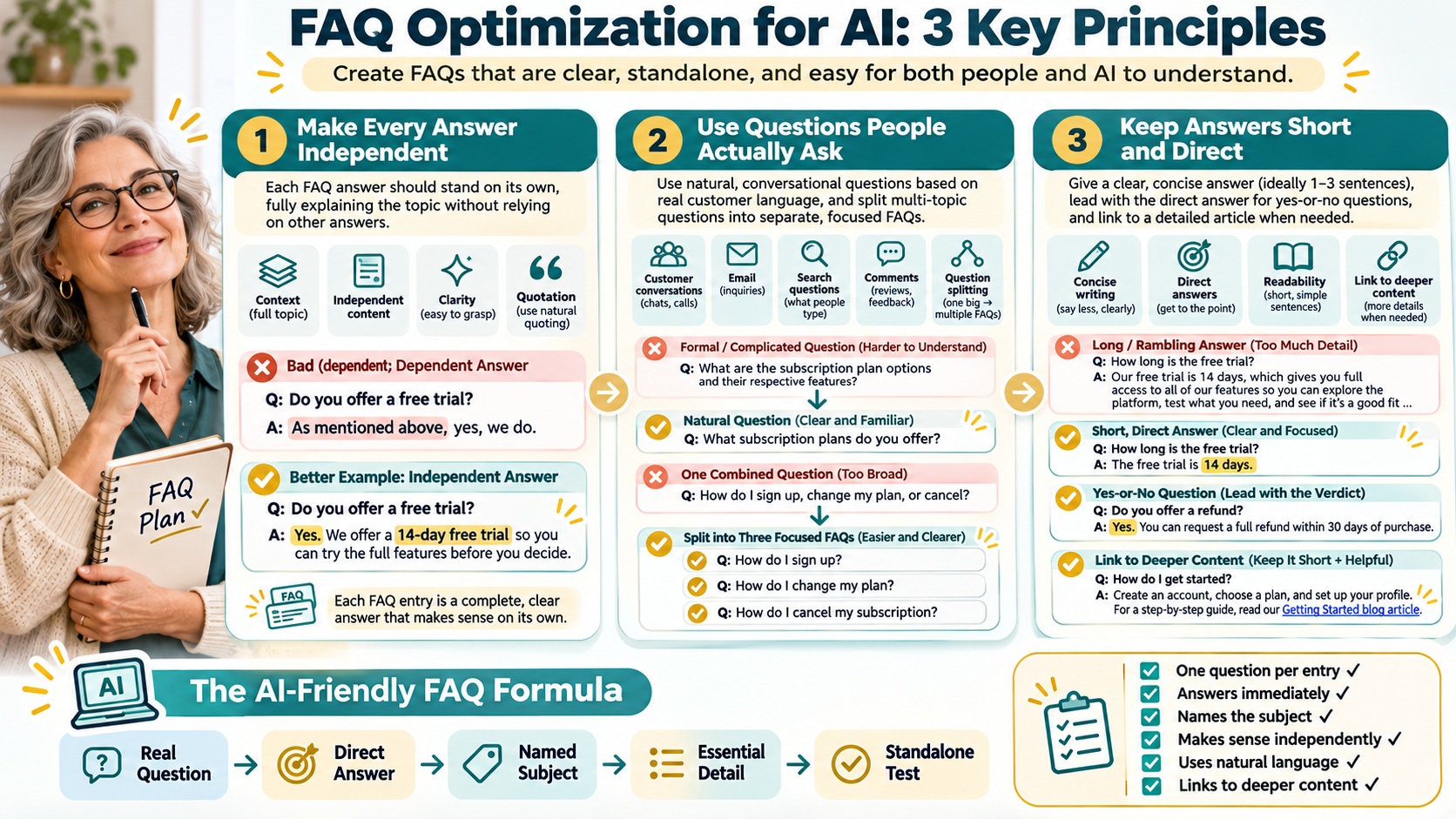
A Simple FAQ Optimization for AI Framework
Here is a practical framework you can use when creating or reviewing an FAQ section.
Step 1: Find a Real Question
Choose a question your audience genuinely asks.
Step 2: Keep It Specific
Make sure the question focuses on one clear topic.
Step 3: Answer Immediately
Place the direct answer in the first sentence.
Step 4: Name the Subject
Include enough context for the answer to make sense independently.
Step 5: Add Essential Detail
Include a short explanation, condition, or example where necessary.
Step 6: Test It in Isolation
Copy the answer into a blank note and check whether it still makes sense.
Step 7: Link to Deeper Content
If the reader needs more information, provide a link to a relevant article.
The framework is simple:
Real Question → Direct Answer → Named Subject → Essential Detail → Standalone Test
Use it repeatedly across your website.
What Does a Well-Structured FAQ Look Like?
Here is an illustrative FAQ section for a business helping beginners create digital products.
What is a digital product?
A digital product is an item delivered electronically rather than physically, such as an eBook, printable planner, template, or online course.
Do I need technical skills to create a digital product?
No, advanced technical skills are not necessary to create a simple digital product. Beginner-friendly tools can help you produce worksheets, guides, and templates while you gradually develop your skills.
What is a good first digital product?
A checklist, worksheet, or simple printable planner can be a manageable first digital product because it focuses on solving a specific problem without requiring extensive content development.
Can AI help me create a digital product?
Yes, AI can help with brainstorming, outlining, drafting, and reviewing digital product content. You should still check the accuracy, usefulness, and quality of the finished product before selling it.
Notice what happens when you read each answer independently.
Every answer names its subject.
Every answer addresses a specific question.
None depends on the answers above or below it.
Each one is a small, complete piece of useful information.
That is the structure you are aiming for.
Turn Your Existing FAQs Into Useful Content Assets
You do not need to rebuild your website.
Start with one FAQ section you already have.
Read each answer separately.
Identify the answers that depend on earlier information.
Replace vague references with clear subjects.
Split questions that cover multiple topics.
Rewrite formal questions using everyday language.
Move the direct answer to the beginning.
Trim unnecessary words.
Add links to your more detailed articles where appropriate.
These are small changes, but they can significantly improve how easy your content is to navigate and understand.
And while no particular formatting technique guarantees an AI citation, creating clear, independent answers gives your content a better foundation for being interpreted and reused accurately.
The Real Value of Better FAQs
An FAQ section should not be something you add to the bottom of a page simply because websites are supposed to have one.
It should be a useful resource.
Each question represents something a real person wants to know.
Each answer is an opportunity to demonstrate your knowledge.
Each clear explanation can help someone make a better decision.
FAQ optimization for AI is not about replacing your personality with robotic answers.
It is about removing unnecessary barriers between a question and the useful information you already have.
Start with one question.
Write a complete answer.
Read it on its own.
Then repeat the process.
Your existing knowledge may be far more useful than you realize.
Sometimes, all it needs is a better structure.
Get our new Releases
 Join the Challenge: Access Classroom · The Opportunity Lab™ Today
Listen to our Podcast Channel – The Opportunity Hub Podcast Channel
Read:
Systeme.io Review: All-in-One Business Platform
Effective Strategies for Incorporating AI in Your Business Operations
Ultimate Guide to Mastering AI Copywriting Techniques in 2026
Top 10 AI Content Creation Tips for High-Quality AI-Driven Content
Top 5 AI Copywriting Mistakes to Steer Clear Of
The 4 Cs of Better AI Copy / Mastering AI Copywriting: 7 Essential Frameworks Revealed
📅 Last updated:
