
Exploring 5 Easy AI Business Models for New Entrepreneurs
I remember sitting at my kitchen table a few years ago, staring at a blank screen. I had this nagging feeling that artificial intelligence was about to change everything, but I had no clue where to start. If you feel the same way, you are not alone. The good news is that you do not need a computer science degree to build a real online business today. I have spent months testing different strategies, and I want to share five straightforward paths that actually work. These are not get-rich-quick schemes. They are simple AI models that anyone can learn. In this article, I will walk you through each model step by step. You will see how beginners are already earning money using these methods. Let us dive into the world of AI business models beginners can actually use to build sustainable income.

Introduction to AI Business Models for Beginners
When I first heard about AI business models for beginners, I assumed it meant building complex software from scratch. That could not be further from the truth. The landscape has shifted dramatically over the last two years. Now, you can leverage pre-built tools and platforms to create value without writing a single line of code. I have seen people launch profitable ventures using nothing more than a laptop and a willingness to learn.
The core idea behind these models is simple. You take an existing AI tool, apply it to a specific problem, and deliver a solution to paying customers. This is what I call the “layering” approach. You layer your own expertise or service on top of AI automation. For example, you might use a language model to generate marketing copy for local businesses. That is a service people will gladly pay for.
One of the biggest misconceptions I encounter is that you need to be a technical wizard. I am living proof that is not true. My background is in marketing, not engineering. Yet I have built multiple income streams using these exact strategies. The key is to focus on the outcome, not the technology. Your customers do not care if you used AI. They care about the result.
Let me share a quick story. A friend of mine named Sarah started a small content agency last year. She had zero technical skills. She used a simple AI writing assistant to draft blog posts for real estate agents. Within three months, she was earning over four thousand dollars per month. She did not build the AI. She just used it to deliver faster and better work. That is the power of this approach.
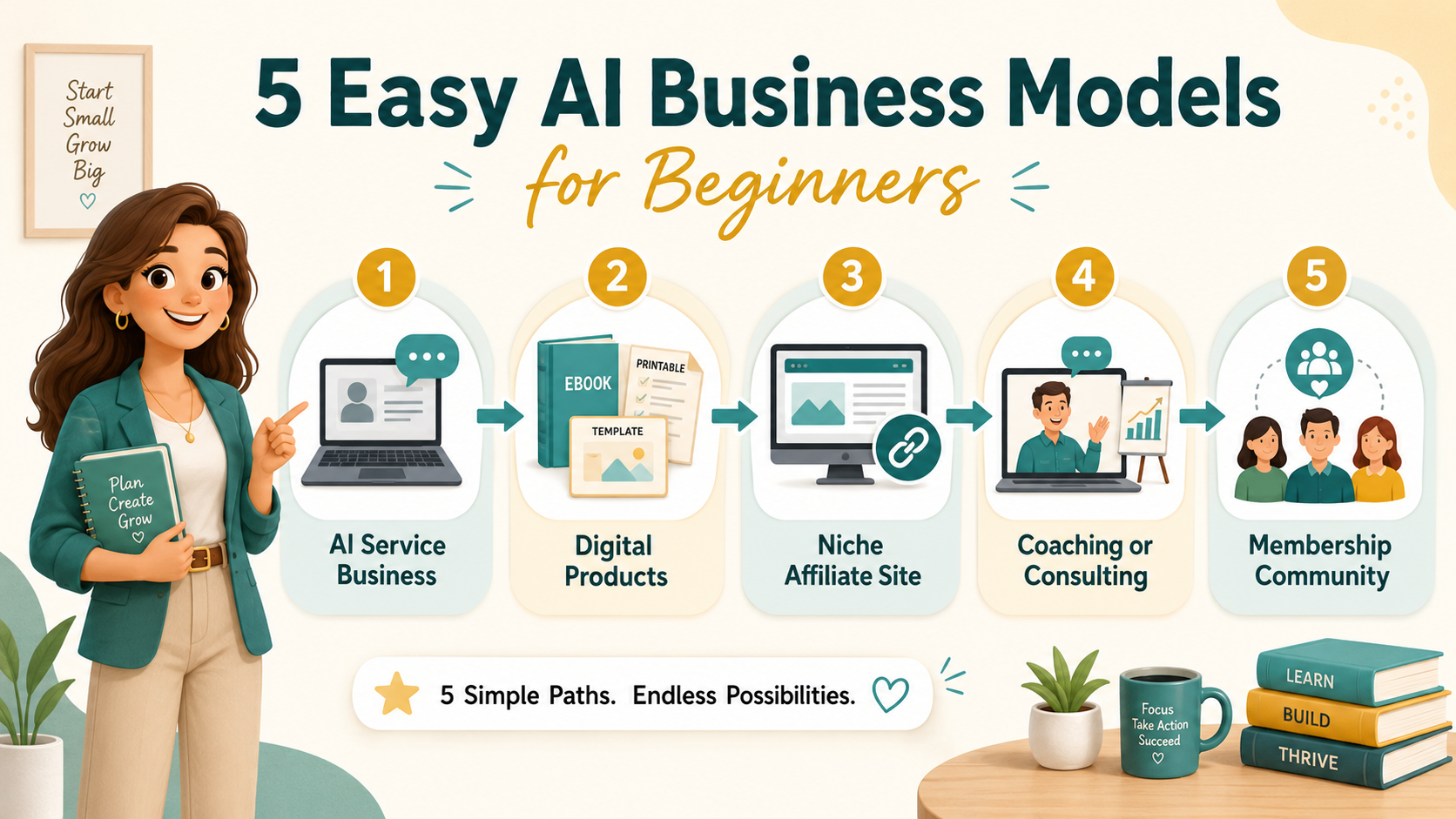
I have identified five distinct models that consistently work for beginners. They range from service-based offerings to productized solutions. Each model requires a different level of effort and investment. I will break them down in detail, so you can pick the one that fits your personality and goals. The most important thing is to take action. You can read all the theory in the world, but nothing happens until you start.
Understanding the AI-Powered Toolkit
Before I jump into the specific business models, I want to talk about the tools that make everything possible. You do not need to own every gadget on the market. In fact, I recommend starting with just two or three core pieces of software. The goal is to build a simple AI models toolkit that you can master quickly.
Essential Software for Beginners
I have tested dozens of AI tools over the past year. The ones that stand out are the ones that are user-friendly and affordable. For text generation, I rely on tools like ChatGPT and Claude. These platforms allow you to generate high-quality content, answer questions, and even create marketing copy in seconds. The key is learning how to write good prompts. That is a skill you can develop in a few hours.
For image creation, I use platforms like Midjourney or DALL-E. These tools are incredible for creating visuals for social media, websites, and product mock-ups. Again, you do not need design experience. You just need to describe what you want. The AI does the heavy lifting.
There is also a growing ecosystem of no-code automation tools. Zapier and Make let you connect different apps together. You can set up workflows that run automatically. For example, you can have new email subscribers automatically added to a mailing list and receive a welcome message. This saves hours of manual work every week.
Hardware Considerations
You might think you need a supercomputer to run AI tools. That is a common misconception. Most AI business models beginners can start with a standard laptop. I use a mid-range Windows machine that cost around eight hundred dollars. It handles everything I need. The real processing happens on remote servers, not your local device.
That said, a reliable internet connection is non-negotiable. You will be uploading files, accessing cloud platforms, and communicating with clients. A slow connection will kill your productivity. I recommend investing in a stable broadband plan before spending money on anything else.
Free vs Paid Tools
I always tell people to start with free versions whenever possible. Most AI platforms offer a free tier with limited usage. This is perfect for testing and learning. Once you confirm that a tool fits your workflow, you can upgrade to a paid plan. I made the mistake of buying expensive subscriptions upfront. Do not repeat my error. Try before you buy.
There are also open-source alternatives that cost nothing. Tools like Stable Diffusion for images and Llama for text generation are completely free. They require a bit more technical setup, but the savings can be substantial. If you are on a tight budget, this is a viable path.
Benefits of AI and Business Membership
One of the most effective ways to accelerate your learning is to join a membership community focused on AI business models beginners. I have been part of several groups, and the benefits are enormous. You gain access to curated resources, expert guidance, and a network of like-minded people. This is not just about motivation. It is about practical, actionable support.
When you join a membership, you typically get access to training modules that cover the fundamentals. These courses are designed by people who have already succeeded. They know the pitfalls and shortcuts. I have saved months of trial and error by following their frameworks. The cost of membership is usually a fraction of what you would spend on individual courses.
Another major benefit is accountability. It is easy to get distracted when you work alone. Being part of a group creates gentle pressure to keep moving forward. Members share their wins and challenges. This creates a culture of progress. I have personally launched projects faster because I knew I had to report back to the group.
Membership communities also offer live Q&A sessions. You can ask specific questions about your business and get immediate feedback. This is invaluable when you hit a roadblock. I remember struggling with pricing my services. A quick question in the community chat gave me a framework that doubled my rates. That single insight was worth the membership fee many times over.
Finally, many memberships include access to exclusive tools and templates. These are not available to the general public. For example, I received a spreadsheet that calculates profit margins for different service packages. It saved me hours of manual math. These resources give you a head start over competitors who are figuring things out alone.
Exploring the Smart Start Membership
I want to dive deeper into one specific membership model that I have found particularly effective. It is called the Smart Start Membership. This is a structured program designed for people who want to build a business using simple AI models. The focus is on taking action from day one, not just consuming information.
The Smart Start Membership is built around a weekly sprint system. Each week, you focus on one specific task. For example, week one might be choosing your niche. Week two is setting up your tools. Week three is creating your first offer. This step-by-step approach prevents overwhelm. I have seen people go from zero to their first paying client in under thirty days using this system.
One of the standout features is the library of done-for-you prompts. These are pre-written instructions for AI tools that generate specific outputs. You do not need to learn prompt engineering from scratch. You can copy and paste these prompts to create sales pages, email sequences, and social media content. This dramatically reduces the learning curve.
The membership also includes a private community where members share their results. I have seen people launch freelance services, digital products, and even small agencies using the same framework. The variety is inspiring. One member started a resume writing service using AI. Another created a meal planning subscription. The possibilities are endless when you have a solid foundation.
Another key component is the weekly coaching calls. A seasoned entrepreneur reviews member progress and answers questions. This is not generic advice. It is tailored to your specific situation. I have personally received feedback on my pricing strategy, my marketing messages, and my workflow optimization. The accountability alone is worth the investment.
If you are serious about building an online income stream, I recommend exploring membership options like this. They provide structure, support, and a clear path forward. You avoid the paralysis that comes from having too many choices. Instead, you follow a proven system that has worked for hundreds of other beginners.
Utilizing Free Resources Effectively
You do not need to spend a lot of money to get started with AI business models beginners. There is a wealth of free resources available if you know where to look. I have compiled a list of the most effective ones that I personally use. These will help you build your skills without breaking the bank.
YouTube Tutorials and Channels
YouTube is a goldmine for learning AI tools. I subscribe to several channels that post high-quality tutorials every week. Channels like “AI Foundations” and “The AI Advantage” break down complex topics into digestible videos. I learned how to use advanced prompt techniques just by watching fifteen-minute videos during my lunch break.
The key is to search for specific use cases. Instead of searching for “AI business,” search for “AI for freelance writers” or “AI for social media management.” This narrows the results to exactly what you need. I have found playlists that cover entire workflows from start to finish.
Free Courses and Certifications
Several platforms offer free courses on AI fundamentals. Coursera has a course called “AI For Everyone” by Andrew Ng. It is completely free to audit. This course explains the core concepts in plain language. I recommend it to anyone who feels intimidated by the technology. It takes about four hours to complete.
Google also offers free AI training through their Grow with Google program. They have modules on machine learning basics and practical applications. These courses include hands-on exercises that let you practice in a sandbox environment. You earn a certificate upon completion, which you can add to your LinkedIn profile.
Community Forums and Discussion Groups
Reddit has several active communities focused on AI business. Subreddits like r/ArtificialIntelligence and r/Entrepreneur are full of real-world advice. I have learned about new tools and strategies by reading posts from other entrepreneurs. The comments section often contains gold nuggets of practical wisdom.
Discord servers are another great resource. Many AI tool creators have official Discord communities where users share tips and troubleshoot issues. I joined the Midjourney Discord server and learned advanced image generation techniques just by observing conversations. The community is incredibly generous with their knowledge.
Free Trials and Tiered Plans
Almost every AI tool offers a free trial. I make it a habit to sign up for trials of new tools every month. This allows me to test them thoroughly before committing. I keep a spreadsheet where I track which tools I have tried and what I liked or disliked about them. This helps me make informed decisions later.
Some platforms offer generous free tiers that last indefinitely. Canva, for example, has a free version that includes basic AI features. You can create professional graphics without paying a dime. Similarly, Grammarly offers a free writing assistant that catches errors and suggests improvements. These tools are powerful enough to run a small business.
Open-Source Alternatives
I mentioned open-source tools earlier, but they deserve a deeper look. Platforms like Hugging Face host thousands of free AI models. You can use them for text generation, image recognition, and data analysis. The interface is user-friendly, and there are extensive documentation and tutorials available.
Another option is to use Google Colab, which provides free access to GPU computing power. You can run complex AI models without owning expensive hardware. This is a gamechanger for beginners who want to experiment without financial risk. I have used Colab to train simple models for personal projects.
Engaging in The Opportunity Lab Community
One community that I want to highlight specifically is The Opportunity Lab. This is a vibrant group of entrepreneurs who are actively building businesses using simple AI models. I joined this community six months ago, and it has been one of the best decisions I have made for my business.
The Opportunity Lab is different from other groups because it focuses on action over theory. Every week, there are challenges and sprints that push members to launch something. For example, one week we had a “Product Launch Sprint” where everyone had to create and publish a digital product within seven days. The energy was incredible. People supported each other, shared feedback, and celebrated wins together.
The community also has a mentorship program where experienced members volunteer their time. I was paired with a mentor who had built a six-figure agency using AI tools. He reviewed my business plan and gave me specific advice on how to position my services. That one-hour conversation saved me months of trial and error.
Another feature I love is the resource library. Members contribute templates, checklists, and case studies. I have downloaded a client onboarding checklist that streamlined my entire process. There is also a database of AI prompts organized by industry. If you are targeting real estate agents, you can find prompts specifically designed for that niche.
The community hosts live events every month. These include guest speakers, panel discussions, and networking sessions. I have connected with potential collaborators and even found my first client through a networking event. The relationships you build here can last a lifetime.
If you are looking for a supportive environment to grow your AI business, I highly recommend checking out The Opportunity Lab. The cost is minimal compared to the value you receive. You can join for a small monthly fee and cancel anytime. There is no long-term commitment, which makes it a low-risk investment.
Building a Service-Based AI Business
Now let me walk you through the first specific business model. This is the one I recommend for most beginners. It is a service-based model where you offer your skills to clients using AI as a tool. This is the fastest way to generate cash flow because you are solving an immediate problem for someone.
Think about what small businesses struggle with. They need content for their websites, social media posts, email newsletters, and marketing materials. Most of them do not have the time or skills to create this content. You can step in and provide that service using AI. You are not replacing the business owner. You are augmenting their capabilities.
I started by offering blog writing services to local businesses. I used AI to generate drafts, then edited them to add a human touch. My clients loved the speed and quality. I charged fifty dollars per post initially. As I gained experience and testimonials, I raised my rates to one hundred fifty dollars per post. Within six months, I had a steady stream of clients.
The key to success in this model is specialization. Do not try to serve everyone. Pick a niche and become the go-to person for that industry. For example, you could focus on writing for dental practices, real estate agents, or fitness coaches. When you specialize, you can create templates and workflows that are highly efficient. Your quality improves, and your delivery time shrinks.
Another service model is virtual assistance. Many entrepreneurs need help with administrative tasks like email management, calendar scheduling, and data entry. AI tools can automate a lot of this work. You can offer a package where you handle these tasks using AI, freeing up your client’s time. This is a high-demand service that commands good rates.
I have also seen success with social media management. You can use AI to generate content calendars, write captions, and even create images. You then schedule everything using a tool like Buffer or Hootsuite. Clients are happy to pay a monthly retainer for consistent social media presence. This creates recurring revenue for you.
Creating Digital Products with AI
The second business model I want to explore is creating and selling digital products. This is a fantastic way to generate passive income. You create a product once, and you can sell it infinitely. AI makes this process faster and easier than ever before.
Digital products can take many forms. eBooks, templates, courses, printables, and software are all popular options. The key is to identify a specific problem that people are willing to pay to solve. For example, I created a set of AI prompts for freelance writers. It included prompts for generating article ideas, writing outlines, and editing drafts. I sold it for twenty-seven dollars and made over two thousand dollars in the first month.
AI helps you create these products in a fraction of the time. You can use AI to brainstorm ideas, write content, design covers, and even create marketing copy. I used AI to generate the first draft of my eBook. I then spent a few hours editing and formatting it. The entire process took less than a week.
Another popular product type is online courses. You can create a course teaching others how to use AI for a specific purpose. For example, “AI for Real Estate Agents” or “AI for Small Business Owners.” The course can include video lessons, written guides, and downloadable resources. Platforms like Gumroad and Systeme.io make it easy to host and sell your course.
Templates are another low-effort high-value product. You can create templates for business plans, marketing calendars, or client proposals. AI can help you design these templates quickly. You then sell them on marketplaces like Etsy or Creative Market. I have a friend who makes over three thousand dollars per month selling Notion templates. She uses AI to design and describe each template.
The beauty of digital products is that they do not require inventory or shipping. You earn money while you sleep. Once the product is created, your only job is marketing. And AI can help with that too. You can use AI to write email sequences, social media posts, and ad copy to promote your products.
Building a Niche Affiliate Site
The third model is building a niche affiliate site powered by AI. This is a classic online business model that has been supercharged by AI. You create content around a specific topic, recommend products, and earn commissions when people buy through your links. AI makes content creation fast and scalable.
I have built several affiliate sites in different niches. The most successful one is in the home office equipment space. I write reviews of desks, chairs, monitors, and accessories. I use AI to research products, compare features, and write comprehensive reviews. The content is informative and helpful, which builds trust with readers.
The key to success with affiliate marketing is choosing a niche with high commission rates and strong demand. Look for products that cost over fifty dollars. The commission should be at least twenty percent. Physical products, software subscriptions, and online courses all work well. Avoid low-ticket items unless you have massive traffic.
AI helps you scale content production. You can generate multiple articles per day using AI. I use a system where I create a content calendar, then use AI to write drafts for each article. I then review, edit, and publish. This allows me to build a site with hundreds of articles in a few months. More content means more traffic and more commissions.
Another strategy is to use AI for keyword research. Tools like Semrush and Ahrefs are expensive. But you can use AI to brainstorm long-tail keywords that have low competition. I ask AI to generate a list of questions people ask about my niche. I then create content that answers those questions. This drives targeted traffic that converts well.
I also use AI to create email sequences for my affiliate site. When someone signs up for my newsletter, they receive a series of emails that recommend products. AI writes the emails based on my guidelines. This automated system generates commissions without any ongoing effort from me.
Launching a coaching or Consulting Practice
The fourth model is leveraging AI to build a coaching or consulting practice. This is a high-ticket service model that can generate substantial income. You use AI to enhance your expertise and deliver better results to clients.
Many people think they need to be a world-class expert to charge premium rates. That is not true. You just need to know more than your clients about a specific problem they want solved. If you have learned how to use AI tools for content creation, productivity, marketing, planning, or business setup, you can teach others how to use them too.
I started by offering one-on-one coaching sessions to small business owners who felt overwhelmed by AI. Most of them had heard about ChatGPT, but they had no idea how to use it in a practical way. They did not need a long technical explanation. They needed someone to sit with them, show them how to write better prompts, and help them apply AI to their real business tasks.
That is where the opportunity lies. You are not selling AI itself. You are selling clarity, confidence, and implementation.
For example, you could help a coach create weekly content using AI. You could help a local business owner write better email newsletters. You could help a retiree turn their knowledge into a digital product. You could help a blogger create outlines, social media posts, and lead magnets faster. These are practical outcomes people understand and will pay for.
The best part is that AI helps you prepare for each client session. Before a coaching call, you can use AI to create a simple action plan, worksheet, checklist, or prompt pack based on the client’s goals. After the session, you can use AI to summarize the next steps and send a follow-up email. This makes your service feel polished and professional, even if you are just starting.
There are several ways to package this model. You can offer single strategy sessions, a four-week coaching package, a group workshop, or a done-with-you implementation service. Beginners often do well with a simple starter offer such as:
“AI Business Setup Session: Get your first simple AI workflow created in 90 minutes.”
That kind of offer feels specific and useful. It does not overwhelm people with too much theory. It promises a clear result.
Pricing can vary depending on your experience and audience. If you are new, you might start with a low-cost beta offer to get testimonials. For example, you could charge $47 to $97 for a one-hour AI setup session. Once you have proof and confidence, you can raise your prices to $197, $497, or more for a complete package.
The secret is to focus on one audience and one problem. Do not try to coach everyone on everything. Pick a clear niche. You might focus on AI for coaches, AI for bloggers, AI for local businesses, AI for seniors, or AI for digital product creators. When your message is specific, people understand immediately whether your offer is for them.
A good coaching or consulting business does not need a complicated website. You can start with a simple booking page, a short description of your offer, and a way for people to pay. You can promote it through your email list, social media, community groups, or personal network.
I have seen beginners land their first paid clients simply by posting something like:
“I am helping small business owners use AI to save time on content and email marketing. If you want help setting up your first simple AI workflow, message me.”
That is not fancy, but it works because it is clear.
AI also helps you improve your client experience. You can create custom templates, content calendars, business plans, email drafts, social media captions, and training notes in a fraction of the time. Your clients still benefit from your guidance, but AI helps you deliver faster and with more structure.
One thing I want to stress is this: coaching and consulting should never be about pretending to know everything. It is about helping someone get from confusion to action. If you can do that, you have value to offer.
This model is especially powerful if you already have life experience, business experience, teaching experience, or problem-solving skills. Many retirees, career changers, and experienced professionals underestimate how much they know. AI gives them a way to turn that knowledge into a practical service.
Start small. Offer a simple session. Help one person get one result. Then use that experience to improve your offer. Over time, your coaching or consulting practice can become a strong income stream.
Creating a Membership Community
The fifth AI business model is creating a membership community. This is one of my favorite models because it combines recurring income with real human connection. Instead of selling one product or one service, you create a place where people can learn, ask questions, get support, and keep making progress.
At first, a membership might sound intimidating. You might imagine needing hundreds of members, complicated technology, and endless content. That is not necessary. A membership can start very small. In fact, some of the best communities begin with just ten or twenty people who share the same goal.
The basic idea is simple. Members pay a monthly fee to access ongoing value. That value might include weekly lessons, templates, prompts, live calls, challenges, accountability posts, resource libraries, or community discussions. AI can help you create and manage much of this content.
For example, you could build a membership around helping beginners use AI to start an online business. Each month, you could focus on one theme such as content creation, digital products, email marketing, affiliate marketing, or simple automation. AI can help you create worksheets, lesson outlines, prompt packs, email examples, social posts, and checklists for each theme.
This is where AI becomes a real time-saver. Instead of sitting for hours trying to create content from scratch, you can use AI to help you draft the first version. You still add your own voice, examples, and experience, but the heavy lifting is much easier.
A beginner-friendly membership does not need to be packed with too much content. In fact, too much content can overwhelm people. A simple structure works better. For example:
Week 1: Short lesson
Week 2: Simple action task
Week 3: Template or prompt pack
Week 4: Q&A, review, or member wins
This gives members a rhythm they can follow. They know what to expect, and you are not constantly scrambling to create something new.
One of the biggest benefits of a membership is recurring revenue. If you charge $19 per month and attract 100 members, that is $1,900 per month. If you charge $29 per month and attract 200 members, that is $5,800 per month. Those numbers can make a big difference for a solopreneur.
The real value, though, is not just the income. It is the relationship you build with your audience. A membership allows people to stay connected with you over time. They get to know your style, your ideas, and your approach. That trust can lead to future sales of courses, coaching, digital products, workshops, and premium offers.
AI can also help you manage the community experience. You can use AI to brainstorm weekly discussion questions, summarize member feedback, create monthly content calendars, write welcome emails, draft challenge prompts, and generate ideas based on what members are asking for.
For example, if several members keep asking how to create their first digital product, you can use AI to help you create a mini-training, checklist, and prompt pack around that topic. This allows your membership to respond to real needs instead of guessing what people want.
There are many platforms you can use to host a membership. You can start with something simple like a private Facebook group, Skool, Systeme.io, Teachable, or another membership platform. The platform matters less than the promise of the community. People join because they want help, direction, and support.
A simple membership promise might be:
“A beginner-friendly community that helps you use AI to create content, build simple digital products, and grow your online income one step at a time.”
That is clear, practical, and attractive to people who feel overwhelmed.
One important lesson I have learned is that community members do not only want information. They want encouragement. They want to feel that they are not behind, not silly for asking questions, and not alone in the process. This is especially true for beginners and retirees who may feel intimidated by technology.
That is why a warm, supportive tone matters. Your membership does not have to be the biggest or flashiest. It simply needs to help people take consistent action.
You can also combine this model with the other four business models. For example, you might sell digital products and then invite buyers into your membership. You might offer coaching as an upgrade for members who want personal help. You might recommend affiliate tools inside the community. You might use your service experience to create better training.
That is what makes the membership model so powerful. It can become the center of your business ecosystem.
If you are starting from scratch, keep it simple. Choose one audience, one monthly topic, and one clear promise. Invite a small group of founding members at a low introductory price. Ask them what they need. Build with them, not just for them.
Over time, your membership can grow into a steady income stream and a valuable community where people learn, connect, and take action together.
Choosing the Right AI Business Model for You
Now that we have looked at five easy AI business models, the next question is simple: which one should you choose?
If you want to earn money quickly, start with an AI service business. It is the fastest path to cash flow because you are solving a direct problem for clients.
If you want something you can create once and sell many times, start with digital products. This is a great option if you enjoy creating templates, guides, ebooks, planners, or courses.
If you enjoy writing and building content over time, a niche affiliate site may be the right fit. It takes longer to grow, but it can become a strong income stream once your traffic builds.
If you enjoy helping people directly, coaching or consulting could be a natural choice. This works especially well if you already have experience, skills, or knowledge that others need.
If you want recurring income and enjoy building relationships, a membership community may be your best long-term model.
The important thing is not to choose all five at once. That is where many beginners get stuck. Pick one model. Learn the basics. Test a simple offer. Get feedback. Improve as you go.
AI does not remove the need for effort, patience, or good judgment. But it does make the process faster, easier, and more accessible. You do not need to be a technical expert. You just need to be willing to learn, experiment, and take one practical step at a time.
Start small. Choose your model. Use simple tools. Focus on helping real people solve real problems.
That is how an AI-powered business begins.
Get our FREE resource – The AI-Powered Toolkit
To see the full system:
 Read:
Read:
Systeme.io Review: All-in-One Business Platform
How to Start and Grow an Online Business Using AI
A Comprehensive Guide to Implementing AI-Powered Online Business Models
📅 Last updated:
