
The Ultimate Guide to Launching AI Product Strategies Successfully
Launching an AI product is no walk in the park. Whether you’re a startup founder or part of an established tech company, knowing the right launch AI product strategies can dramatically improve your chances of success. AI products bring unique challenges and opportunities compared to traditional tech offerings. In this guide, I’ll walk you through the essential steps to not only launch your AI product but also grow your AI business sustainably. From understanding the AI landscape to building customer relationships and measuring success, this comprehensive guide covers it all.

Understanding AI Product Launches
Before diving into launch AI product strategies, it’s crucial to grasp what makes AI products distinct. Unlike conventional software, AI products often rely on machine learning models, data pipelines, and continuous training to improve over time. This adds layers of complexity in development, deployment, and user experience.
AI product launches require a deeper focus on data quality and model performance. A poorly trained AI can cause mistrust among users or even harm your brand. For example, Microsoft’s early AI chatbot “Tay” famously spiraled out of control due to inadequate safeguards, showing how AI products can backfire without proper preparation.
Additionally, AI products often have regulatory and ethical considerations. Depending on your industry, you might need to comply with data privacy laws like GDPR or ensure your AI doesn’t introduce bias. These factors must be baked into your launch strategy from day one.
Successful AI launches also differ in their go-to-market approach. Since AI is often seen as cutting-edge, your messaging should educate and build trust. Customers need to understand the tangible benefits and limitations of your AI product, not just the hype. This education-driven marketing helps set realistic expectations, reducing churn and increasing adoption.
Finally, AI products thrive on iteration. Unlike one-time software releases, you’ll likely update your AI models regularly based on new data and feedback. This means your launch is not a single event but the beginning of an ongoing journey.
Understanding these unique aspects will help you create launch AI product strategies that are tailored and effective. It sets the foundation to plan the next stages with clarity and precision.
Setting Objectives and Goals
Launching an AI product without clear objectives is like setting sail without a compass. Defining precise, measurable goals guides your entire launch strategy and keeps your team aligned.
Define SMART Goals
Start by setting SMART goals: Specific, Measurable, Achievable, Relevant, and Time-bound. Instead of a vague goal like “get users,” aim for “acquire 1,000 active users within three months.” This clarity helps you track progress and adjust tactics as needed.
Identify Key Performance Indicators (KPIs)
Choose KPIs that reflect your product’s health and growth potential. For AI products, relevant KPIs might include model accuracy, user retention, engagement rates, or time saved through automation. For instance, if you’re launching an AI-powered marketing tool, measuring increased campaign ROI driven by your product gives direct evidence of value.
Align Goals with Business Strategy
Your launch objectives should support broader AI business growth ambitions. If your company aims to position itself as a leader in AI-driven customer service, your product goals should emphasize user satisfaction and resolution rates. This alignment ensures marketing, development, and sales efforts pull in the same direction.
Example of Goal Setting in AI Launch
Consider Grammarly, which launched an AI product focused on writing assistance. Their goals likely included improving grammar correction accuracy, increasing daily active users, and expanding to new languages. These objectives not only supported product improvement but also business expansion.
Setting clear objectives and goals is the cornerstone of your launch AI product strategies. They create focus, facilitate communication, and empower data-driven decision-making.
Leveraging AI Tools for Product Development
Developing an AI product demands more than traditional software skills. Leveraging the right AI tools can accelerate your development cycle, improve model quality, and reduce costs.
Data Preparation and Management Tools
High-quality data powers AI products. Tools like Databricks or OpenRefine help you clean, transform, and manage data efficiently. These platforms enable your team to prepare datasets that improve model performance.
Machine Learning Frameworks
Frameworks such as TensorFlow, PyTorch, and scikit-learn provide robust libraries for building AI models. Their flexibility allows you to experiment with different algorithms and architectures, speeding up innovation. For example, PyTorch’s dynamic computation graph is favored for rapid prototyping.
AutoML Platforms
If your team lacks deep AI expertise, AutoML platforms like Google Cloud AutoML or H2O.ai can automate model selection and tuning. This democratizes AI development, enabling even small teams to build competitive products.
Cloud Infrastructure
Cloud services like AWS, Azure, and Google Cloud offer scalable infrastructure tailored for AI workloads. They provide GPU instances, managed machine learning services, and data storage solutions that support both development and deployment phases.
Example: AI Product Development Workflow
Imagine a startup creating an AI-based recommendation engine. They might use Databricks for data processing, TensorFlow for model training, and deploy on AWS SageMaker for scalability. This integrated toolset cuts down development time and ensures smooth production deployment.
By leveraging these AI tools, you build a solid technical foundation that supports your launch AI product strategies while enabling continuous improvement.
Creating a Marketing Plan
Marketing an AI product requires a blend of education, trust-building, and targeted outreach. Unlike consumer apps, AI products often solve complex problems and need clear communication to demonstrate value.
Identify Your Target Audience
Start by defining who benefits most from your AI product. Are you targeting enterprise customers, SMBs, or individual users? Understanding their pain points helps craft messaging that resonates.
Develop Clear Messaging
Focus on tangible benefits rather than technical jargon. Instead of “leveraging deep neural networks,” say “helping you save 3 hours per week through automation.” This clarity engages potential buyers and reduces confusion.
Content Marketing and Thought Leadership
Educational content builds credibility in the AI space. Publish blog posts, whitepapers, and case studies that explain your technology and its real-world impact. Platforms like Forbes AI section or Emerj offer excellent examples of thought leadership.
Leverage Social Proof and Testimonials
Early adopters’ reviews and case studies provide social proof. Highlight how your AI product solved specific challenges. For instance, a testimonial like “Our sales team increased lead conversion by 20% using this AI tool” adds authenticity.
Choose the Right Channels
LinkedIn is great for B2B AI products, while Twitter and AI forums can help engage enthusiasts and developers. Paid ads targeting relevant keywords can also boost visibility during launch phases.
Example Marketing Campaign
When IBM Watson launched its AI offerings, their marketing combined webinars, detailed case studies, and partnerships with industry leaders. This multi-channel approach educated prospects and built trust effectively.
Creating a strategic marketing plan tailored to your audience and product ensures your launch AI product strategies reach the right people at the right time.
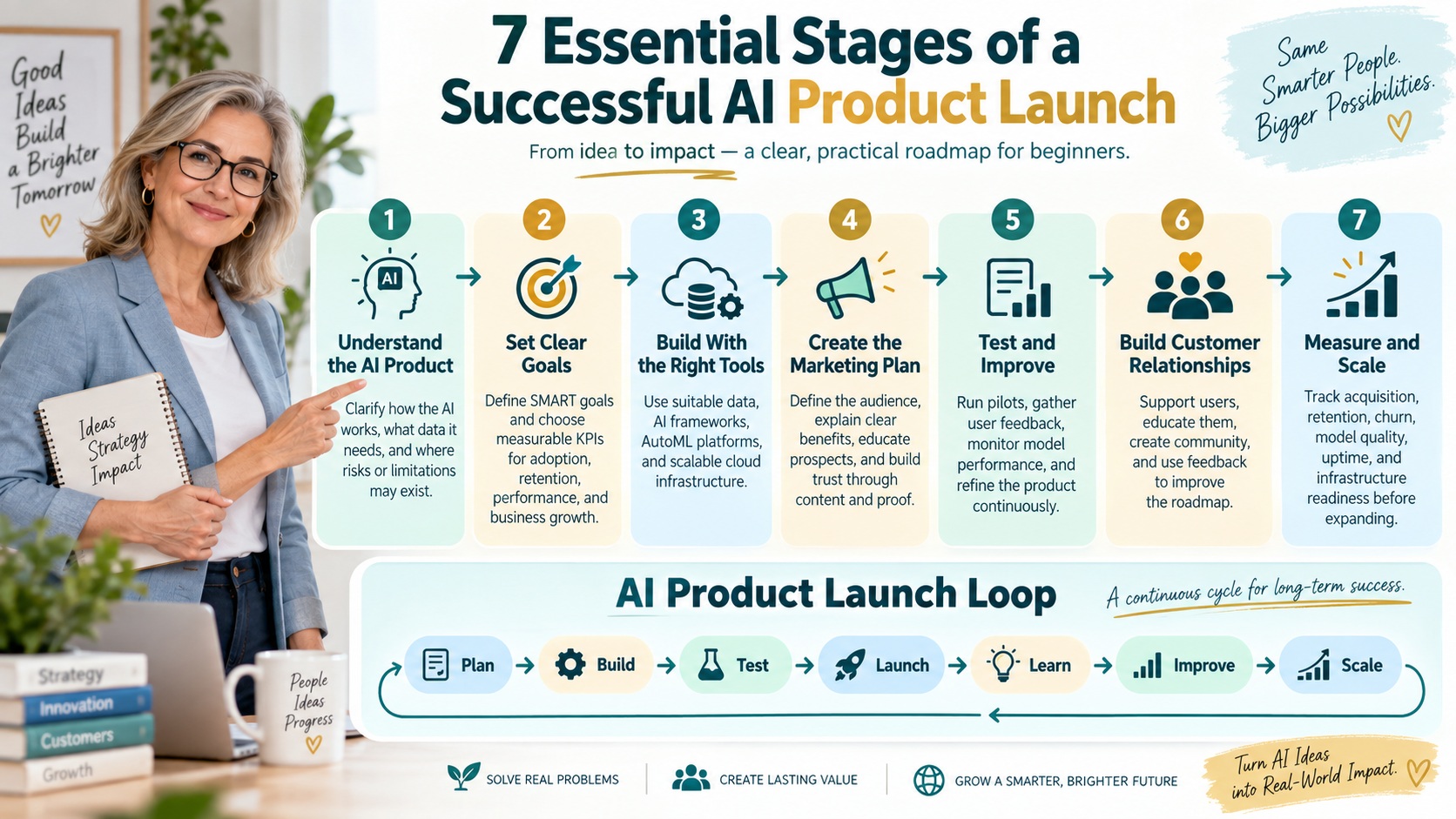
Testing and Iterating Your AI Product
AI products thrive on iteration. Unlike static software, your AI needs continuous testing and refinement to maintain accuracy and user satisfaction.
User Testing and Feedback Loops
Gather feedback early from a beta group or pilot customers. Their insights highlight usability issues and feature gaps. Tools like UserTesting or Hotjar can capture user behavior and sentiment.
Model Validation and Performance Monitoring
Regularly validate your AI model against fresh data sets. Monitor key metrics like precision, recall, and F1 score to ensure your model maintains quality. For example, a fraud detection AI must minimize false positives to avoid customer frustration.
Implement Agile Development Practices
Use agile methodologies to release updates frequently. This approach enables rapid response to bugs and evolving customer needs. Continuous integration and deployment pipelines automate testing and reduce downtime.
Example of Iteration Success
Netflix’s AI recommendation engine continuously updates based on viewer preferences and engagement metrics. This iterative approach keeps recommendations relevant and improves user retention.
Testing and iterating your AI product is a vital stage in successful AI product launches. It reduces risk and enhances product-market fit over time.
Building Customer Relationships
Launching your AI product is just the beginning. Building strong, ongoing relationships with customers ensures long-term success and fuels AI business growth.
Offer Exceptional Customer Support
AI products can be complex, so accessible and knowledgeable support reassures users. Chatbots, help centers, and responsive teams reduce user frustration and increase loyalty.
Educate Users Continuously
Provide tutorials, webinars, and updates that help customers maximize your AI product’s value. For example, HubSpot offers extensive resources that empower users to leverage their AI-driven marketing tools.
Engage Through Communities
Build forums or social media groups where users share tips and feedback. This sense of community fosters brand advocacy and uncovers feature ideas.
Collect and Act on Feedback
Establish channels for regular feedback and show customers their input shapes your roadmap. This transparency deepens trust and aligns your product evolution with user needs.
Example: Customer Relationship Success
Salesforce integrates AI-powered insights while maintaining close customer engagement through their Trailblazer Community. This blend of tech and relationship-building drives retention and upsell opportunities.
Strong customer relationships are a cornerstone of your launch AI product strategies and lay the groundwork for sustainable growth.
Measuring Success Metrics and Scaling Your AI Product
After launch, tracking the right metrics and scaling appropriately ensures your AI product continues to thrive.
Identify Core Success Metrics
Depending on your goals, focus on metrics like user acquisition cost (UAC), customer lifetime value (CLV), churn rate, and model accuracy. For AI products, also consider operational metrics such as inference latency and uptime.
Analyze Data for Insights
Leverage analytics platforms to monitor user behavior and product performance. Tools like Google Analytics, Mixpanel, or custom dashboards help you understand what drives engagement and where bottlenecks exist.
Plan for Scalability
As user demand grows, your AI infrastructure should scale seamlessly. Use cloud auto-scaling features, optimize model efficiency, and plan for data storage expansion. A sudden spike in users can overwhelm systems, so stress testing is vital.
Expand Market Reach
Once you’ve validated product-market fit, explore new verticals, geographies, or integration partnerships. For instance, an AI chatbot initially designed for retail can be adapted for healthcare or finance.
Example of Scaling Success
OpenAI scaled its GPT models by optimizing training algorithms and expanding cloud resources, enabling millions of users to access powerful AI capabilities worldwide.
By measuring success metrics accurately and scaling thoughtfully, you ensure your AI product not only survives but flourishes long after the initial launch.
Conclusion
Launching an AI product requires a blend of technical expertise, strategic planning, and customer-centric marketing. By understanding the unique challenges of AI products, setting clear goals, leveraging the best tools, and continuously iterating, you position your product for success. Building strong customer relationships and carefully measuring key metrics allow you to scale confidently and fuel AI business growth. These launch AI product strategies are your roadmap to turning innovative AI ideas into thriving realities.
For further insights on AI product launches and innovation, check out the McKinsey report on analytics and AI growth.
Visit our GPT, Prompt & Skills Site – The AI Knowledge Vault
To see the full system:
 Read:
Read:
Systeme.io Review: All-in-One Business Platform
AI Business Strategies for Beginners: How to Implement AI for Growth
Enhance Your AI Business Model: 5 Expert Tips
Leveraging AI for Enhanced Online Sales Performance
Top AI Development Tools for Entrepreneurs: A Comparative Guide
Exploring Top AI Tools for Enhanced Business Automation
Top AI Business Models for Beginners: A Comprehensive Guide
Mastering AI-Powered Business Techniques for Future Success
Effective Strategies for Incorporating AI in Your Business Operations
📅 Last updated:
