
Top 10 Innovative AI Business Ideas to Kickstart Today
I have spent years watching technology reshape how we work and earn. Artificial intelligence is no longer a distant concept from sci-fi movies. It is a practical tool that anyone can use to build a real business. I see so many people wondering where to start. They feel overwhelmed by the technical jargon and complex systems. But I promise you, the path is clearer than you think. In this article, I will walk you through ten innovative AI business ventures you can kickstart today. We will explore proven AI business models, sustainable online income streams, and the best AI tools for beginners. My goal is to give you actionable steps, not just theory. Let us dive in and find the right opportunity for your skills and goals.

Innovative AI Business Ventures Overview
The landscape of business has shifted dramatically over the last few years. I have watched small teams compete with large corporations using smart automation and intelligent systems. The core advantage comes from leveraging AI to do more with less. You do not need a massive budget or a team of engineers. You need a clear idea and the willingness to learn. I have compiled a list of ventures that range from content creation to data analysis. Each one taps into a growing market demand.
When I look at the current market, I see three major trends driving these opportunities. First, businesses are desperate for personalized customer experiences. Second, companies need to automate repetitive tasks to save money. Third, there is a huge demand for data-driven decision making. AI business models that address these needs have a high chance of success. I always tell my readers to focus on solving a specific problem. Do not try to build a generic AI tool. Find a niche and dominate it.
Let me give you a concrete example. A friend of mine started a business using AI to generate custom marketing copy for local restaurants. He did not build a general writing tool. He focused entirely on menu descriptions, social media posts, and email campaigns for eateries. Within six months, he had over forty clients. That is the power of a focused AI business venture. You can replicate this approach in almost any industry. The key is to identify a pain point that AI can solve efficiently.
I also want to emphasize that these ventures are not get-rich-quick schemes. They require consistent effort and learning. But the barrier to entry is lower than ever. You can start with a simple subscription to an AI platform and a basic website. Many of the AI tools for beginners are affordable and user-friendly. You do not need to write code. You need to understand how to apply the technology to real-world problems. That is what we will cover in the sections ahead.
Why Now Is the Perfect Time to Start
The timing for starting an AI business could not be better. I have seen data showing that the global AI market is expected to grow at over thirty-seven percent annually through 203. That is massive growth. Early adopters are already building significant advantages. But there is still plenty of room for new players. The technology is becoming more accessible every quarter. New models and APIs are released regularly, giving you fresh opportunities to innovate.
I also notice that many traditional businesses are struggling to adapt. They know they need AI, but they do not know how to implement it. That creates a gap you can fill. You can position yourself as a consultant or service provider who bridges that gap. Companies are willing to pay a premium for solutions that save them time and increase revenue. This is your moment to step in and offer value.
AI Business Ideas for Beginners
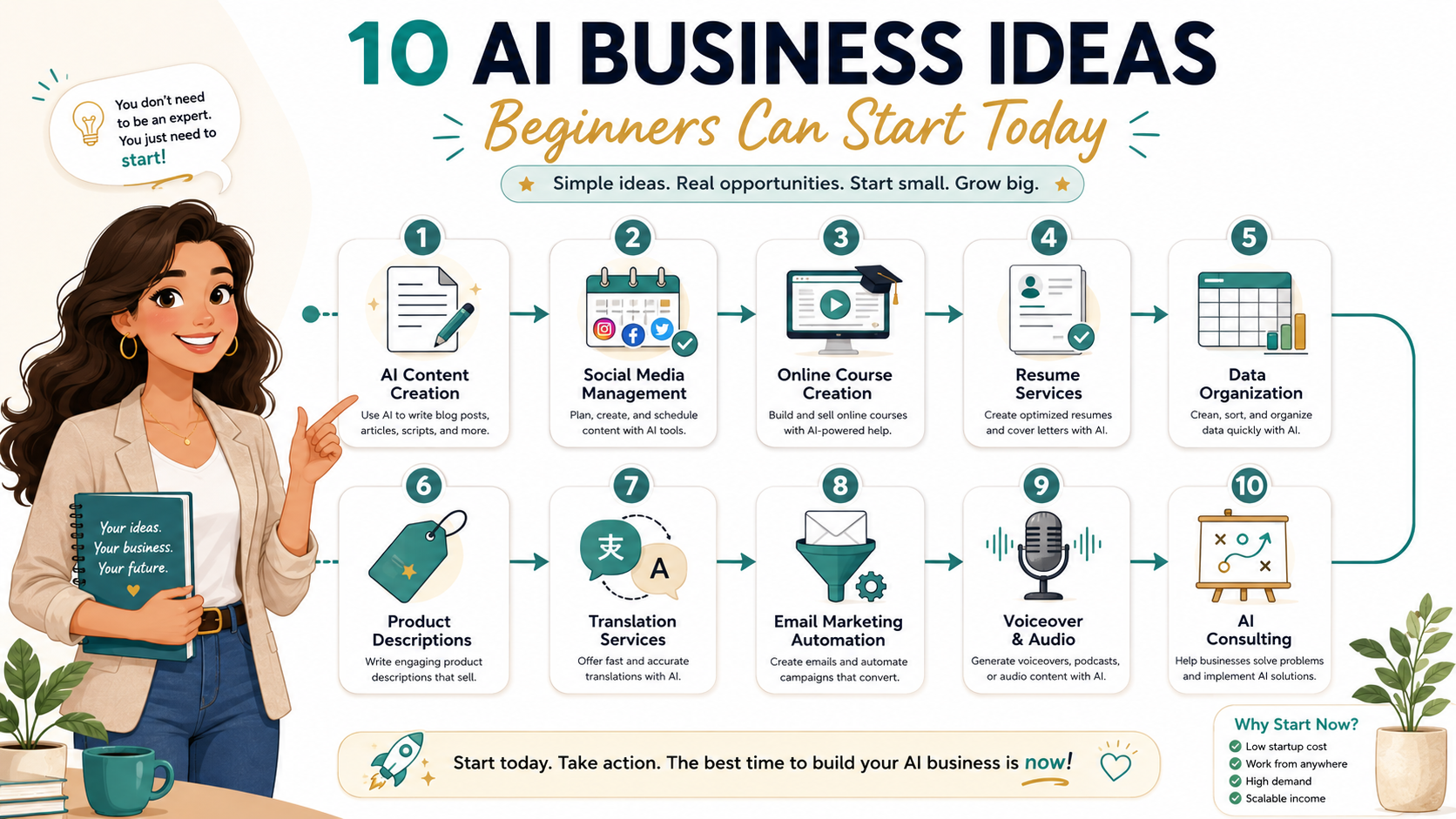
I often get asked what the easiest AI business ideas are for someone with no technical background. My answer is always the same: start with what you already know. If you have experience in marketing, use AI to enhance marketing services. If you are a writer, use AI to produce content faster. The technology is a multiplier, not a replacement for your existing skills. Let me break down ten specific ideas that are beginner-friendly.
First, consider AI-powered content creation services. Many businesses need blog posts, social media captions, and email newsletters. They struggle to produce enough content consistently. You can use tools like Jasper or Copy.ai to generate drafts quickly. Then you edit and refine them to match the client’s voice. This is one of the most accessible online income streams because the tools are cheap and the demand is high.
Second, you can offer AI-driven social media management. Platforms like Hootsuite and Buffer now have AI features for scheduling and analytics. But you can go deeper. Use AI to analyse engagement patterns and suggest content topics. You can automate replies to common questions using chatbots. Businesses love this because it saves them hours each week. I have seen freelancers charge over a thousand dollars per month for this service.
Third, try AI-assisted online course creation. You can use AI to outline courses, generate quiz questions, and even create video scripts. Platforms like Systeme.io and Thinkific make it easy to host your content. The AI handles the heavy lifting of research and structuring. You focus on your expertise and recording the material. This is a fantastic way to build passive income over time.
Fourth, consider an AI-based resume and job application service. Many job seekers struggle to tailor their resumes for each application. You can use AI to analyse job descriptions and rewrite resumes to match keywords. This is a pain point that people will pay to solve. I have seen services charging fifty to one hundred dollars per resume review.
Fifth, look into AI-powered data entry and organization. Small businesses often have messy spreadsheets and scattered records. You can use AI tools to clean, categorize, and analyse their data. This is not glamorous work, but it pays well. Businesses value accuracy and efficiency. You can charge by the hour or by the project.
Sixth, offer AI-generated product descriptions for e-commerce stores. Online sellers need hundreds of unique descriptions for their inventory. Writing them manually is tedious. AI can generate compelling descriptions in seconds. You can offer a package of fifty descriptions for a flat fee. I have seen this become a recurring revenue stream for many freelancers.
Seventh, start an AI-powered translation service. While machine translation is not perfect, it is good enough for many use cases. You can use tools like DeepL or Google Translate API to handle the bulk of the work. Then you review and polish the output. This allows you to offer faster turnaround times than traditional translators.
Eighth, consider AI-driven email marketing automation. Businesses need to send personalized emails to their subscribers. AI can segment audiences, write subject lines, and optimize send times. You can set up these systems using platforms like Mailchimp, Kit or Aweber. Clients will pay for increased open rates and conversions.
Ninth, try AI-based voiceover and audio production. Tools like ElevenLabs and Murf allow you to generate realistic voiceovers from text. You can create audiobooks, podcast intros, or video narrations. This is a growing market as more people consume audio content. You do not need a recording studio or a professional voice actor.
Tenth, offer AI consulting and strategy services. This is for those who want to work at a higher level. You help businesses identify where AI can improve their operations. You recommend tools and workflows. This requires more knowledge, but it also commands higher fees. I suggest starting with one of the other ideas first to build experience.
AI-Powered Online Income Streams
I want to shift focus to the specific online income streams you can build using AI. These are not just theoretical concepts. I have personally tested several of these models, and I know they work. The key is to treat them like real businesses, not side hobbies. You need a system for acquiring clients, delivering value, and collecting payments. Let me walk you through the most reliable streams I have found.
The first stream is service-based income. You do the work for clients on a recurring basis. This is the fastest way to generate cash flow. For example, you can offer monthly content packages. You commit to delivering ten blog posts or twenty social media posts each month. The client pays a flat fee. Your cost is the AI tool subscription and your time. The margins can be excellent. I have seen profit margins of seventy percent or higher on these services.
The second stream is productized services. This is a step up from custom services. You create a standardized offer with a fixed price and scope. For instance, you might offer a “Website Copy Audit” for two hundred dollars. You use AI to analyse the existing copy and generate recommendations. The client knows exactly what they get. This makes it easier to market and sell. You can also scale by creating multiple productized offers.
The third stream is digital products. You create templates, guides, or software tools that leverage AI. For example, you could build a set of AI prompts for generating marketing ideas. Sell it as a downloadable PDF. Or you could create a simple web app that uses an AI API to generate something useful. Digital products have high margins because you create them once and sell them many times. This is a powerful way to build passive income.
The fourth stream is affiliate marketing combined with AI. You can review AI tools on your blog or YouTube channel. When someone buys through your link, you earn a commission. Many AI tool companies have generous affiliate programs. I have seen affiliates earning thousands per month by creating honest, helpful reviews. The trick is to build an audience that trusts your recommendations.
The fifth stream is coaching and consulting. Once you master an AI tool or workflow, you can teach others. You can offer one-on-one coaching sessions or group programs. You can also create a paid community where members get ongoing support. This is a high-ticket income stream. People will pay hundreds or thousands of dollars to learn from someone who has already done it.
I want to emphasize that you do not need to choose just one stream. Many successful entrepreneurs combine multiple streams. For example, you might offer a service while also selling a digital product. The service provides steady cash flow, and the product builds long-term wealth. This diversification reduces risk and increases your overall income potential.
How to Choose the Right Income Stream for You
Choosing the right income stream depends on your personality and goals. I always advise people to start with a service if they need quick money. Services have the shortest time to first sale. You can find clients on freelancing platforms or through your network. If you prefer to build something more scalable, start with a digital product. Just be prepared for a longer ramp-up time. You need to create the product and then market it consistently.
Another factor is your risk tolerance. Services have lower upfront costs but require your time. Digital products require more upfront effort but can generate passive income. I recommend starting small. Pick one stream and master it before adding others. This focused approach will give you the best chance of success.
Step-by-Step Guide to Starting an AI Business
I know that knowing what to do is different from knowing how to do it. That is why I have created a clear, step-by-step guide for starting your AI business. Follow these steps in order, and you will avoid common pitfalls. I have used this framework myself and taught it to hundreds of students.
Step one is to identify your niche. Do not try to serve everyone. Pick a specific industry or problem. For example, instead of offering general copywriting, focus on copywriting for real estate agents. This makes your marketing more effective. You can speak directly to their pain points. I suggest making a list of three to five niches and then researching the demand for each.
Step two is to validate your idea. Before you invest time and money, make sure people will pay for your solution. You can do this by talking to potential customers. Ask them about their current struggles and what they have tried. You can also create a simple landing page and see if people sign up for a waitlist. Do not skip this step. I have seen too many people build something nobody wants.
Step three is to choose your AI tools. As a beginner, you want tools that are easy to use and affordable. I will cover specific recommendations in the next section. For now, focus on finding one or two tools that match your niche. Do not get overwhelmed by the options. Start simple and upgrade as you grow.
Step four is to set up your delivery system. How will you deliver your service or product to customers? If you are offering a service, you need a way to communicate with clients and share files. If you are selling a digital product, you need a platform like Gumroad or Payhip. Set up your systems before you start marketing. This ensures a smooth customer experience.
Step five is to create your offer. This includes your pricing, package details, and guarantees. I recommend starting with a low price to get your first few clients. Then you can raise prices as you gain testimonials and experience. Your offer should clearly state what the customer gets and what it costs. Avoid vague language.
Step six is to market your business. This is where most people struggle. You need to get in front of your target audience. You can use social media, content marketing, or paid advertising. I suggest starting with organic methods like posting valuable content on LinkedIn or Twitter. Build relationships before you ask for the sale. This approach takes longer but builds trust.
Step seven is to deliver exceptional work. Your first clients are your most valuable asset. They will provide testimonials and referrals. Go above and beyond their expectations. Ask for feedback and improve your process. Happy clients are the best marketing you can get.
Step eight is to iterate and scale. Once you have a working system, look for ways to grow. You can raise prices, add new services, or hire help. I recommend tracking your key metrics like customer acquisition cost and lifetime value. Use this data to make informed decisions.
Essential AI Tools for Entrepreneurs
I want to share the specific AI tools that I use and recommend for beginners. These tools are the building blocks of your new business. I have tested dozens of platforms, and these are the ones that deliver consistent results. You do not need to use all of them. Pick the ones that fit your chosen niche.
For content creation, tools like ChatGPT and Gemini are excellent starting points, depending on how you like to work. ChatGPT is strong at brainstorming, outlining, rewriting, creating blog posts, email sequences, product descriptions, and adapting tone, making it very useful when you want polished, structured content quickly. Its weakness is that you still need to check facts, add your own voice, and guide it with clear prompts. Gemini is also helpful for content creation, especially when you want quick research support, idea generation, summaries, and integration with Google-style workflows. Its weakness is that the writing can sometimes feel more general or less emotionally polished, so it may need extra editing for personality and persuasion. Both tools can save hours, but the best results come when you use them as creative assistants rather than relying on them to do everything for you.
For image generation, tools like Midjourney and ChatGPT’s image creation features are both excellent options, depending on what you need. Midjourney is known for producing stunning, artistic, highly polished visuals, making it ideal for social media graphics, blog featured images, product mock-ups, and creative brand visuals. Its weakness is that it can take more practice to control exact details, especially if you need precise text or very specific layout changes. ChatGPT’s newer image creation tools have become much stronger at following detailed prompts, creating usable marketing visuals, editing images, working from uploaded references, and producing clearer text inside images. This makes it especially useful for entrepreneurs who want to create blog covers, infographics, social posts, and branded visuals in one place. Its weakness is that some images may still need small corrections, especially for fine details, hands, or complex text-heavy designs. Both tools can save a huge amount of time, but the best results come when you use clear prompts and review the final image before publishing.
For data analysis and automation, I recommend OpenAI’s API. This is more technical, but it is incredibly powerful. You can build custom tools that analyse data, generate reports, or automate tasks. Many no-code platforms now integrate with the API, making it accessible to non-developers. I have seen entrepreneurs use it to create chatbots, data dashboards, and personalized recommendation engines.
For video and audio, I use ElevenLabs for voice generation and Descript for video editing. ElevenLabs can create realistic voiceovers in multiple languages. Descript allows you to edit video by editing the text transcript. This saves hours of manual editing. Both tools are essential for anyone creating video content or podcasts.
For business operations, I rely on Notion AI. It integrates with your project management system and helps you write, summarize, and brainstorm. It is like having an assistant that knows your entire workflow. I use it to draft emails, create meeting agendas, and organize my ideas. It is a small investment that pays huge dividends in productivity.
I also want to mention Zapier. While not strictly an AI tool, it connects your AI tools with other apps. You can automate workflows like sending new leads to your CRM or posting content to social media. This saves you time and ensures nothing falls through the cracks. I consider it essential for building a scalable business system. For more advanced users you can use your current AI tools and vibe code with the new capabilities to do these functions.
How to Evaluate AI Tools
When evaluating AI tools, I look for three things: ease of use, output quality, and pricing. Ease of use is critical for beginners. If the tool has a steep learning curve, you will waste time. Look for tools with intuitive interfaces and good documentation. Output quality matters because your clients expect professional results. Always test the tool with your specific use case before committing. Pricing should be transparent and fit your budget. Many tools offer free tiers or trials, which I recommend using to compare options.
I also suggest reading reviews from other entrepreneurs. Look for feedback on customer support and reliability. The last thing you want is a tool that goes down when you have a client deadline. Choose established tools with a track record of uptime and updates. This will save you headaches down the road.
Building a Successful AI Business System
I have learned that a successful AI business is not just about the technology. It is about the system you build around it. You need processes for client acquisition, delivery, and support. Without a system, you will burn out. I have seen it happen to many talented entrepreneurs. They focus all their energy on the creative work and neglect the operational side. Then they wonder why they are exhausted.
The first component of a good system is client acquisition. You need a repeatable way to find and attract clients. This could be content marketing, paid ads, or partnerships. I recommend documenting your process so you can refine it over time. Track where your best clients come from and double down on those channels. For example, if you get most of your clients from LinkedIn, invest more time there.
The second component is delivery. You need a standardized workflow for completing client work. This reduces errors and ensures consistent quality. I use a project management tool like Trello or Asana to track every step. I also create templates for common deliverables. This allows me to work faster without sacrificing quality. Your delivery system should be documented so you can train someone else to do the work.
The third component is customer support. Clients will have questions and issues. You need a system for handling them promptly. I use a combination of email and a knowledge base. I answer common questions with pre-written responses. For complex issues, I schedule a call. Good support leads to repeat business and referrals. Do not neglect this aspect of your business.
The fourth component is financial management. You need to track your income, expenses, and taxes. I use accounting software like FreshBooks or QuickBooks. I set aside a percentage of every payment for taxes. I also review my finances monthly to ensure I am profitable. Many beginners ignore this and end up in trouble. Treat your business like a business from day one.
The fifth component is continuous learning. The AI landscape changes rapidly. New tools and techniques emerge constantly. I dedicate time each week to learning. I read blogs, watch tutorials, and take courses. This keeps my skills relevant and my services competitive. I recommend joining communities where you can learn from others. I will discuss this more in the next section.
Don’t miss our AI & Business Membership training
Automating Your Business System
Once you have your system in place, you can start automating parts of it. This is where AI really shines. You can use tools to automate client onboarding, invoicing, and follow-ups. For example, you can set up an email sequence that welcomes new clients and collects necessary information. You can use AI to generate initial drafts of deliverables, which you then refine. Automation frees up your time to focus on high-value activities like strategy and client relationships.
I recommend starting with one automation at a time. Do not try to automate everything at once. Pick a repetitive task that takes up a lot of your time. Find a tool or workflow to automate it. Test it thoroughly before moving on. Over time, you will build a business that runs smoothly with minimal manual effort. This is the ultimate goal for any entrepreneur.
Join our Opportunity Lab Community for guidance, tools, and support
Community Support in AI Business Ventures
I cannot overstate the importance of community support when starting an AI business. This journey can be lonely. You will face challenges and setbacks. Having a group of like-minded people to share ideas with makes a huge difference. I have been part of several communities, and they have been instrumental in my growth. You can learn from others’ mistakes, get feedback on your ideas, and find collaboration opportunities.
There are many online communities focused on AI entrepreneurship. Facebook groups, Discord servers, and Slack channels are great places to start. Look for communities that are active and moderated. Avoid groups that are full of spam and self-promotion. You want a space where people genuinely help each other. I recommend joining one or two communities and being an active participant. Ask questions, share your wins, and offer help to others.
Join our Opportunity Lab Community for guidance, tools, and support
Community Support in AI Business Ventures
Another option is to find a mentor or coach. This can accelerate your learning because you are not trying to figure everything out alone. A good mentor can help you choose the right business idea, avoid common mistakes, and focus on the actions that actually move you forward.
You do not need someone who knows everything about AI. You need someone who understands how to turn ideas into simple business systems. That could be a coach, a course creator, a community leader, or even a fellow entrepreneur who is a few steps ahead of you.
Community support is especially helpful when you are just starting. It gives you a place to ask questions, test ideas, and get feedback before you spend too much time or money. It also keeps you accountable. When you are building alone, it is easy to get distracted or give up when things feel confusing. When you are surrounded by people working toward similar goals, it becomes easier to stay consistent.
I recommend choosing a community that focuses on practical action, not just theory. Look for a space where members share real examples, simple tools, beginner-friendly tutorials, and honest lessons from what they are trying. You want encouragement, but you also want useful guidance.
AI business ventures move quickly, and nobody has all the answers. That is why being part of a learning community can be such an advantage. You get exposed to new ideas, new tools, and new opportunities before they become mainstream. You also learn from other people’s experiments, which can save you months of trial and error.
If you are serious about starting an AI business, do not try to do it in isolation. Find a small group, join a useful membership, follow a trusted mentor, or connect with other beginners who are building alongside you. The right support can make the journey feel much less overwhelming.
Join our Opportunity Lab Community for guidance, tools, and support
Conclusion
Starting an AI business today does not require a technical background, a huge budget, or a complicated plan. You only need one clear idea, one specific audience, and one simple way to use AI to solve a real problem.
The ten ideas in this article give you several possible starting points. You could offer AI-powered content creation, manage social media, create online courses, help with resumes, organize business data, write product descriptions, provide translation support, set up email automation, create voiceovers, or offer AI consulting.
The best choice is the one that fits your current skills, interests, and goals. If you enjoy writing, start with content creation or email marketing. If you enjoy teaching, consider online courses or consulting. If you like systems and organization, data cleanup or automation may be a better fit.
Do not try to start all ten ideas at once. Pick one. Test it. Learn from the response. Improve your offer. Then build from there.
AI is not a magic shortcut, but it is a powerful tool. It can help you work faster, create better systems, serve clients more effectively, and build income streams that were much harder to create in the past.
The opportunity is real, but action is what makes it work. Start small, keep it simple, and take the first step today.
Get our FREE resource – 60-minute List Builder
To see the full system:
 Read:
Read:
Systeme.io Review: All-in-One Business Platform
How to Start and Grow an Online Business Using AI
A Comprehensive Guide to Implementing AI-Powered Online Business Models
5 Easy AI Business Models for New Entrepreneurs
📅 Last updated:
