
A Beginner’s Guide to Implementing AI for Business Growth: AI Business Strategies Unveiled
Are you curious about how artificial intelligence can boost your business but don’t know where to start? You’re not alone. Many beginners find the world of AI business strategies overwhelming at first glance. This guide is designed to walk you through the essentials of implementing AI for business growth in a friendly, straightforward way. By the end, you’ll have a solid foundation to begin leveraging AI tools and techniques that can transform your business operations, marketing efforts, and customer engagement. Let’s dive into the exciting potential AI holds for your business journey.
The best way to start with AI is not to transform your whole business overnight. Start with one clear problem, one simple tool, and one measurable result. Once that works, you can build the next layer.

Understanding AI Business Strategies
To effectively implement AI for business growth, it’s crucial to grasp what AI business strategies really mean. At its core, AI business strategies involve integrating artificial intelligence technologies into various business processes to enhance efficiency, innovation, and decision-making. These strategies aren’t just about adopting flashy tools; they’re about aligning AI capabilities with your business goals.
Artificial intelligence encompasses a range of technologies such as machine learning, natural language processing, computer vision, and robotics. Each of these can serve different purposes depending on your industry and objectives. For example, machine learning can help analyze customer data to predict buying patterns, while natural language processing can automate customer service through chatbots.
One key aspect of AI business strategies is understanding the problem you’re trying to solve. Are you aiming to improve customer experience, streamline supply chain management, or optimize marketing campaigns? Defining clear goals helps tailor AI applications effectively, rather than just experimenting blindly.
Consider the example of Amazon. Their AI-powered recommendation engine accounts for a significant portion of their sales. This technology analyzes browsing history, purchase behavior, and even product ratings to suggest items customers might like. This strategic use of AI boosts customer satisfaction and revenue simultaneously.
Another important element is the data your business collects. AI thrives on quality data. Without accurate, relevant data, AI models can’t deliver meaningful insights. So, preparing your data infrastructure is often the first step in your AI journey.
To summarize, AI business strategies are about leveraging AI technologies in a purposeful way to meet business goals. They require a deep understanding of both your business needs and the AI tools available. With this foundation, you can begin to explore how AI can truly drive growth.
Benefits of Implementing AI for Beginners
For those new to AI, the benefits of implementing AI business strategies can seem abstract at first. However, the advantages quickly become clear once you see how AI can transform everyday business operations.
One of the most immediate benefits is automation. AI can handle repetitive tasks such as data entry, scheduling, and even customer inquiries. This frees up your team to focus on higher-value activities like creative problem-solving and strategic planning. For example, AI chatbots can respond instantly to customer questions 24/7, improving service without extra staffing costs.
Another major advantage is improved decision-making. AI systems analyze vast amounts of data faster and more accurately than humans. This means you can gain actionable insights about market trends, customer preferences, and operational inefficiencies. Research from McKinsey has shown that companies using AI often report productivity and efficiency gains, especially when AI is connected to clear business goals and strong data practices.
AI also enhances personalization, which is crucial for marketing and customer retention. By analyzing user behavior, AI can tailor offers, content, and product recommendations to individual preferences. This personalized approach often leads to higher engagement and sales conversion rates.
Cost reduction is another compelling benefit. AI can optimize inventory management, forecast demand more accurately, and reduce waste. For example, AI algorithms can predict when certain products will sell out or become obsolete, helping businesses manage stock smartly.
Lastly, implementing AI can give your business a competitive edge. Early adopters often enjoy a first-mover advantage by offering more innovative services and improving operational efficiency ahead of rivals.
For beginners, these benefits mean AI is not just a futuristic concept but a practical tool that can impact your bottom line positively. The key is to start small, focusing on areas where AI can quickly deliver value.
Step-by-Step Guide to Integrate AI in Business
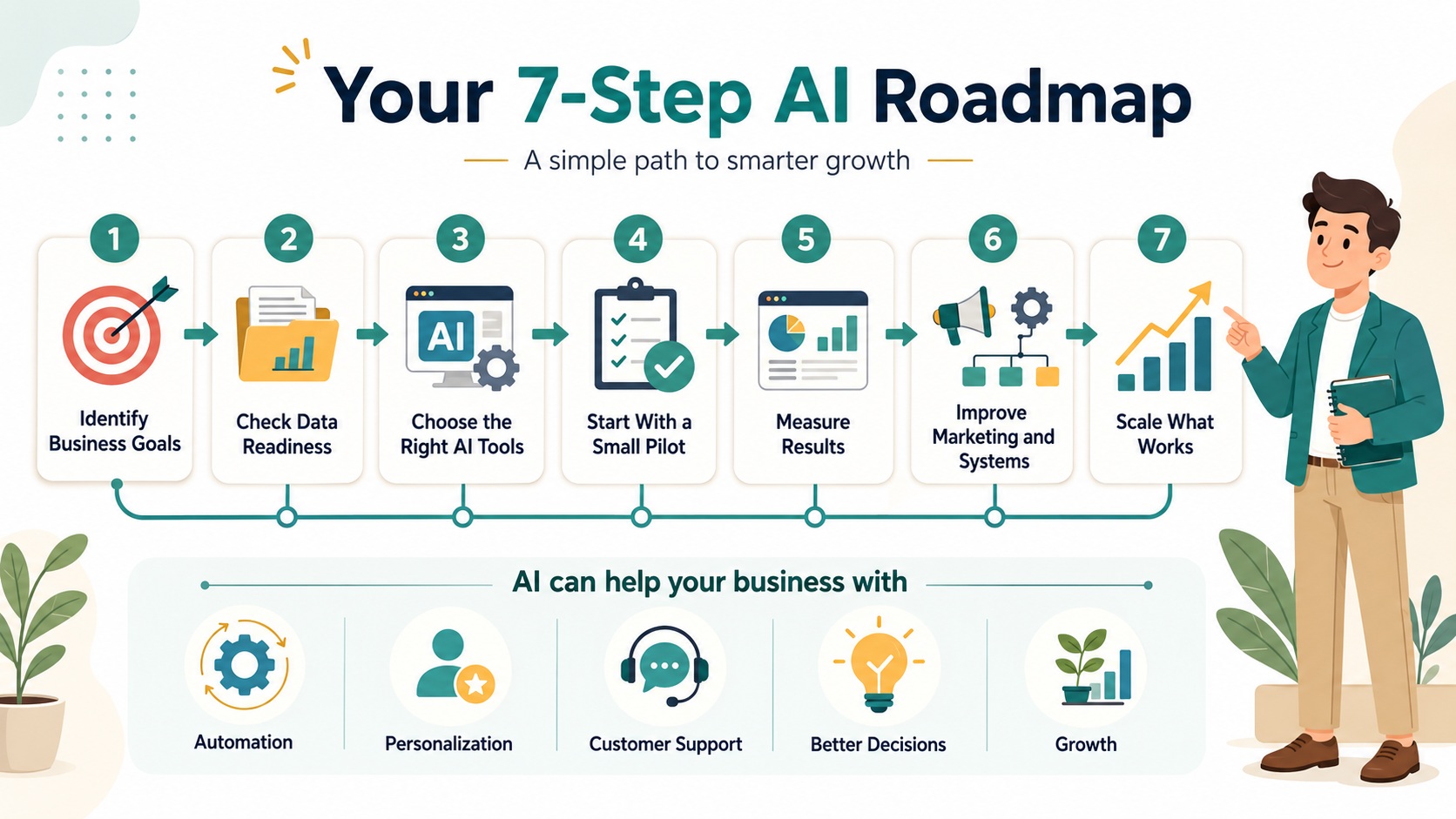
Implementing AI business strategies may seem daunting initially, but breaking it down into manageable steps can make the process smoother. Here is a step-by-step guide tailored for beginners to effectively integrate AI for business growth.
1. Identify Business Challenges and Goals
Start by pinpointing specific challenges or opportunities within your business where AI could add value. For instance, are you struggling with customer churn, inefficient workflows, or low conversion rates? Defining clear, measurable goals will guide your AI approach and help evaluate success later.
2. Assess Your Data Readiness
AI depends heavily on data quality and availability. Audit your existing data sources to determine if they are sufficient and reliable. You may need to clean, organize, or collect additional data. For example, CRM systems, website analytics, and sales records can be valuable data reservoirs.
3. Choose the Right AI Tools
There’s a plethora of AI tools designed for different business needs. Beginners should look for user-friendly platforms that match their goals. For example, AI-powered marketing platforms like HubSpot or Salesforce Einstein can help automate customer engagement, while tools like Google Cloud AI provide accessible machine learning capabilities.
4. Develop or Source AI Expertise
Depending on your resources, you can either hire AI specialists, train existing staff, or partner with external vendors. For beginners, working with consultants or using no-code AI platforms can be practical options to start without significant technical hurdles.
5. Pilot AI Projects
Before a full rollout, conduct small-scale pilots to test AI applications. This minimizes risk and provides insights into effectiveness. For example, try using an AI chatbot for customer service on a limited basis and gather feedback.
Example first AI project: set up a chatbot to answer your five most common customer questions. Measure how many questions it answers, how much time it saves, and whether customers still feel supported. If it works, improve the answers and then expand the chatbot slowly.
6. Analyze and Optimize
Monitor the pilot’s performance using relevant metrics. Identify what works and what doesn’t, then refine your approach. Continuous improvement is vital for maximizing AI’s impact.
7. Scale AI Implementation
Once confident in your AI strategy, gradually expand its use across other business areas. Maintain flexibility to adapt as technology evolves and business needs change.
Following these steps ensures a structured, low-risk path to integrating AI. It also aligns your AI initiatives with actual business objectives, increasing the chances of sustained growth.
AI Tools and Resources for Beginners
Choosing the right AI tools is a critical part of implementing AI business strategies. Fortunately, many beginner-friendly options exist that don’t require deep technical knowledge but still offer powerful functionality.
AI for Marketing Automation
Tools like HubSpot and Salesforge provide AI-powered marketing automation. They can segment customers, personalize emails, and optimize campaign timing based on behavioral data. These platforms often include intuitive dashboards for easy monitoring.
Customer Service AI
AI chatbots and virtual assistants such as IBM Watson Assistant enable 24/7 customer support. They handle common inquiries, freeing human agents to manage complex issues. Advanced chatbots can even learn from interactions and improve over time.
Data Analysis and Visualization
Tools like Tableau and Microsoft Power BI incorporate AI features to uncover trends and generate predictive insights. These platforms allow businesses to make data-driven decisions without needing to build custom AI models.
Machine Learning Platforms
For those interested in deeper AI applications, platforms such as Google Cloud AI and Microsoft Azure Machine Learning provide scalable environments for developing custom models. While more technical, they offer extensive documentation and community support for beginners willing to learn.
Educational Resources
Several free or affordable courses help beginners understand AI fundamentals and practical implementation. Websites like Coursera and edX offer relevant courses taught by top universities. These resources empower business owners and teams to build AI literacy and confidence.
By leveraging these tools and resources, beginners can start implementing AI business strategies with minimal technical barriers. The key is to select solutions aligned with your specific goals and scale up as your understanding grows.
Strategy First, Tool Second
One of the biggest mistakes beginners make is starting with the tool. They hear about ChatGPT, HubSpot, Salesforce Einstein, or Google Cloud AI and immediately wonder which one they should use. A better question is: what business problem am I trying to solve? Once you know the goal, the right tool becomes much easier to choose.
Measuring Success: Metrics for AI Business Strategies
Tracking the performance of your AI initiatives is essential to determine their value and guide future investment. Without clear metrics, it’s difficult to know if your AI business strategies are driving growth or need adjustment.
Key Performance Indicators (KPIs) to Consider
Here are some common KPIs that can help you measure AI success:
- Return on Investment (ROI): Calculate the financial gains relative to the costs of AI implementation. Positive ROI indicates effective use of resources.
- Customer Satisfaction Scores: Metrics like Net Promoter Score (NPS) can reflect improvements in customer experience due to AI-driven personalization or support.
- Operational Efficiency: Measure reductions in process time, error rates, or manual labor hours after AI adoption.
- Sales Conversion Rates: Track changes in the percentage of leads turning into customers, especially if AI is used in marketing or sales.
- Engagement Metrics: Analyze website visits, click-through rates, and content interactions influenced by AI-powered recommendations.
Using Analytics to Gain Insights
Many AI tools provide built-in analytics dashboards that visualize these KPIs in real time. Regularly reviewing these reports helps identify trends and areas for improvement. For example, if chatbot response times are improving but customer satisfaction is stagnant, you might explore enhancing chatbot conversational abilities or integrating human support more seamlessly.
Benchmarking and Continuous Improvement
Compare your metrics against industry benchmarks or past performance to contextualize results. AI implementation is an ongoing journey, and success often comes from iterative refinement rather than one-time deployment.
For instance, a retail company might initially see a 10% boost in online sales after introducing AI recommendations. Over time, by tweaking algorithms and expanding AI use, they could increase that gain to 25%. Monitoring these changes quantitatively ensures your AI business strategies remain aligned with growth objectives.
Ultimately, measuring success is about choosing the right metrics for your unique business context and using data-driven insights to continuously optimize AI applications.
Integrating AI into Business Marketing Strategies
Marketing is one of the most dynamic areas where AI business strategies can make a significant impact. AI enhances how businesses target customers, personalize messaging, and optimize campaigns.
AI-powered marketing platforms analyze large datasets from social media, email campaigns, and website interactions to identify patterns and preferences. For example, AI can segment your audience based on behavior, allowing for more precise targeting. This means your ads and content reach the right people at the right time.
Personalization is another gamechanger. AI algorithms tailor product recommendations and email content to individual preferences. Spotify, for example, uses AI to curate personalized playlists, increasing user engagement and retention. Similarly, e-commerce businesses use AI to show relevant products, boosting conversion rates.
Programmatic advertising uses AI to automate ad buying based on real-time data, improving efficiency and ROI. Platforms like Google Ads employ machine learning to optimize bids and placements dynamically. This reduces manual work and ensures your budget is spent effectively.
Additionally, AI can predict trends and customer lifetime value, helping marketers allocate resources wisely. Predictive analytics might reveal that certain customer segments have high churn risk, prompting targeted retention campaigns.
By integrating AI into your marketing strategies, you can deliver more relevant experiences, improve campaign performance, and ultimately accelerate business growth.
Optimizing Business Systems with AI
Beyond marketing, AI business strategies extend to optimizing internal systems and processes. AI can streamline operations, reduce errors, and enhance productivity across departments.
In supply chain management, AI predicts demand, optimizes inventory levels, and identifies potential disruptions. For example, AI models can forecast seasonal sales fluctuations, enabling businesses to stock appropriately and avoid overstocking or stockouts. This improves cash flow and customer satisfaction.
Human resources also benefit from AI. Recruiting platforms use AI to screen resumes and identify top candidates faster. AI-driven employee engagement tools analyze feedback to improve workplace culture and retention.
Finance teams leverage AI for fraud detection, automated bookkeeping, and financial forecasting. Machine learning algorithms can spot unusual transactions quickly, reducing risk. AI-powered forecasting helps businesses plan budgets and investments more accurately.
Customer service systems become more efficient with AI chatbots and automated ticketing. These technologies reduce response times and increase resolution rates.
Overall, AI optimizes business systems by automating routine tasks, enhancing decision-making, and improving resource allocation. This holistic approach supports sustainable growth and competitiveness.
Common Challenges Beginners Face When Implementing AI
While AI business strategies offer exciting opportunities, beginners often encounter challenges during implementation. Being aware of these obstacles helps prepare and overcome them effectively.
Data Quality and Availability
Many startups and small businesses lack clean, comprehensive data. Poor data quality leads to inaccurate AI insights. Investing time in data collection, cleaning, and management is essential before deploying AI tools.
Technical Complexity
AI technologies can be complex and intimidating. Beginners might struggle with selecting the right tools or understanding technical requirements. Partnering with experts or using no-code solutions can alleviate this challenge.
Cost Constraints
Implementing AI can involve upfront costs for software, hardware, and talent. It’s important to start with affordable pilots and scale gradually to avoid overextending resources.
Change Management
Introducing AI often requires changes in workflows and employee roles. Resistance to change can slow adoption. Clear communication about AI’s benefits and training initiatives help ease transitions.
Ethical and Privacy Concerns
Businesses must ensure AI complies with data privacy laws and ethical standards. Misuse of data or biased algorithms can damage reputation and lead to legal issues.
Understanding these challenges allows beginners to plan proactively. With thoughtful preparation, the hurdles become manageable stepping stones toward successful AI integration.
- Do not upload sensitive customer data into tools you do not understand.
- Review AI-generated content before publishing.
- Be transparent when customers are interacting with AI.
- Watch for biased or inaccurate outputs.
- Keep a human review step for important decisions.
Future Trends in AI Business Strategies
AI continues to evolve rapidly, shaping new possibilities for business growth. Staying informed about emerging trends can help beginners anticipate changes and position their companies advantageously.
One major trend is the rise of generative AI, which can create content, designs, and even code. Tools like ChatGPT and DALL·E demonstrate how AI can assist in creative processes, opening new marketing and product development opportunities.
Edge AI is another development where AI processing happens locally on devices rather than centralized servers. This reduces latency and enhances data privacy, enabling real-time decision-making in areas like manufacturing and IoT.
Explainable AI is gaining importance, focusing on making AI decisions transparent and understandable. This helps build trust with stakeholders and ensures compliance with regulations.
AI democratization is making sophisticated AI accessible to smaller businesses through no-code platforms and cloud services. This levels the playing field and accelerates AI adoption across industries.
Lastly, AI-human collaboration is emerging as a key theme. Rather than replacing humans, AI augments human capabilities, enabling smarter, faster decisions.
Keeping an eye on these trends will help your AI business strategies remain relevant and innovative.
Real-World Success Stories of AI Business Growth
Seeing how others have succeeded with AI can inspire and inform your own efforts. Here are a few real-world examples demonstrating the power of AI business strategies:
- Netflix: Uses AI algorithms to personalize content recommendations, resulting in higher viewer retention and subscription growth. Their system analyzes viewing habits and preferences continuously.
- Spotify: Leverages AI to create personalized playlists and music discovery features, increasing user satisfaction and time spent on the platform.
- Zara: Employs AI for inventory management and demand forecasting, reducing overstock and markdowns, thus improving profitability.
- A small online course creator could use AI to segment subscribers, send more relevant emails, summarize survey responses, and identify which lesson topics students ask about most.
These examples show that AI business strategies can be adapted to diverse industries and business models, always with impressive results.
Where Beginners Should Start With AI
If you are new to AI, do not start with a complicated system. Start with one area of your business where you feel the most pressure.
That could be:
- answering repeat customer questions
- writing emails or social posts
- organizing customer data
- summarizing feedback
- improving your content planning
- automating simple follow-ups
- tracking basic performance metrics
Choose one task that either saves time, improves customer experience, or helps you make better decisions.
Then test one AI tool.
Do not worry about building the perfect system. Your first goal is simply to prove that AI can help with one useful result.
Once you see what works, you can improve it, document the process, and apply the same thinking to another part of your business.
Conclusion
Implementing AI business strategies is a powerful way to accelerate growth, improve efficiency, and gain a competitive edge. This beginner’s guide has covered the fundamentals of understanding AI’s role in business, the benefits it brings, and practical steps to integrate AI effectively. We explored useful tools, how to measure success, and ways to optimize marketing and operations with AI. While challenges exist, they can be overcome with careful planning and the right resources.
By starting small, focusing on clear goals, and continuously refining your AI initiatives, you can unlock tremendous potential for your business. Remember, AI is not just a technology trend — it’s a strategic asset that, when used wisely, transforms businesses for the better.
Discover effective AI business strategies in this comprehensive beginner’s guide. Learn how to implement AI for business growth today by taking the first step with the insights shared here.
Visit our GPT, Prompt & Skills Site – The AI Knowledge Vault
To see the full system:
 Read:
Read:
Systeme.io Review: All-in-One Business Platform
AI Business Model – A Comprehensive Guide to Development
A Comprehensive Guide to Beginner AI Automation Tools
How to Develop AI-Powered Apps Without Coding Experience
Developing AI Apps Without Coding Knowledge Beginners Guide
📅 Last updated:
