
Maximizing Efficiency: A Guide to AI-Powered Process Automation
I remember the first time I realized how much time I was wasting on repetitive tasks. It hit me while I was through a mountain of customer service emails, each one asking the same basic questions. I thought there has to be a better way. That is when I discovered AI-powered process automation. This guide is my way of sharing everything I have learned since then, from the basics to advanced strategies. Whether you are a solopreneur or part of a larger team, you will find actionable steps to streamline your work. We will explore tools, metrics, and real-world examples to help you more efficient. Let us dive in and transform how you handle your daily processes.

Understanding AI-Powered Process Automation
AI-powered process automation combines artificial intelligence with automation to handle tasks smarter and faster. It is not just about setting up rules for repetitive actions. It is about using machine learning to adapt and improve over time. For example, a simple automation might forward emails to a folder. An AI-powered system can read those emails, understand their content, and route them to the right person. It can even draft responses based on past interactions. This technology learns from data, making it incredibly powerful for businesses of all sizes.
Many people confuse basic automation with AI-enhanced automation. Traditional automation follows predefined scripts. AI brings a layer of intelligence that allows for decision-making. Think of it like having a virtual assistant that gets better with experience. It can recognize patterns, predict outcomes, and handle exceptions without human intervention. This is crucial for scaling operations without increasing overhead. Industries from healthcare to retail are adopting these solutions to stay competitive.
One key aspect is natural language processing, or NLP. This allows AI to understand and generate human language. Chatbots are a common application. They can handle customer inquiries 24/7, providing instant support. Another is predictive analytics, where AI forecasts trends based on historical data. This helps in inventory management or sales forecasting. The combination of these technologies creates a seamless, efficient workflow that reduces errors and saves time.
Implementing AI-powered process automation does require an initial investment. However, the long-term benefits far outweigh the costs. It frees up your team to focus on strategic tasks. It also improves customer satisfaction through faster, more accurate responses. As AI continues to evolve, its capabilities will only expand. Staying informed and starting small can set you up for success. I have seen businesses transform their operations by embracing this technology early on.
Benefits of Implementing AI Tools for Business Automation
The benefits of AI-powered process automation are vast and impactful. First and foremost, it drastically reduces the time spent on mundane tasks. I have personally cut my administrative work by half using these tools. This allows me to concentrate on growth-oriented activities. For businesses, this means higher productivity without hiring more staff. Employees can shift from repetitive duties to creative problem-solving. This boosts morale and innovation within the team.
Cost savings are another significant advantage. Automating processes reduces operational expenses. You spend less on labor and minimize errors that lead to financial losses. For instance, in accounting, AI can automate invoice processing. It extracts data, matches it with purchase orders, and flags discrepancies. This not only speeds up the process but also enhances accuracy. Over time, these savings add up, improving your bottom line.
Customer experience gets a major upgrade with AI automation. Chatbots and virtual assistants provide instant support. They can handle common queries, schedule appointments, and even upsell products. This leads to higher customer satisfaction and loyalty. I have seen businesses reduce response times from hours to seconds. This level of service can set you apart from competitors. It also allows your human staff to handle more complex issues, adding value where it matters most.
Scalability becomes much easier with AI tools. As your business grows, manual processes often become bottlenecks. Automation handles increased volume effortlessly. You can serve more customers without compromising quality. Data-driven insights from AI also help in making informed decisions. For example, AI can analyze customer behavior to personalize marketing efforts. This targeted approach increases conversion rates and ROI. The flexibility of AI systems means they can adapt to changing business needs.
Real-World Example: E-commerce Automation
Consider an e-commerce store using AI for inventory management. The system predicts demand based on sales data, seasonality, and trends. It automatically reorders stock when levels are low. This prevents stockouts and overstocking. It also personalizes product recommendations for shoppers. This not only improves the shopping experience but also boosts sales. I have worked with stores that saw a 20% increase in revenue after implementing such systems.
Step-by-Step Guide to Automating Business Processes with AI
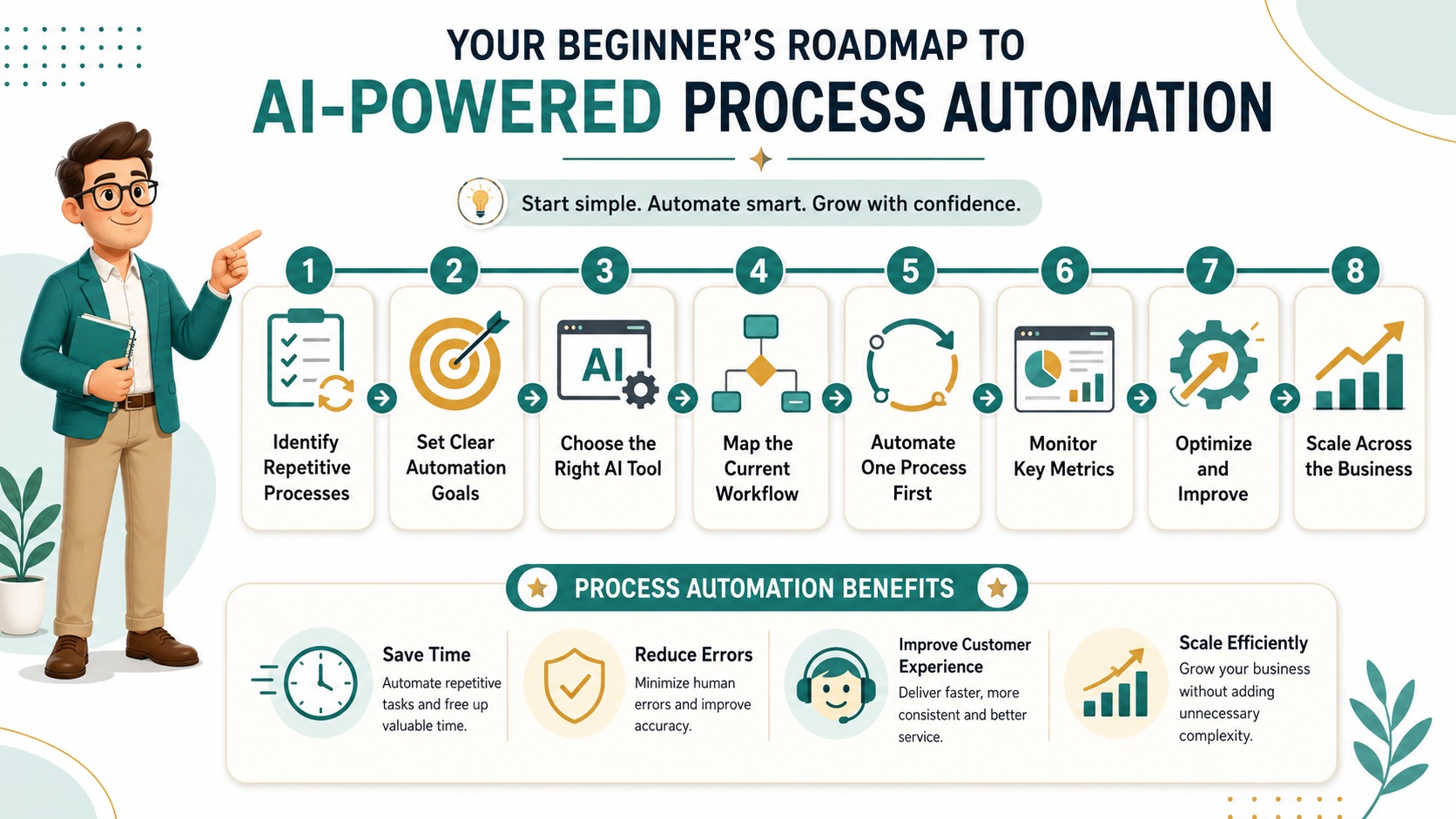
Starting with AI-powered process automation might seem daunting but breaking it down steps makes it manageable. First, identify the processes that are repetitive and time-consuming. Look for tasks that involve data entry, scheduling, or customer communication. These are prime candidates for automation. I began with my email management and saw immediate benefits. Document each step of the process to understand what can be automated.
Next, set clear objectives for what you want to achieve. Do you want to save time, reduce errors, or improve customer service? Having specific goals helps in choosing the right tools and measuring success. For example, if your goal is faster response times, focus on chatbot integration. If it is data accuracy, look into AI-driven data validation tools. I always recommend starting with one process to test and learn before scaling.
Choose an AI tool that fits your needs and budget. There are many options available, from all-in-one platforms to specialized software. Consider factors like ease of use, integration capabilities, and support. I have found that tools with drag-and-drop interfaces are great for beginners. Implement the tool in a controlled environment first. Train your team on how to use it and gather feedback. This ensures a smoother transition and higher adoption rates.
Monitor and optimize the automation continuously. AI systems learn from data, so the more you feed them, the better they perform. Track key metrics like time saved, error rates, and customer satisfaction. Use this data to tweak and improve the process. I review my automations monthly to identify areas for enhancement. This iterative approach ensures long-term success and maximizes ROI.
Example: Automating Social Media Posting
Let us say you want to automate social media updates. First, use a tool like Buffer or Hootsuite that offers AI scheduling. The AI can analyze when your audience is most active and schedule posts accordingly. It can also suggest content based on engagement data. This saves hours each week and increases reach. I have used this to maintain a consistent online presence without daily manual input.
Choosing the Right AI Tools for Your Business
Selecting the right AI tools is critical for successful automation. Start by assessing your specific needs. Different tools excel in different areas. For customer service, consider chatbots like Intercom or Drift. For marketing, platforms like HubSpot offer AI-driven analytics. I always look for tools that integrate well with my existing systems. This avoids data silos and ensures a smooth workflow.
Ease of use is another important factor. If a tool is too complex, your team might resist using it. Look for intuitive interfaces and good customer support. Many tools offer free trials, which I highly recommend taking advantage of. Test them with real tasks to see how they perform. Cost is also a consideration but remember that the cheapest option is not always the best. Weigh the features against the price to find value.
Scalability should not be overlooked. Choose tools that can grow with your business. Cloud-based solutions often offer flexible pricing plans. They can handle increased demand without requiring significant changes. Security features are equally important, especially if you are dealing with sensitive data. Ensure the tool complies with regulations like GDPR or HIPAA if applicable.
Read reviews and case studies to see how others have succeeded with the tool. Reach out to your network for recommendations. I have discovered some of my favorite tools through peer suggestions. Finally, consider the vendor’s reputation and update frequency. AI technology evolves rapidly, so you want a provider that continuously improves their product. This ensures your investment remains relevant and effective.
Top AI Tools to Explore
HubSpot Marketing Hub offers excellent AI features for automation. Zapier is great for connecting different apps without coding. IBM Watson provides advanced AI capabilities for larger enterprises. Each has strengths depending on your use case.
AI Automation Strategies for Beginners
If you are new to AI-powered process automation, start with simple strategies. Focus on low-risk, high-impact areas. Email automation is a great starting point. Set up rules to sort and prioritize incoming messages. Use templates for common responses to save time. I began by automating my newsletter sign-ups and saw engagement improve instantly. This builds confidence before tackling more complex processes.
Another beginner-friendly strategy is automating social media. Schedule posts in advance using AI tools that optimize timing. This ensures consistent content without daily effort. You can also use AI to curate content based on your audience’s interests. I have found this drives more traffic and engagement. Gradually, you can incorporate AI for analytics to refine your strategy.
Data entry automation is another area where beginners can excel. Tools like OCR (optical character recognition) can digitize paper documents. AI can then extract and organize the data into your systems. This reduces manual input and errors. I implemented this for invoice processing and cut processing time by 70%. Start with one type of document to keep it manageable.
Do not forget to educate yourself and your team. Take online courses or attend webinars on AI automation. Many platforms offer tutorials and communities for support. I joined a few forums where I learned tips and tricks from other users. This knowledge helps in avoiding common pitfalls. Remember, the goal is to enhance efficiency, not complicate things. Keep strategies simple and focused initially.
Measuring Success: Key Metrics in AI-Powered Process Automation
To ensure your AI-powered process automation is effective, you need to measure its impact. Start with time savings. Track how many hours are freed up for strategic work. For example, if a task used to take 10 hours weekly and now takes 2, that is an 80% improvement. I use time-tracking software to get accurate data. This metric directly ties to productivity gains.
Error reduction is another crucial metric. Compare error rates before and after automation. In data entry, this might mean fewer mismatches or duplicates. Lower errors lead to higher quality outcomes and customer satisfaction. I have seen error rates drop from 15% to under 2% with AI tools. This not only saves time on corrections but also enhances reliability.
Customer satisfaction scores can indicate success. Use surveys or net promoter scores to gauge feedback. If response times improve, satisfaction often follows. For instance, after implementing a chatbot, one of my clients saw their CSAT score jump by 30 points. This shows the direct impact on user experience. Monitor these scores regularly to ensure continuous improvement.
ROI is the ultimate measure of success. Calculate the cost savings from reduced labor and increased efficiency against the investment in tools. A positive ROI within a year is a good target. I also look at scalability metrics, like the ability to handle increased volume without added costs. These metrics help in justifying further investments in automation and refining strategies.
Leveraging AI & Business Memberships for Enhanced Automation
Business memberships and communities can amplify your AI automation efforts. Many membership platforms offer exclusive access to tools and resources. For example, some provide discounts on software or early beta access. I have joined several such groups and gained insights that are not publicly available. This can accelerate your learning and implementation.
Networking within these memberships is invaluable. You can connect with others who are implementing similar automations. Share experiences and learn from their successes and mistakes. I have collaborated on projects that would have been too complex alone. This collective knowledge helps in avoiding common issues and discovering new applications.
Training and workshops offered through memberships are another benefit. They often cover the latest trends and best practices in AI automation. Attending these keeps your skills sharp and your strategies current. I make it a point to participate in at least one workshop quarterly. This ensures I am always up to date with technological advancements.
Some memberships provide customized support for implementing AI tools. This can include one-on-one coaching or group sessions. Having expert guidance reduces the learning curve and maximizes effectiveness. I have used this to fine-tune my automations for better results. If you are serious about automation, investing in a relevant membership can be a gamechanger.
Building a Community: The Opportunity Lab’s Approach to AI Automation
The Opportunity Lab exemplifies how collective effort enhances AI automation. They focus on bringing together entrepreneurs and experts. Their community shares resources and tools for implementing AI strategies. I have been part of their events and found the collaborative environment inspiring. It is not just about individual success but lifting everyone together.
They emphasize education through webinars and hands-on sessions. Members learn to apply AI-powered process automation in real scenarios. This practical approach ensures that knowledge translates into action. I have adopted several techniques from their workshops that improved my efficiency. The support system helps in overcoming challenges quickly.
Networking within the lab leads to partnerships and innovations. By sharing data and insights, members develop more robust automation solutions. This community-driven model accelerates adoption and refinement of AI tools. I have seen startups scale rapidly thanks to these collaborations. It proves that together; we can achieve more than alone.
Their focus on ethical AI use is also noteworthy. They promote transparency and best practices to ensure automation benefits all stakeholders. This builds trust and sustainability. I appreciate their commitment to responsible innovation. If you are looking to deepen your AI automation journey, communities like The Opportunity Lab are worth exploring.
Future Trends in AI-Powered Process Automation
The future of AI-powered process automation is incredibly exciting. We are seeing more integration with IoT devices. This allows for automation in physical environments, like smart offices or factories. I predict this will become standard in the next few years. It will enable real-time monitoring and adjustments without human intervention.
AI will become more accessible to small businesses. Tools are already becoming cheaper and easier to use. This democratization will level the playing field. I expect to see more no-code platforms that allow anyone to build automations. This will spur innovation across industries. Staying updated on these trends will help you stay ahead.
Personalization will reach new heights with AI. Automation will tailor experiences to individual preferences on a large scale. For marketing, this means hyper-targeted campaigns that yield better results. I am experimenting with this now and seeing higher engagement rates. As AI algorithms improve, so will the accuracy of personalization.
Ethical considerations will play a larger role. As automation expands, ensuring fairness and privacy will be crucial. Regulations will evolve, and businesses must adapt. I advocate for proactive measures to address these issues. By focusing on ethical AI, we can build systems that benefit everyone.
Conclusion
AI-powered process automation is no longer a luxury but a necessity for efficient business operations. From understanding the basics to implementing advanced strategies, this guide covers essential steps. Start small, measure your success, and continuously optimize. The benefits in time savings, cost reduction, and improved customer experience are undeniable. Leverage communities and memberships to accelerate your journey. As technology evolves, staying informed will ensure you maximize its potential. Embrace these tools to transform your workflows and achieve sustainable growth.
Visit our GPT, Prompt & Skills Site – The Smart AI Vault
To see the full system:
 Read:
Read:
Systeme.io Review: All-in-One Business Platform
A Comprehensive Guide to Developing Your AI Business Model
A Comprehensive Guide to Implementing AI-Powered Online Business Models
5 Easy AI Business Models for New Entrepreneurs
AI business models for beginners – An Implementation Guide
Selecting the Ideal AI Business Model for Your Needs
AI Automation Techniques for Enhancing Your Side Business
Exploring Top AI Tools for Enhanced Business Automation
📅 Last updated:
