
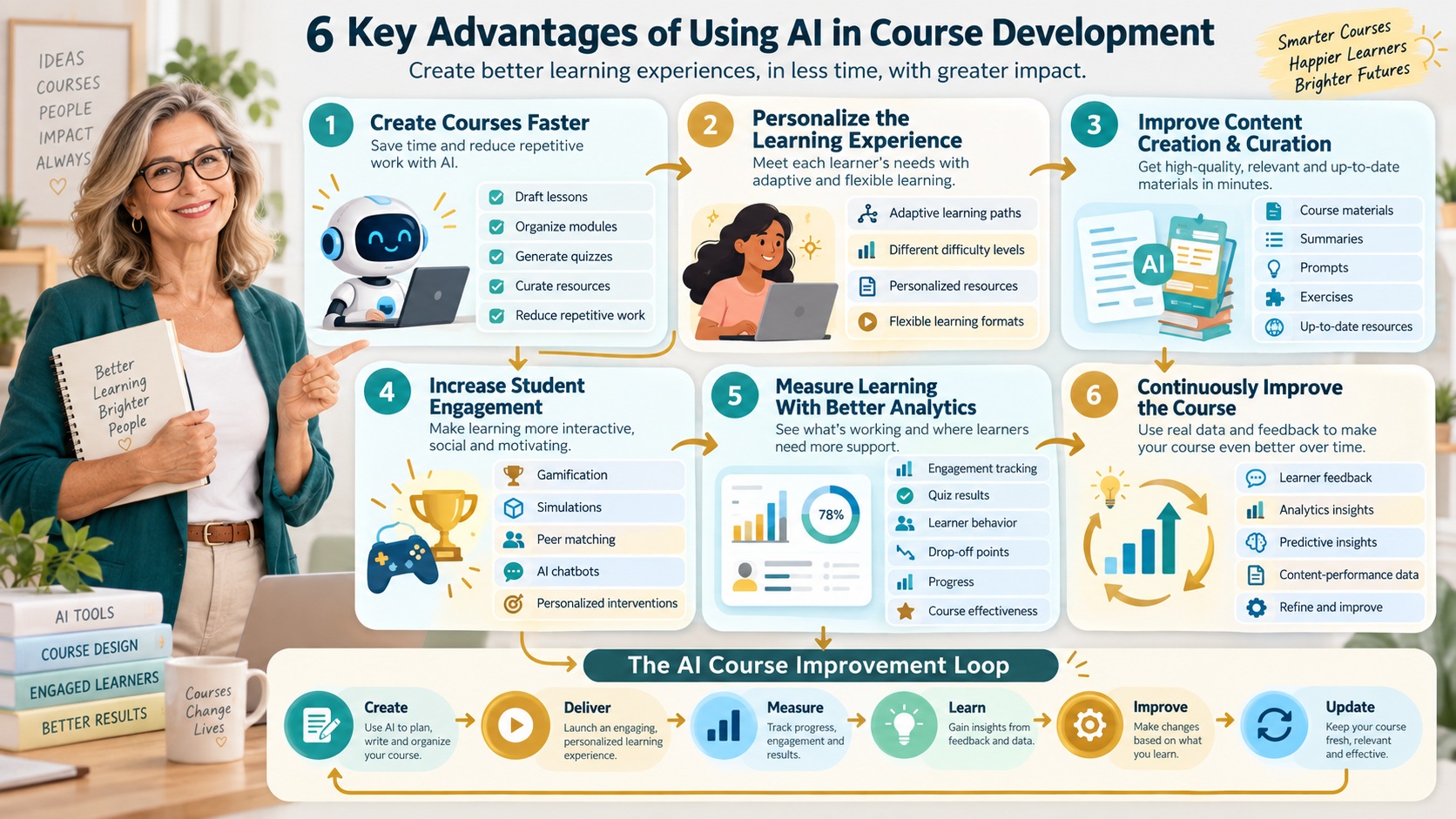
Key Advantages of Utilizing AI in Course Development
When it comes to online course creation, leveraging the power of AI in course development is transforming how educators design, deliver, and optimize learning experiences. AI tools are no longer futuristic concepts; they’re practical resources that boost efficiency, personalize learning, and enhance engagement. As someone deeply involved in education technology, I’ve witnessed firsthand the many benefits of AI tools that help instructors and course creators achieve more with less effort. This article explores the key advantages of integrating AI into course development, revealing why it’s becoming a game-changer in modern education.

The Role of AI in Modern Education
The role of AI in modern education is expanding rapidly, shaping how knowledge is shared and consumed. AI-powered systems are capable of analyzing vast amounts of data to tailor learning paths, automate administrative tasks, and provide real-time feedback. This technology serves as a catalyst for both educators and learners, creating a more interactive and adaptive environment.
For example, AI-driven platforms like Coursera and Udacity utilize machine learning algorithms to recommend courses based on user behavior and interests. This personalization helps learners find relevant content quickly, making the entire process more efficient and enjoyable. Additionally, AI chatbots support students by answering common questions 24/7, reducing the workload on instructors and improving the learner’s experience.
AI in course development also helps democratize education by enabling access to high-quality resources regardless of geographic location. Tools like automated translation and speech recognition make content accessible to non-native speakers and those with disabilities.
Moreover, AI is transforming assessment methods by providing instant grading and detailed analytics, which help educators identify areas where students struggle. This immediate feedback loop supports continuous improvement in teaching strategies and course content. The integration of AI isn’t just a trend; it’s a fundamental shift that enhances the entire educational ecosystem.
Understanding the full potential of AI in modern education sets the stage for exploring how it specifically improves course development efficiency and effectiveness.
Enhancing Course Efficiency with AI Technology
One of the standout benefits of AI in course development is its ability to significantly enhance efficiency. Creating an online course manually can be labor-intensive and time-consuming, often requiring hours of work to develop content, organize modules, and prepare assessments. AI tools streamline these tasks, saving time and reducing human error.
For instance, AI-powered content generation tools can create initial drafts of course materials based on prompts or outlines. This capability allows course creators to focus more on refining content rather than starting from scratch. Platforms like Jasper AI and Writesonic are popular examples that assist in generating written course content rapidly.
Additionally, AI automates the curation of resources, sorting through thousands of articles, videos, and studies to present the most relevant materials. This capability ensures that courses remain up-to-date with the latest information without manual research overload. It’s like having a personal research assistant that never sleeps.
In practical terms, AI tools can also optimize course sequencing by analyzing learner data to suggest the most effective order of modules. This data-driven approach results in a smoother learning journey, which improves knowledge retention and learner satisfaction.
Moreover, AI-powered project management systems help course creators track progress, deadlines, and collaboration efforts, making the entire development process transparent and manageable. These systems reduce the risk of missed deadlines or content gaps, further improving efficiency.
By incorporating AI technology, educators and content creators can focus more on creativity and pedagogy, leaving routine tasks to intelligent systems that increase productivity and reduce burnout.
Personalization and Adaptability in AI-Powered Courses
One of the most exciting AI benefits in education is the ability to deliver personalized learning experiences. Unlike traditional one-size-fits-all courses, AI-powered courses adapt to each learner’s pace, preferences, and knowledge level. This adaptability significantly improves learner outcomes and motivation.
AI algorithms analyze each student’s interactions, quiz results, and engagement patterns to adjust content difficulty and suggest tailored resources. For example, if a student excels in one topic but struggles with another, the AI system can recommend additional exercises or alternative explanations to reinforce weak areas.
Adaptive Learning Paths
Adaptive learning systems use machine learning to dynamically alter the learning path. Platforms like Knewton and Smart Sparrow exemplify this approach by creating individualized study plans that evolve as learners progress. This level of customization reduces frustration and boredom, which are common barriers to course completion.
Real-Time Feedback and Support
Another aspect of personalization is real-time feedback. AI-powered tools provide instant insights on quizzes and assignments, allowing learners to understand mistakes immediately and correct them. Some systems even offer hints or additional explanations, mimicking one-on-one tutoring.
Furthermore, AI chatbots act as personal tutors available 24/7, answering questions and guiding learners through challenging concepts. This constant support fosters a more engaging and supportive learning environment.
Personalized learning also extends to content format. AI can suggest video, audio, or text-based materials based on learner preferences or accessibility needs, ensuring everyone benefits from the course design.
Ultimately, personalization and adaptability through AI empower learners to take control of their education, leading to higher satisfaction and better retention rates.
AI Tools for Content Creation and Curation
Developing high-quality content is the backbone of any successful online course. AI tools have revolutionized this process, offering powerful capabilities for both content creation and curation, which are essential for producing engaging and relevant courses.
Content Creation with AI
AI writing assistants help generate course descriptions, lesson plans, and even detailed explanations. They can produce diverse content formats like quizzes, summaries, or discussion prompts, accelerating the course creation timeline. These tools use natural language processing to maintain coherence and style, making the content feel human and conversational.
For example, AI can help create coding tutorials by generating step-by-step instructions and sample code snippets, which are instantly testable. This capability is invaluable for technical courses where accuracy and clarity are critical.
Content Curation and Updating
AI excels at curating content by scanning vast online databases to find the most relevant and up-to-date resources. This includes research papers, news articles, multimedia, and case studies that align with course objectives. By automating this process, course creators ensure their materials remain fresh and authoritative without manual effort.
Moreover, AI tools can monitor content performance and learner feedback to identify outdated or ineffective materials. This insight allows for continuous course improvement, which is crucial in fast-evolving fields like technology and marketing.
Some platforms, such as Scribbr’s AI content curation guide, explain how AI supports educators in maintaining high content standards efficiently.
By leveraging these AI tools, course developers save time, reduce workload, and produce richer, more engaging educational experiences.
Improving Student Engagement through AI Strategies
Student engagement is a critical factor in the success of online courses. AI in course development enhances engagement by creating interactive, immersive, and responsive learning environments that keep students motivated and involved.
Gamification powered by AI is one popular strategy. AI systems can customize badges, leaderboards, and rewards based on individual progress, creating a sense of achievement and competition that drives continued participation.
Another technique involves AI-driven simulations and virtual reality experiences that provide hands-on learning opportunities. For example, medical students can practice surgery in a virtual environment where AI responds realistically to their actions, providing immediate feedback. This immersive approach deepens understanding and makes learning more memorable.
AI also supports social learning by connecting students with peers who share similar interests or challenges. Intelligent matchmaking algorithms create study groups or discussion forums that foster collaboration and peer support, enhancing the overall learning experience.
Additionally, AI analyzes engagement metrics such as time spent on tasks, quiz attempts, and participation in discussions. This data helps instructors identify disengaged students early, enabling timely interventions such as personalized messages or tailored content to re-engage learners.
By incorporating AI strategies, course developers create dynamic environments that not only attract learners but also keep them committed till the end.
Measuring Success: Analytics and AI Insights
One of the most powerful benefits of AI tools in course development is the ability to measure success through detailed analytics and actionable insights. Traditional course evaluation methods often rely on end-of-course surveys, which provide limited and delayed feedback. AI changes that by offering continuous, data-driven analysis.
Learning Analytics
AI systems track a wide range of learner behaviors: time spent on modules, quiz scores, interaction patterns, and even sentiment analysis from discussion posts. This data paints a comprehensive picture of student performance and engagement.
For instance, platforms like Canvas and Moodle integrate AI-powered analytics dashboards that help instructors identify trends, such as which topics cause the most difficulty or where learners drop off. This information guides targeted improvements to course design.
Predictive Insights
Beyond descriptive analytics, AI provides predictive insights by identifying at-risk students before problems escalate. Predictive models use historical data to forecast dropout probabilities or performance issues, enabling proactive support measures.
Such insights improve retention rates and learner satisfaction by addressing challenges early. The Education Corner resource on AI in education discusses how predictive analytics is reshaping student support systems.
Automated Reporting
AI also automates the generation of reports that summarize course effectiveness, learner feedback, and engagement metrics. These reports save educators time and provide clear evidence of course impact for stakeholders.
Ultimately, the ability to measure success precisely and continuously empowers course creators to refine their offerings, maximize learning outcomes, and demonstrate value to their audiences.
Future Trends in AI-Enhanced Online Learning
The future of AI in course development looks incredibly promising, with emerging trends set to further revolutionize online education. Staying informed about these innovations helps educators and creators prepare for what’s next.
AI-Driven Immersive Experiences
Virtual reality (VR) and augmented reality (AR) integrated with AI will create even more immersive learning environments. These technologies will enable learners to practice real-world skills in safe, simulated scenarios with AI providing personalized guidance and feedback.
Advanced Natural Language Processing
Improvements in natural language processing will make AI tutors more conversational and intuitive. Learners will engage in natural dialogue with AI systems, receiving explanations, answering questions, and clarifying doubts as if interacting with a human instructor.
Ethical AI and Data Privacy
As AI becomes more embedded in education, ethical considerations and data privacy will take center stage. Future AI tools will emphasize transparency, fairness, and protection of learner data, building trust and ensuring equitable access.
Integration with Learning Management Systems (LMS)
AI will become more seamlessly integrated into LMS platforms, providing real-time personalization, automated content updates, and cross-platform analytics. This integration will simplify course management and enrich the learner experience.
Collaborative AI and Human Teaching
Rather than replacing educators, AI will increasingly act as a collaborative partner, augmenting human teaching with data-driven insights and automation. This synergy will elevate educational quality and accessibility.
By embracing these trends, course developers and educators will continue to unlock new possibilities, making online learning more effective, engaging, and inclusive than ever before.
Exploring Forbes’ insights on AI’s future in education offers a glimpse into these exciting developments.
Conclusion
Utilizing AI in course development offers a multitude of advantages—from boosting efficiency and enabling personalization to enhancing engagement and providing deep analytics. The benefits of AI tools in online course creation are clear: they empower educators to deliver tailored, interactive learning experiences while saving valuable time and resources.
As AI continues to evolve, its integration into education will deepen, opening new doors for innovation and accessibility. Whether you are an instructor, course creator, or education technology enthusiast, embracing AI in course development is a smart step toward building impactful learning journeys that meet the needs of diverse learners today and tomorrow.
Visit our GPT, Prompt & Skills Site – The AI Knowledge Vault
To see the full system:
 Read:
Read:
Systeme.io Review: All-in-One Business Platform
AI Business Strategies for Beginners: How to Implement AI for Growth
Top AI Development Tools for Entrepreneurs: A Comparative Guide
Exploring Top AI Tools for Enhanced Business Automation
Mastering AI-Powered Business Techniques for Future Success
Effective Strategies for Incorporating AI in Your Business Operations
The Ultimate Guide to Launching AI Product Strategies Successfully
Mastering the Art of Evaluating AI Business Performance with AI Business Audit Tactics
📅 Last updated:
