
Top AI Business Ideas and Trends for 2026
AI is no longer something sitting on the edge of the business world. It is already inside the tools we use to write, design, research, plan, automate, support customers, analyse data, and create new offers.

But here is the part I want beginners to understand clearly.
AI does not magically create a business for you.
The real opportunity comes from the fit.
The fit between your skills, your audience, the problem you can solve, and the AI tools that help you deliver that solution faster or better.
That is why 2026 is such an interesting year for AI business ideas. The tools are becoming easier to use, more practical, and more available to everyday entrepreneurs. You do not need to be a software developer to start experimenting. You do not need a big team. You do not need to understand every technical term.
You do need a clear problem, a simple offer, and the willingness to test one idea at a time.
In this guide, we will look at practical AI business ideas and trends for 2026, especially for beginners, retirees, solopreneurs, creators, coaches, freelancers, marketers, and small business owners who want to build online income without getting overwhelmed.
The AI Business Landscape in 2026
AI is not one single thing. It is an ecosystem of tools, platforms, workflows, and services that can support many different types of businesses.
Some AI tools help with writing and content creation. Others help with automation, data analysis, customer support, image generation, video creation, research, app building, or business planning.
This is why the AI business landscape can feel exciting and confusing at the same time.
There are so many possibilities.
You could use AI to:
- Create content faster
- Build digital products
- Offer AI-assisted services
- Automate business tasks
- Improve customer support
- Build simple no-code apps
- Create AI-powered templates
- Launch a niche membership
- Help small businesses use AI tools
- Build a simple AI-assisted consulting offer
Gartner has forecast that worldwide AI spending will continue growing strongly in 2026, which shows that businesses are still investing heavily in AI tools, platforms, and infrastructure. At the same time, McKinsey’s State of AI research shows that while many organisations are using AI, most are still working out how to turn that usage into consistent business value.
That is important.
It means there is opportunity, but it also means beginners should avoid chasing hype.
The smart question is not, “What is the hottest AI business idea?”
The smart question is, “Where can I use AI to solve a real problem for a real audience?”
That shift makes all the difference.
Why Beginners Have an Advantage
It may sound strange, but beginners can have an advantage in the AI business space.
Why?
Because beginners are often closer to the real questions people are asking.
They know what feels confusing. They know where people get stuck. They know what needs to be explained in plain language.
Many people do not want a complex AI system. They want help with a simple problem.
They want to know which tool to use. They want a template. They want a workflow. They want someone to explain the steps. They want help turning a messy task into something easier.
That creates business opportunities for people who can simplify AI.
If you are a retiree, coach, creator, freelancer, former teacher, marketer, business owner, admin professional, project manager, or consultant, you may already have useful experience. AI can help you package that experience in new ways.
For example:
A retired teacher could create AI-assisted learning resources.
A former marketer could offer AI-supported content planning.
A coach could build an AI prompt pack for client reflection.
A small business owner could teach other small business owners how to automate simple workflows.
A freelancer could offer AI-assisted research, content, or admin support.
The point is not to start from the tool.
Start from what you already understand.
Then ask where AI can help you deliver more value.
Beginner-Friendly AI Tools to Explore
You do not need to master every AI tool. In fact, trying to use too many tools at once is one of the fastest ways to get overwhelmed.
Start with a small, practical toolkit.
Here are useful beginner-friendly categories to explore:
1. Writing and Research Tools
Tools like ChatGPT, Claude, Gemini, and similar AI assistants can help with brainstorming, outlines, content drafts, email ideas, summaries, research support, and planning.
These tools are useful for bloggers, coaches, newsletter writers, content creators, course builders, and freelancers.
The business opportunity is not just “AI writes content.”
The opportunity is helping a specific audience use AI to create better, clearer, more useful content.
2. Design and Visual Content Tools
Canva and other AI-assisted design tools make it much easier to create social posts, lead magnets, workbooks, presentations, and promotional graphics.
This is helpful for people who want to offer digital product creation, template design, social media support, or simple branding services.
3. Automation Tools
Tools like Zapier, Make, IFTTT, and built-in platform automations can help connect tasks between apps.
For example, you might automate:
- New subscriber follow-ups
- Form responses
- Client onboarding steps
- Lead capture
- Social post scheduling
- Simple reporting
- Customer support workflows
This is a strong area for beginners because many small businesses need automation, but they do not want complicated systems.
4. No-Code AI Tools
No-code and low-code tools allow people to build simple apps, dashboards, forms, workflows, and AI-powered tools without traditional programming.
This opens opportunities for small AI app ideas, business tools, calculators, trackers, assessment forms, and simple client portals.
5. Video, Audio, and Repurposing Tools
AI tools can help turn long-form content into short clips, captions, summaries, scripts, newsletters, and social posts.
This is useful for creators, coaches, podcasters, YouTubers, and educators who already have content but need help turning it into more assets.
Top AI Business Ideas for 2026
Let us make this practical.
Here are AI business ideas worth considering in 2026, especially if you are starting small.
1. AI Content Support Service
Many small business owners know they need content, but they struggle to create it consistently.
You could offer an AI-assisted content support service where you help clients create blog outlines, newsletters, social posts, lead magnets, content calendars, or email sequences.
The key is human editing and strategy.
Do not position yourself as “I push a button and AI writes everything.”
Position yourself as someone who helps clients turn their ideas into clear, useful, audience-friendly content with the support of AI.
Possible niches:
- Coaches
- Local businesses
- Course creators
- Wellness professionals
- Etsy sellers
- Consultants
- Real estate agents
- Online entrepreneurs
Simple starter offer:
“Four AI-assisted blog outlines and eight social post ideas per month.”
That is clear, useful, and not overwhelming.
2. AI Prompt Packs and Workflow Templates
People are buying prompts, templates, checklists, and step-by-step systems because they want shortcuts that are easy to use.
You could create AI prompt packs for a specific audience.
Examples:
- AI prompts for coaches
- AI prompts for Etsy sellers
- AI prompts for bloggers
- AI prompts for retirees starting online
- AI prompts for newsletter writers
- AI prompts for business planning
- AI prompts for customer research
- AI prompts for course creation
The best prompt packs do not just include random prompts. They guide the user through a result.
For example:
“30 prompts to plan your first lead magnet.”
“25 prompts to write better email newsletters.”
“AI business planning prompts for beginners.”
This is a good business idea because it can start as a simple digital product and grow into a larger toolkit, course, or membership.
3. AI Automation Setup for Small Businesses
Small business owners often waste hours on repetitive tasks. They may know automation exists, but they do not know where to start.
You could offer simple AI automation setup services.
Examples:
- New lead follow-up workflow
- Appointment reminder workflow
- Customer inquiry sorting
- Email welcome sequence
- Content repurposing workflow
- Client onboarding checklist
- Weekly reporting automation
The beginner-friendly angle is important.
Many small businesses do not need complex enterprise automation. They need one simple workflow that saves them time.
Starter offer idea:
“I will set up one simple business automation that saves you time every week.”
That is much easier to understand than selling “AI transformation.”
4. AI-Powered Digital Products
Digital products are still a strong online business model, and AI can help you create them faster.
You could create:
- Workbooks
- Planners
- Checklists
- Templates
- Swipe files
- Prompt guides
- Mini courses
- Trackers
- Journals
- Resource packs
AI can help with outlining, drafting, organizing, formatting ideas, and creating variations.
But the value comes from your judgment.
A useful digital product solves a specific problem for a specific person.
For example:
- A content planner for beginner bloggers
- A simple AI checklist for solopreneurs
- A launch worksheet for coaches
- A side hustle idea tracker for retirees
- A prompt workbook for newsletter writers
This is a great route if you prefer creating assets once and selling them repeatedly.
5. AI Side Gig Starter Service
Many beginners want to use AI to make extra income, but they do not know which idea fits them.
You could offer a simple service that helps people choose and start an AI side gig.
This could include:
- A skills and audience assessment
- A short list of suitable AI side gig options
- A simple starter offer
- A tool recommendation
- A first-week action plan
This type of service works because it solves a real problem: too many options.
You are not selling AI magic. You are selling clarity.
6. AI-Assisted coaching or Consulting
If you already have experience in business, marketing, teaching, productivity, planning, wellness, or another niche, you can use AI to improve your coaching or consulting process.
AI can help you:
- Prepare session notes
- Create client worksheets
- Summarize action plans
- Generate reflection questions
- Build learning paths
- Personalize follow-up emails
- Create resource recommendations
The business model is still based on your expertise.
AI simply helps you deliver faster, more personalized support.
This works especially well for coaches, consultants, trainers, and educators who want to create a more structured client experience.
7. AI Membership or Resource Vault
Memberships can work well when people need ongoing support, new resources, and a reason to keep learning.
An AI-focused membership could offer:
- Monthly prompt packs
- Tool walkthroughs
- Beginner AI lessons
- Templates
- Checklists
- Office hours
- Community discussions
- AI tool updates
- Use-case examples
The trick is to avoid making the membership too broad.
A membership called “Learn AI” is vague.
A membership called “AI Content Systems for Beginner Online Business Owners” is clearer.
A membership called “AI Tools and Templates for Retirees Building Online Income” is even more specific.
The more specific the audience, the easier it is to create useful content and attract the right people.
8. AI Newsletter or Curated Resource Service
AI changes quickly. Many people do not have time to track every new tool, feature, and trend.
You could create a newsletter or curated resource service that helps a specific audience stay informed without overwhelm.
Examples:
- AI tools for small business owners
- AI updates for creators
- AI prompts for coaches
- AI automation ideas for solopreneurs
- AI business ideas for beginners
- AI side gig opportunities
This can be monetized through paid subscriptions, affiliate links, sponsorships, digital products, or a membership upgrade.
The key is curation.
Do not just list everything. Tell people what matters, what to ignore, and what to try next.
9. No-Code AI App Ideas
No-code AI app creation is becoming more accessible, and that opens up small product opportunities.
You could create simple AI-assisted tools such as:
- A lead magnet idea generator
- A niche selection quiz
- A content planning assistant
- A customer FAQ chatbot
- A business idea evaluator
- A habit or goal tracker
- A learning recommendation tool
- A simple client intake assistant
These do not need to be complicated.
A small useful app that solves one clear problem can be more valuable than a big app nobody understands.
10. AI Training for Beginners
This may be one of the strongest opportunities for 2026.
Many people still feel behind with AI.
They do not want technical training. They want practical help.
You could teach:
- How to use ChatGPT for everyday business tasks
- How to create a lead magnet with AI
- How to write better emails with AI
- How to plan content with AI
- How to automate one simple workflow
- How to build a digital product with AI
- How to choose the right AI side gig
This can become a workshop, mini-course, webinar, coaching package, or membership.
The best AI training is not about showing off advanced features.
It is about helping people get a useful result.
Future AI Trends to Watch in 2026
Now let us look at the trends shaping AI business opportunities.
1. AI Agents and Multi-Agent Workflows
AI agents are tools that can complete tasks with more independence than a basic chatbot. Gartner has highlighted multiagent systems as one of the strategic technology trends for 2026.
For small business owners, this does not mean you need to build complex agent systems today.
It means you should watch how business workflows evolve.
Simple examples may include:
- An AI assistant that drafts a blog post, creates a social post, and schedules it
- A customer support agent that answers common questions and sends unresolved issues to a human
- A research agent that gathers information and produces a summary
- A sales assistant that helps qualify leads and prepare follow-up messages
The opportunity is in helping people use these tools safely and practically.
2. No-Code and Low-Code AI
No-code AI will keep opening doors for non-technical entrepreneurs.
This matters because many useful AI products do not require advanced development. They require a clear use case, a simple interface, and a real audience.
Expect more tools that help beginners build:
- Chatbots
- Internal dashboards
- AI workflows
- Simple apps
- Client portals
- Content tools
- Business calculators
This trend supports creators, freelancers, and small business owners who want to build without hiring a developer.
3. Personalization
AI makes personalization easier.
Businesses can use AI to personalize:
- Email sequences
- Product recommendations
- Learning paths
- Coaching resources
- Customer support
- Content suggestions
- Sales follow-up
For small businesses, personalization does not have to be complicated. It can be as simple as segmenting your audience and sending more relevant messages.
The business opportunity is helping people make their offers feel more personal without creating more manual work.
4. AI for Productivity and Operations
Many AI opportunities will come from boring tasks.
That may not sound exciting, but it is where real value often lives.
Businesses need help with:
- Admin
- Scheduling
- Inbox sorting
- Reporting
- Customer replies
- Content repurposing
- Research
- Document summaries
- Standard operating procedures
If you can help a business save five hours a week, that is valuable.
Do not underestimate simple productivity offers.
5. Responsible and Trustworthy AI
As more people use AI, trust will matter more.
Businesses will need to think about:
- Privacy
- Accuracy
- Bias
- Transparency
- Human review
- Data protection
- Clear disclaimers
- Ethical content use
This creates opportunities for practical AI safety checklists, training, consulting, and templates.
Beginners do not need to become legal experts, but they should build responsible habits from the start.
How to Choose the Right AI Business Idea
Before you choose an AI business idea, ask yourself these questions:
- What skills or experience do I already have?
- Who do I understand well?
- What problem can I help them solve?
- Where does AI make the result faster, easier, or better?
- Can I test this idea in a small way?
- Would someone pay for this result?
- Can I explain the offer clearly in one sentence?
This is where many beginners go wrong.
They start with the tool.
They say, “I want to build something with AI.”
A better starting point is:
“I help beginner coaches create their first lead magnet using AI.”
Or:
“I help small business owners set up one simple automation that saves time every week.”
Or:
“I create AI prompt packs for retirees starting an online side business.”
Those are clearer. They have a person, a problem, and a result.
A Simple 7-Step Plan to Start
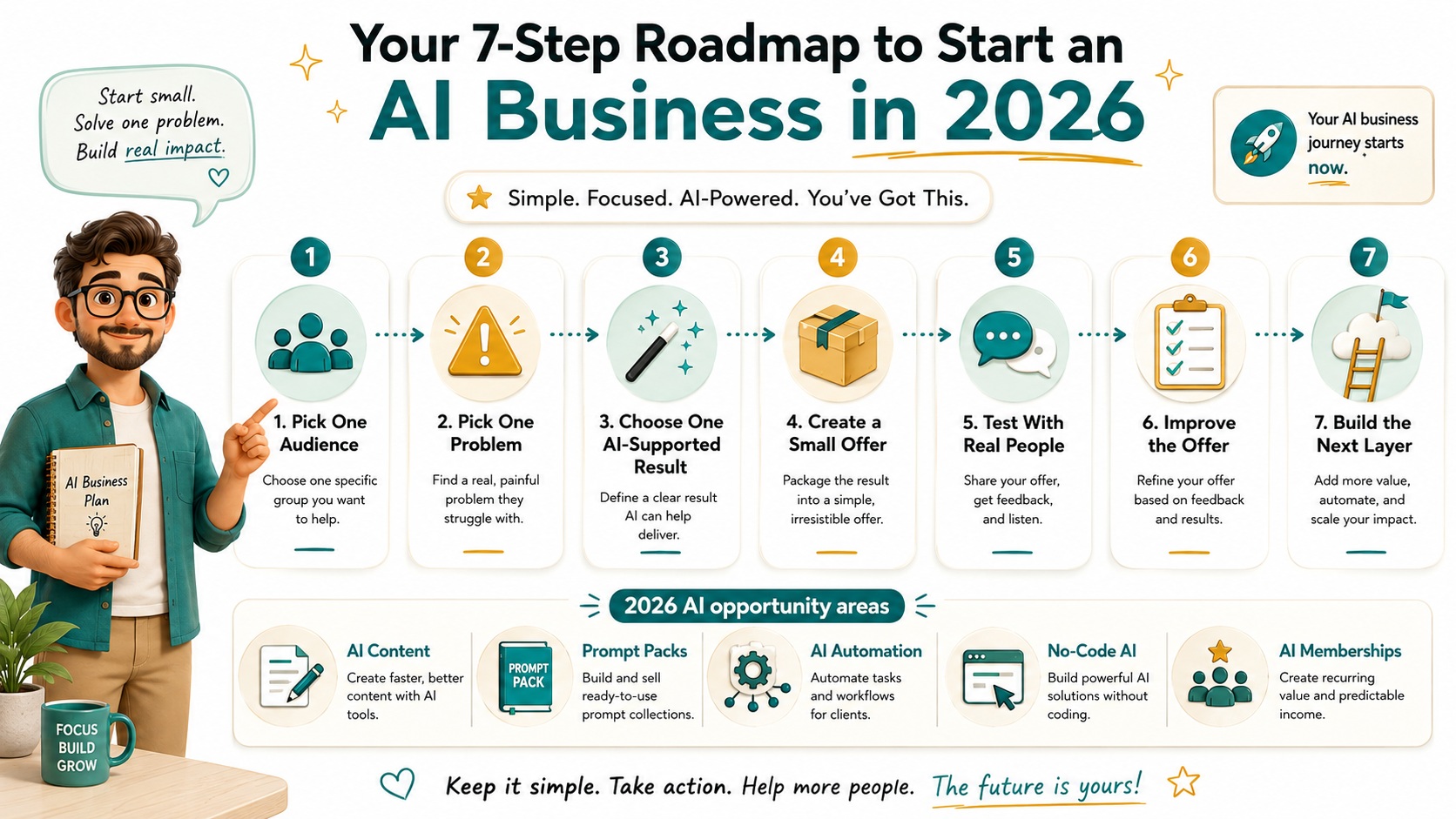
Here is a simple way to start without getting lost.
Step 1: Pick One Audience
Choose one group of people you understand.
Examples:
- Coaches
- Bloggers
- Retirees
- Etsy sellers
- Local businesses
- Course creators
- Freelancers
- Small business owners
Step 2: Pick One Problem
Choose one problem they care about.
Examples:
- They need content ideas
- They struggle with email follow-up
- They do not know which AI tool to use
- They want to save time
- They need a lead magnet
- They want to start a side gig
Step 3: Pick One AI-Assisted Result
Decide what outcome you will help them get.
Examples:
- A content plan
- A prompt pack
- A simple automation
- A digital product outline
- A chatbot script
- A newsletter system
- A mini-course plan
Step 4: Create a Small Offer
Do not start with a huge course or complex product.
Start with one simple offer.
Examples:
- A $27 digital download
- A $49 workshop
- A $97 setup service
- A $197 coaching package
- A free lead magnet leading to a paid offer
Step 5: Test With Real People
Share the idea with your audience.
Ask:
- Is this useful?
- Would you use it?
- What would make it better?
- What feels confusing?
- What result do you want most?
Step 6: Improve the Offer
Use feedback to make the offer clearer and more useful.
Do not keep adding more just to make it feel bigger. Better usually means simpler, clearer, and easier to use.
Step 7: Build the Next Layer
Once the first offer works, you can add:
- A template pack
- A workshop
- A membership
- A coaching offer
- A bundle
- A newsletter
- A higher-value service
This is how you build an AI business without creating chaos.
Common Mistakes to Avoid
Here are the mistakes I would watch for in 2026.
Mistake 1: Chasing Every New Tool
You do not need every tool.
Choose a small tool stack and learn how to use it well.
Mistake 2: Starting Too Broad
“AI for business” is too broad.
“AI email prompts for beginner coaches” is clearer.
Mistake 3: Ignoring Your Existing Skills
AI works best when it supports what you already understand.
Do not throw away your experience. Build on it.
Mistake 4: Making Claims You Cannot Prove
Be careful with income promises.
Instead of saying, “This will make you money,” say, “This can help you create a clearer offer, save time, and test an income idea.”
That is more honest and more trustworthy.
Mistake 5: Forgetting the Human Touch
AI can help you create, automate, and analyse.
But people still buy from people they trust.
Keep your voice, your judgment, and your care in the process.
Final Thoughts
AI business ideas in 2026 are not only for tech experts.
They are for people who can see a real problem and use AI to solve it in a practical way.
That could mean creating prompt packs, offering AI-assisted services, building digital products, teaching beginners, setting up simple automations, launching a membership, or creating no-code AI tools.
The best place to start is not with the trend.
Start with fit.
What do you already know?
Who can you help?
What problem can you solve?
Which AI tool makes that result easier to deliver?
That is where the real business opportunity lives.
Start small. Test one idea. Keep it practical. Improve as you go.
You do not need to master the whole AI world to build something useful.
You only need one clear audience, one real problem, and one simple AI-supported solution.
Visit our GPT, Prompt & Skills Site – The AI Knowledge Vault
To see the full system:
 Read:
Read:
Systeme.io Review: All-in-One Business Platform
A Comprehensive Guide to Developing Your AI Business Model
Exploring Top AI Tools for Enhanced Business Automation
Top 7 Essential AI Business Tools
Top 6 Essential AI Automation Tools for Beginners
A Comprehensive Guide to Beginner AI Automation Tools
A Beginner’s Guide to Launching Your AI Side Hustle Today
📅 Last updated:
