
A Beginner’s Guide to Launching Your AI Side Hustle Today
I remember staring at my bank account last year and feeling that familiar knot in my stomach. My day job paid the bills, but barely. I needed more income, but I had zero coding experience and maybe two hours of free time each evening. That is when I discovered the world of AI side hustle opportunities. Within three months, I built a small but steady stream of income using tools I had never heard of before. If I can do it, you absolutely can too. This guide will show you exactly how to start an AI side hustle from scratch, even if you have no technical background.

Understanding AI Side Hustles
Let me paint a picture for you. An AI side hustle is any income-generating activity where you use artificial intelligence tools to create value faster than you could alone. You are not building robots or writing complex algorithms. You are simply leveraging existing AI platforms to do work that humans used to do manually. Think of it like using a calculator instead of doing long division by hand. The calculator does the heavy lifting, but you still decide what numbers to plug in.
The market for AI automation is growing quickly. Gartner has reported that by 2026, more than 80% of enterprises will have used generative AI APIs, models, or generative AI-enabled applications. For beginners, this is great news. It means these tools are becoming mainstream, easier to access, and more reliable. You are not too late, but you are still early enough to build practical AI skills before they become standard in most business workflows.
Why Now Is the Perfect Time
I have seen this pattern before with the internet boom and the rise of social media. Early adopters always win. Right now, most people are still afraid of AI. They think it is too complicated or that they will break something. That fear leaves the door wide open for you. Companies are desperate for content, data analysis, and customer service automation. They do not care if you use AI to get the work done. They just want the results.
McKinsey research on the economic potential of generative AI suggests that the technology could contribute trillions of dollars in annual economic value across business functions. My takeaway is simple: there will be plenty of work for people who know how to direct these tools and turn AI output into useful business results. You do not need to be a programmer. You need to be a problem solver who can use AI wisely.
Common Myths That Hold Beginners Back
I hear the same objections over and over. Let me address them directly. First, people think they need to be a tech wizard. False. I barely know how to reset my router. Second, people believe AI side hustles are scams. Some are, but legitimate work exists. You just need to know where to look. Third, people assume they need thousands of dollars to start. Wrong again. I started with a free account and a library card for research.
Another myth is that AI will replace you. In my experience, AI does not replace people. People who use AI replace people who do not. That is the cold truth. The AI side gig guide I wish I had when starting would have told me to ignore the noise and focus on execution. That is exactly what we will do here.
Choosing the Right AI Tools
Walking into the AI tool landscape without a map is a recipe for overwhelm. I made that mistake. I signed up for ten different platforms in one weekend and ended up using exactly zero of them. The key is to start with one or two tools that match your specific goal. You are not trying to become an AI expert. You are trying to make money.
Content Creation Tools
If you want to write articles, social media posts, or email newsletters, you need a solid text generation tool. I use a combination of ChatGPT, Gemini, Claude, or Jasper to create content. The trick is learning how to prompt effectively. A vague prompt like “write about coffee” gives you garbage. A specific prompt like “write a 300-word blog introduction for a premium organic coffee brand targeting busy professionals” gives you gold.
I have tested dozens of tools over the past year. My advice is to pick one text tool and one image tool. For images, I recommend DALL-E 3 or Midjourney. You can create book covers, social media graphics, and product mockups in minutes. That alone can become a lucrative AI side hustle. Freelance designers charge hundreds for what you can do in twenty minutes.
Automation and Workflow Tools
This is where AI automation for beginners gets exciting. Tools like Zapier and Make (formerly Integromat) let you connect apps without writing a single line of code. I built a system that automatically generates social media posts from my blog content. It saves me about ten hours per week. Those ten hours become billable time for clients.
Another powerful category is voice and transcription tools. Descript and Otter.ai can transcribe meetings, podcasts, and videos. Many business owners hate taking notes. You can offer a service where you record their meetings and deliver clean summaries using AI. That is a simple, low-effort AI side gig guide anyone can follow.
How to Evaluate a Tool Before Committing
I have a three-step evaluation process. First, I check the free tier. If there is no free trial, I move on. Too many tools charge you before you even know if they work. Second, I search for recent reviews on YouTube. I want to see someone actually using the tool, not just talking about features. Third, I test it with a real project. Not a tutorial. An actual client deliverable. That tells me if the tool is reliable under pressure.
Do not fall for the hype. Every week a new “revolutionary” AI tool launches. Most of them disappear within six months. Stick with established platforms that have proven track records. Your time is too valuable to waste on beta software that crashes halfway through a deadline.
Building Your Step-by-Step System
Having tools without a system is like owning a Ferrari with no gas. You look impressive, but you are not going anywhere. I learned this the hard way when I spent my first month just playing with AI tools instead of actually producing work. A system turns random effort into consistent income.
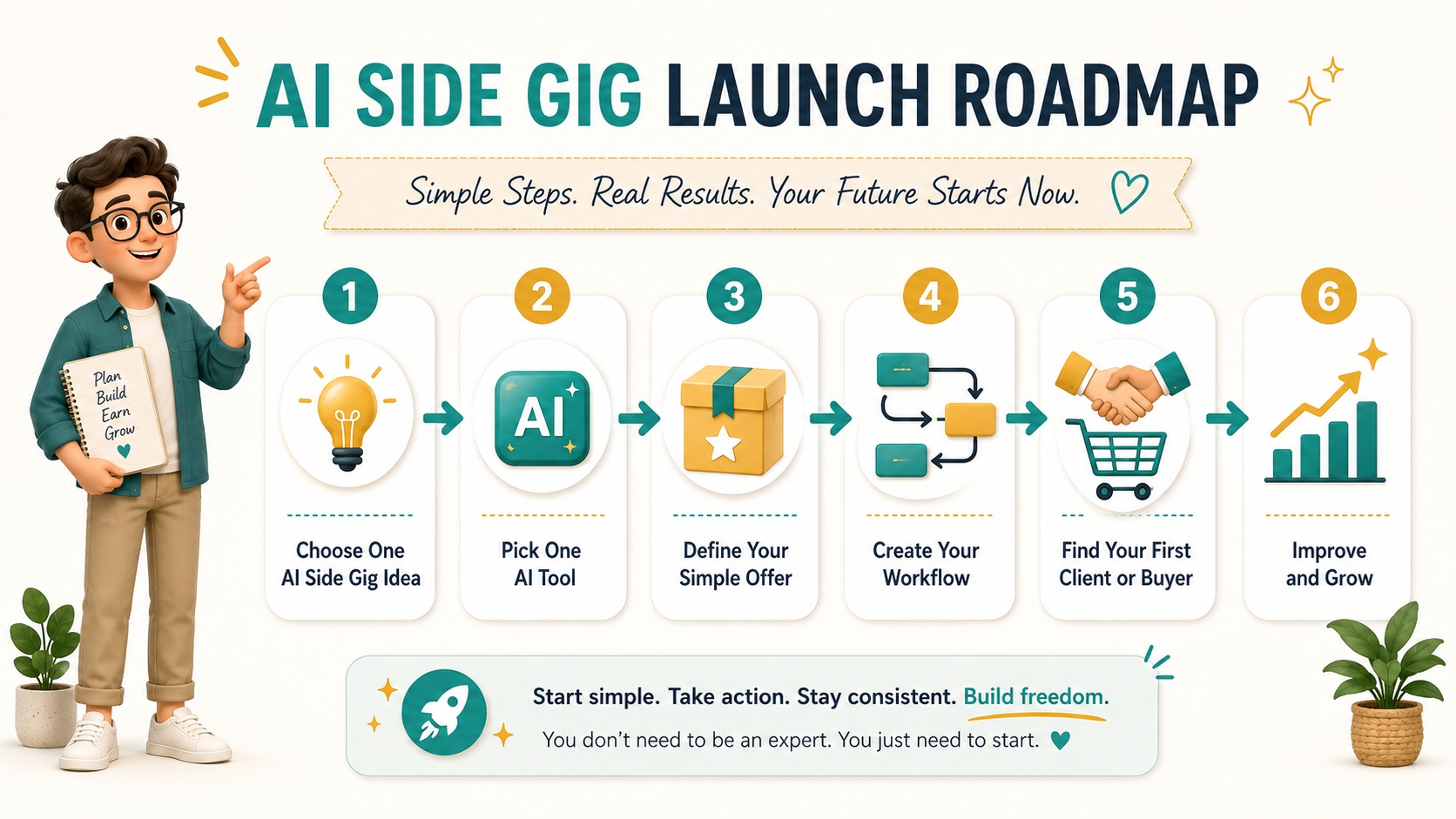
Step 1: Define Your Offer
You cannot sell “AI services.” That is too vague. You need a specific outcome. For example, “I write SEO-optimized blog posts for wellness coaches using AI research tools.” That is clear. That is sellable. I started by offering to write email sequences for local businesses. I charged $200 for a five-email sequence. The AI did the drafting. I did the editing and personalization. It took me about three hours per project.
To define your offer, ask yourself three questions. What skill do you already have? Which AI tool amplifies that skill? Who pays for that combination? For me, I had basic writing skills. AI amplified my speed. Freelancers and small business owners paid for that speed. Your combination might be different. Maybe you are good at graphic design and AI image generators make you faster. Maybe you understand data and AI analysis tools let you deliver insights quickly.
Step 2: Create a Simple Workflow
My workflow looks like this. Monday morning, I check my inbox for new client requests. I batch all similar tasks together. If I have three blog posts to write, I do all the AI research first, then all the drafting, then all the editing. Batching reduces context switching, which is the biggest time killer for freelancers.
I use a kanban board in Trello to track each project. Each card has a checklist. The checklist includes specific AI prompts I use for that type of project. That way, I never have to reinvent the wheel. If a client asks for a similar project six months later, I already have a system ready to go. This is how you scale an AI side hustle without working more hours.
Step 3: Set Up Your Client Pipeline
You need a steady stream of clients. I use three channels. First, I reach out to my existing network. Friends, former colleagues, and local business owners. I offer a free sample project. No strings attached. About half of them convert to paid clients. Second, I post on LinkedIn three times per week. I share tips about AI automation for beginners. That positions me as an expert and attracts inbound inquiries. Third, I use Upwork for overflow work when I have extra capacity.
Do not wait until you feel ready. You will never feel ready. I launched my AI side gig with zero clients and a half-baked website. I learned on the job. Clients do not expect perfection. They expect reliability. Show up on time, deliver quality work, and communicate clearly. That puts you ahead of 90% of freelancers.
Creating Digital Products for Passive Income
Service work is great for immediate cash, but it trades time for money. Digital products break that cycle. You create something once and sell it many times. AI makes product creation faster and easier than ever. I have seen people create profitable digital products in a single weekend using nothing but AI tools.
Types of Digital Products You Can Create
AI-generated templates are a huge market. Think resume templates, social media content calendars, or email swipe files. You can use AI to generate the base content, then add your own design and formatting. I created a pack of 50 ChatGPT prompts for real estate agents. It took me about four hours to refine and format. I sell it on Gumroad for $27. It has generated over $2,000 in passive income so far.
Another option is online courses. You do not need to be a celebrity expert. You just need to be one step ahead of your students. I created a short course on AI automation for beginners using screen recordings and AI-generated scripts. The course covers how to automate social media posting and email responses. I host it on Thinkific and promote it through my email list.
E-books and guides are also viable. AI can help you outline, draft, and even design the cover. I wrote a 50-page guide on starting an AI side hustle using ChatGPT as my co-writer. I edited heavily, but the AI saved me weeks of initial drafting. The guide sells for $12 and has a steady trickle of sales each month.
How to Validate Your Product Idea
Before you spend weeks creating something nobody wants, validate the idea. I use a simple method. I create a landing page with a mock product description and a pre-order button. Then I drive traffic to it using social media or a small Facebook ad. If I get five or more pre-orders within a week, I build the product. If not, I pivot. This saved me from wasting months on a product that had no market.
You can also look at what is already selling. Search for “AI templates” or “ChatGPT prompts” on Etsy or Gumroad. See what has high ratings and lots of reviews. Do not copy those products. Instead, find a gap. Maybe there are lots of prompts for writers but none for therapists. That is your niche. Fill that gap with your own product.
Pricing Your Digital Products
Pricing is tricky. Too low and people think it is low quality. Too high and nobody buys. I follow a simple rule. Price at the level of a fast food meal for small products. $10 to $30 is the sweet spot for templates and guides. For courses, $47 to $97 works well. For comprehensive bundles, $197 to $297 is reasonable.
Do not undervalue your work. You are solving a problem for someone. That has real value. If your product saves someone ten hours of work, it is worth at least $50. I learned to stop pricing based on my own fear and start pricing based on the value I deliver. That shift alone doubled my digital product income.
Joining The Opportunity Lab Community
Going at it alone is the hardest path. I know because I tried it. I spent months making avoidable mistakes. That is why I built The Opportunity Lab. It is a community for people who want to start an AI side hustle but need guidance and accountability. You do not have to figure everything out by yourself.
What You Get Inside the Community
Members get access to a library of AI prompts specifically designed for side hustles. These are not generic prompts. They are battle-tested prompts I use with my own clients. You also get monthly live training sessions where I walk through new tools and strategies. I answer questions in real time. No fluff. Just actionable advice.
There is also a private forum where members share wins, ask for feedback, and collaborate on projects. I have seen members form partnerships. One person handles the AI content creation while another handles the client communication. They split the profits. That is the power of a community. You find people who complement your skills.
Why Community Matters for Beginners
Starting an AI side hustle is lonely. You sit at your computer alone, second-guessing every decision. A community gives you momentum. When I feel stuck, I scroll through the forum and see other people succeeding. That pulls me out of my own head. I also get immediate feedback when I have a question. Instead of waiting days for a YouTube comment reply, I get answers in minutes.
Accountability is another huge benefit. I set weekly goals in the community. Other members check in on me. If I miss a week, I have to explain why. That social pressure keeps me consistent. Consistency is the single biggest factor in whether your AI side hustle succeeds or fails.
How to Get the Most Out of Any Community
Do not just lurk. Introduce yourself. Share your goals. Ask specific questions. The more you engage, the more you get out of it. I also recommend finding an accountability partner within the group. Someone who has similar goals and a similar schedule. You check in with each other daily or weekly. That one connection can double your productivity.
Contribute value too. If you figure something out, share it. Teaching others reinforces your own learning. Plus, people remember those who help. When you eventually launch your own product, those same people will be your first customers. Community is not just about taking. It is about building relationships that last.
Utilizing Free Resources Effectively
You do not need a big budget to start an AI side hustle. Some of the most valuable resources cost nothing. I built my first three months of income using only free tools and publicly available information. The key is knowing where to look and how to use what you find.
Free AI Tools That Actually Work
ChatGPT has a free tier that is powerful enough for most beginners. I used it for months before upgrading. It handles writing, brainstorming, and even basic data analysis. For images, Microsoft Designer / Bing Image Creator offers AI image generation options, often with free access depending on your account and usage limits. Canva offers a free plan with AI design features. You can create professional graphics without spending a dime.
For transcription, Otter.ai gives you 300 minutes of free transcription per month. That is enough to transcribe several client meetings or podcast episodes. For automation, Zapier has a free plan with 100 tasks per month. That is plenty for testing workflows before you scale. I started with all of these free tools and only upgraded when my income justified the expense.
Learning Resources That Do Not Cost Money
YouTube is an endless library of AI tutorials. I recommend channels like Matt Wolfe and The AI Advantage. They break down complex topics into simple steps. I also use the documentation on the official websites of tools like ChatGPT and Zapier. Those docs are written by the developers and are usually accurate and up to date.
Another overlooked resource is Reddit. Subreddits like r/ArtificialIntelligence and r/ChatGPT are full of real users sharing tips and tricks. I have found some of my best AI prompts by reading comments on Reddit. Just be careful. Not everything you read is true. Cross-reference important information with official sources.
How to Structure Your Learning Time
Free resources are abundant, but they can also be overwhelming. I recommend a 70-20-10 rule for your learning time. Spend 70% of your time actually doing the work. Write content, create products, or reach out to clients. Spend 20% of your time learning specific skills you need right now. Spend 10% of your time exploring new tools and trends.
Most beginners get stuck in the learning phase. They watch tutorial after tutorial without ever launching. I fell into that trap. The cure is to set a firm deadline. Give yourself one week to learn a tool, then launch something. It does not have to be perfect. It just has to exist. You can improve later. Perfection is the enemy of progress.
Conclusion
Launching your AI side hustle today is not about having the perfect plan. It is about taking the first step. I started with a free ChatGPT account and a willingness to fail. Within six months, I replaced my part-time job income. You have the same opportunity right now. The tools are accessible. The demand is high. The only thing standing between you and your first AI side gig is action. Pick one tool from this guide. Define one offer. Reach out to one potential client. Do that today. Not tomorrow. Not next week. Today. Your future self will thank you.
Get our FREE resource – The AI Powered Online Business Toolkit
Also recently launched – The Smart Content System
To see the full system:
 Read:
Read:
Systeme.io Review: All-in-One Business Platform
How to Start and Grow an Online Business Using AI
A Comprehensive Guide to Implementing AI-Powered Online Business Models
5 Easy AI Business Models for New Entrepreneurs
Top 7 Must-Have AI Tools for Successful Entrepreneurs
Top 10 Innovative AI Business Ideas to Kickstart Today
📅 Last updated:
