
How to Establish an AI Business System: Your Step-by-Step Guide
I remember staring at my screen, feeling completely overwhelmed by the sheer volume of tasks I needed to complete. It felt like I was spinning my wheels every single day. That is when I decided to stop working harder and start working smarter. I wanted to learn how to establish an AI business system that could handle the heavy lifting for me. This guide is the exact blueprint I used to transform my workflow and start building real online income with AI. You do not need to be a tech wizard to make this work. You just need a clear plan and the right tools. Let me walk you through every single step so you can build a system that works while you sleep.

Understanding the Basics of AI Business Systems
Before we jump into the tools and tactics, we need to get the foundation right. An AI business system is not just a single piece of software. It is a connected network of tools and processes that automate repetitive tasks. Think of it as your digital employee that never sleeps, never complains, and never asks for a raise. The goal here is to free up your time so you can focus on high-value activities like strategy and relationship building.
I have seen too many people jump straight into buying expensive software without understanding the core principles. They end up with a messy collection of tools that do not talk to each other. That is a recipe for frustration, not freedom. When you establish an AI business system, you are creating a workflow that moves data from one step to the next automatically. This could be as simple as having an AI write your social media posts and then schedule them for you.
Why Traditional Systems Fall Short
Traditional business systems rely heavily on manual input and human oversight. You have to write every email, create every graphic, and schedule every post by hand. That works fine when you are just starting out, but it does not scale. As your business grows, the workload grows with it. I hit this wall hard about two years ago. I was working twelve-hour days and still falling behind. That is when I realized I needed a different approach.
AI systems, on the other hand, learn from your inputs and improve over time. They can generate content, analyse data, and even interact with customers. The key difference is that AI systems handle the execution while you handle the direction. You become the architect of your business, not just the worker bee. This shift in mindset is critical for anyone looking to build a sustainable online income stream.
The Core Components You Need
Every solid AI business system has three core components. First, you need an input mechanism. This is where you feed your system information, like a topic for a blog post or a customer inquiry. Second, you need a processing engine. This is the AI itself that takes your input and turns it into something useful. Third, you need an output channel. This is where the final product lands, like your blog, email list, or social media account.
When I first started building my system, I focused too much on the processing engine. I bought the best AI writing tool I could find, but I had no way to get the content out to my audience. That was a massive mistake. You need all three pieces working together to see real results. Once I connected the dots, everything clicked into place. I was able to produce more content in a week than I used to produce in a month.
Choosing the Right AI Tools for Your Business
Now that you understand the basics, it is time to talk about the tools. The market is flooded with AI solutions, and it can be hard to know which ones are worth your time and money. I have tested dozens of tools over the past year, and I have narrowed it down to a few that consistently deliver results. The golden rule is to start simple. Do not try to automate everything at once. Pick one area of your business that causes you the most pain and solve that first.
For most people, content creation is the biggest bottleneck. Writing blog posts, social media captions, and email sequences takes hours. I use a combination of tools to handle this. For long-form content, I rely on a tool that specializes in article generation. For short-form content, I use a different tool that is optimized for platforms like Twitter and LinkedIn. The key is to match the tool to the task. A hammer is great for nails, but it is terrible for screws.
Evaluating AI Writing Assistants
When you evaluate an AI writing assistant, look for three things. First, the quality of the output. Does it sound like a human wrote it, or does it have that robotic feel? Second, the level of customization. Can you train the AI on your brand voice and style? Third, the integration options. Can it connect to your existing tools like WordPress or your email service provider? I have used tools that scored high on quality but low on integration, and they ended up being more trouble than they were worth.
One tool I keep coming back to is Jasper. It offers a good balance of quality and customization. I also use Copy.ai for shorter pieces because it is faster and more intuitive. For those on a tight budget, ChatGPT is a solid option. It is not as specialized as the paid tools, but it is incredibly versatile. You can use it for everything from brainstorming ideas to drafting entire sales pages. The key is to experiment and find what works best for your specific workflow.
Building Your Online Income with AI
The ultimate goal of any AI business setup is to generate income. I have seen people use these systems to build profitable side hustles and even full-time businesses. The most common model is content marketing. You use AI to create high-quality content that attracts an audience. Then you monetize that audience through affiliate marketing, digital products, or coaching. The beauty of this model is that it scales almost effortlessly. Once your system is in place, you can produce content at a rate that would be impossible manually.
I personally use my system to run multiple niche websites. Each site has its own AI-driven content pipeline. I feed the AI a list of topics, it writes the articles, and I publish them with minimal editing. The entire process takes about an hour a day. That is the power of a well-designed system. It turns a complex task into a simple routine. If you are serious about building online income with AI, you need to invest the time upfront to get the system right.
Setting Up Your AI-Powered Toolkit
Setting up your toolkit is where the rubber meets the road. This is not about buying every shiny new tool that hits the market. It is about creating a streamlined workflow that eliminates friction. I recommend starting with a core set of three to four tools. You can always add more later as your needs grow. The most important thing is that your tools work together seamlessly. If you have to manually copy and paste data from one tool to another, you are doing it wrong.
My personal toolkit includes an AI writing assistant, a project management tool, a scheduling tool, and an analytics platform. The writing assistant handles content creation. The project management tool keeps me organized. The scheduling tool pushes content out to my channels. The analytics platform tells me what is working and what is not. This four-tool stack covers all the bases without being overwhelming. I can manage my entire business from a single dashboard.
Get our Free AI-Powered Toolkit
Integrating Your Tools for Maximum Efficiency
Integration is the secret sauce of any successful AI business system. Most modern tools offer some form of API or native integration. For example, I have my AI writing assistant connected directly to my WordPress site. When the AI finishes an article, it is automatically formatted and saved as a draft. I just have to review it and hit publish. This saves me at least thirty minutes per article. Over a month, that adds up to several hours of saved time.
I also use Zapier to connect tools that do not have native integrations. Zapier acts as a bridge between your apps. You can create automated workflows called Zaps. For instance, I have a Zap that takes new blog post ideas from my project management tool and sends them to my AI writing assistant. Another Zap takes completed articles and adds them to my scheduling tool. These small automations compound over time to create a massive efficiency gain.
Automating Your Content Distribution
Content creation is only half the battle. You also need to get that content in front of people. This is where automation really shines. I use a scheduling tool called Buffer to distribute my content across multiple social media platforms. I batch-create my posts once a week and let the tool handle the rest. The AI even suggests optimal posting times based on when my audience is most active. This takes the guesswork out of the equation.
I have also automated my email marketing. My AI writing assistant creates a weekly newsletter based on the content I published that week. The email is automatically formatted and sent to my list. I do not have to think about it at all. The system just works. This level of automation is what allows me to maintain a consistent online presence without spending hours every day on social media. It is a gamechanger for anyone looking to build a scalable business.
Implementing AI Strategies for Online Income
Having the tools is one thing. Knowing how to use them to generate income is another. I have developed a handful of strategies that consistently produce results. The first strategy is what I call the “Content Funnel.” You create a series of interconnected content pieces that guide a reader from awareness to purchase. The AI handles the heavy lifting of creating the content. You just need to provide the strategic direction.
For example, I might create a blog post about a common problem in my niche. That post links to a more in-depth guide that I offer as a free download. The guide includes an affiliate link to a product that solves the problem. The entire funnel is created by AI, from the blog post to the guide to the email sequence that follows up with the downloader. This system runs on autopilot, generating income around the clock.
Leveraging AI for Affiliate Marketing
Affiliate marketing is one of the easiest ways to monetize an AI-driven content system. The AI can research products, compare features, and write compelling reviews. I have had great success with this approach. I simply provide the AI with the product name and a few key features. It generates a comprehensive review that includes personal anecdotes and persuasive language. The reviews rank well in search engines because they are in-depth and original.
One tip that has worked well for me is to focus on products I have actually used. The AI can generate a review based on product specs, but it is much better when you add your own experience. I write a short summary of my experience with the product, and the AI weaves it into the review. This creates a hybrid piece that combines the efficiency of AI with the authenticity of personal experience. Readers can tell the difference, and they trust content that feels real.
Creating Digital Products with AI
Another powerful strategy is creating and selling digital products. AI can help you create e-books, courses, templates, and more. I recently launched a digital course using content that was entirely generated by AI. I provided the outline and the key talking points. The AI wrote the script for each module. I recorded the videos using the script as my guide. The entire process took less than a week. Without AI, it would have taken at least a month.
The key to success with digital products is to focus on a specific pain point. Do not try to create a general course that covers everything. Drill down into a specific problem your audience faces. The AI can help you identify these pain points by analysing comments and questions from your audience. Once you have a clear problem, the AI can generate a solution in the form of a product. This targeted approach leads to higher conversion rates and happier customers.
Membership Options for AI Business Support
Building an AI business system is a journey, and you do not have to do it alone. There are membership options available that provide ongoing support, training, and access to premium tools. I have found that being part of a community accelerates the learning process significantly. You can learn from other people’s mistakes and successes. You also get access to resources that would be expensive to buy on your own.
One membership I highly recommend is the one offered by The Opportunity Lab. It provides a structured framework for building your AI business. The membership includes weekly training sessions, a private community, and exclusive tools. The training covers everything from the basics of AI to advanced automation strategies. The community is active and supportive. I have made valuable connections there that have led to collaborations and joint ventures.
What to Look for in a Membership
When evaluating a membership, look for three things. First, the quality of the training. Is it up-to-date and actionable? Second, the community culture. Is it supportive and collaborative, or is it full of hype and fluff? Third, the value of the bonuses. Does the membership include tools or templates that you would otherwise have to pay for? I have been burned by memberships that promised the world but delivered very little. Do your due diligence before committing.
The Opportunity Lab checks all these boxes. The training is practical and focused on real-world results. The community is one of the most positive and helpful I have ever been a part of. The bonuses, which include AI prompts and workflow templates, save me hours of work every week. If you are serious about building an AI-powered business, this membership is worth every penny.
Free vs. Paid Memberships
There are free memberships available, but they often lack the depth and support of paid options. Free communities can be great for networking and basic questions, but they rarely provide the structured training you need to make real progress. I started with free resources and quickly hit a plateau. I was getting the same advice over and over, and I did not know how to take my system to the next level.
When I joined a paid membership, everything changed. I got access to advanced strategies that I had never even considered. I also got personalized feedback on my workflow. That feedback was invaluable. It helped me identify bottlenecks I did not even know I had. If you are serious about establishing an AI business system, I recommend investing in a paid membership. The return on investment is substantial.
Utilizing Free Resources for AI Business Growth
Not everyone has the budget for paid memberships and premium tools. That is okay. There are plenty of free resources available that can help you build and grow your AI business. The key is to know where to look and how to use them effectively. I started my journey with nothing but free tools and a lot of determination. It took longer, but it was possible. You do not need a huge budget to get started.
One of the best free resources is YouTube. There are countless channels dedicated to AI and automation. I learned the basics of prompt engineering from a free YouTube series. Another great resource is the documentation provided by AI tool companies. Most of them have extensive guides and tutorials. I spent hours reading the documentation for ChatGPT and Jasper. That knowledge has been instrumental in building my system.
Leveraging Free AI Tools
Several high-quality AI tools offer free tiers. ChatGPT has a free version that is surprisingly capable. You can use it for writing, brainstorming, and even basic data analysis. The free version has some limitations, but it is more than enough to get started. I used the free version of ChatGPT for three months before I upgraded to the paid plan. During that time, I built a fully functional content system.
Another free tool I rely on is Canva. It has an AI-powered design feature that can generate graphics based on text prompts. I use it to create social media images and blog graphics. The free version includes thousands of templates and design elements. You do not need to be a designer to create professional-looking visuals. Canva handles the heavy lifting. These free tools are a great way to test the waters before you invest money.
Building Skills Without Spending Money
Skill building is another area where free resources shine. You can learn prompt engineering, data analysis, and workflow design without spending a dime. Websites like Coursera and edX offer free courses on AI and machine learning. I took a free course on AI fundamentals that completely changed how I approach automation. The course was from a top university and was just as good as any paid course I have taken.
I also recommend following AI experts on social media. Many of them share valuable tips and insights for free. I follow a handful of AI influencers on Twitter and LinkedIn. They regularly post about new tools, strategies, and best practices. This keeps me informed without having to pay for a subscription. The key is to be intentional about your learning. Set aside time each week to consume free content and apply what you learn.
Joining The Opportunity Lab Community for Networking
Networking is a crucial part of building any business, and an AI business is no exception. You need to connect with other people who are on the same journey. They can offer support, advice, and even partnership opportunities. I have found that the best place to network is within a dedicated community like The Opportunity Lab. The members there are focused, motivated, and generous with their knowledge.
When I first joined The Opportunity Lab, I was hesitant to participate. I thought I did not have enough experience to contribute. That was a mistake. The community is incredibly welcoming. People are happy to help you, no matter where you are in your journey. I started asking questions and sharing my own experiences. Within a few weeks, I had built meaningful relationships with several members. Those relationships have been a source of encouragement and accountability.
The Power of Peer Accountability
One of the biggest benefits of being part of a community is accountability. It is easy to slack off when you are working alone. But when you know other people are counting on you, you are more likely to follow through. In The Opportunity Lab, we have accountability groups where members check in with each other weekly. We share our goals, our progress, and our challenges. This simple practice has helped me stay consistent and avoid procrastination.
I remember one week when I was struggling with a particularly tricky automation. I was ready to give up. But I posted about my struggle in the community, and several members jumped in to help. They shared their own solutions and offered to hop on a call to troubleshoot. Within a day, my problem was solved. That kind of support is priceless. You cannot get that from a blog post or a YouTube video. You need real human connection.
Collaborations and Joint Ventures
Networking also opens the door to collaborations and joint ventures. I have partnered with other members of The Opportunity Lab on several projects. We have co-created products, cross-promoted each other’s content, and even launched a joint webinar. These collaborations have expanded my reach and generated new income streams. None of that would have happened if I had stayed in my own bubble.
If you are serious about building a scalable AI business, do not underestimate the power of community. Join The Opportunity Lab or a similar group. Be active. Be generous. Offer help before you ask for it. The relationships you build will pay dividends for years to come. Your AI system can handle the tasks, but it cannot replace the value of genuine human connection.
Scaling Your AI Business System
Once you have your system running smoothly, it is time to think about scaling. Scaling means increasing your output without increasing your workload. This is where the real magic happens. A well-designed AI system can handle ten times the workload with only a marginal increase in effort. The key is to build flexibility into your system from the start. Do not create workflows that are rigid and hard to modify.
I designed my system with scalability in mind. I use modular workflows that can be easily duplicated and adapted. For example, I have a master template for blog post creation. I can copy that template and modify it for different niches or content types. This allows me to launch new sites quickly without reinventing the wheel. I have scaled from one site to five sites using the same core system. The process is almost entirely automated.
Outsourcing to AI Virtual Assistants
As you scale, you may want to consider using AI virtual assistants. These are advanced AI agents that can handle complex tasks like customer support, research, and even project management. I use an AI assistant to handle my email inbox. It filters out spam, categorizes messages, and even drafts responses. I just review and approve. This has freed up hours of my time every week.
There are several platforms that offer AI virtual assistants. Some are standalone tools, while others are integrated into larger business suites. I recommend starting with a simple tool that handles one specific task. Once you are comfortable, you can add more assistants for different functions. The goal is to create a team of AI agents that work together seamlessly. This is the ultimate expression of an establish AI business system.
Monitoring and Optimizing Your AI Business System
Scaling is not a set-it-and-forget-it process. You need to monitor your system regularly and make adjustments. I review my analytics every week to see what is working and what is not.
I look at simple numbers first. How much traffic is coming in? Which blog posts are getting the most views? Which emails are getting opened? Which products are converting? Which social media posts are bringing people back to my site? These numbers tell me where to focus my energy.
Your AI business system should make this easier, not harder. You can use analytics tools, spreadsheets, dashboards, and AI assistants to summarize your results. For example, you can export your website traffic data and ask AI to identify patterns. You can paste your email subject lines into AI and ask which ones are likely to perform better. You can review customer questions and ask AI to find common themes.
The goal is not to drown yourself in data. The goal is to make better decisions.
I recommend tracking five simple metrics:
- Website traffic
- Email subscribers
- Sales or affiliate commissions
- Content output
- Time saved through automation
These five numbers give you a clear picture of whether your system is actually helping your business grow.
If your traffic is increasing but your sales are not, you may need to improve your offers or calls to action. If your email list is growing but people are not opening your emails, you may need better subject lines or more relevant content. If your AI tools are saving time but the quality of your work is dropping, you may need to add more human review before publishing.
This is where many people go wrong. They build an AI system and then trust it too much. AI can speed up your work, but it still needs direction. You are still the strategist. You are still responsible for the quality, the message, and the customer experience.
I also suggest doing a monthly system audit. Look at every tool you are paying for and ask three questions:
Is this tool saving me time?
Is this tool helping me make money?
Is this tool making my business simpler or more complicated?
If a tool is not helping, cancel it or replace it. Your AI business system should feel lighter over time, not heavier. The whole point is to reduce overwhelm, not create a new kind of digital clutter.
Common Mistakes to Avoid
When you establish an AI business system, it is easy to get excited and try to automate everything at once. I have made that mistake myself. I added too many tools too quickly, and instead of saving time, I created more confusion.
The first mistake is tool overload. You do not need ten different writing tools, five design platforms, and three automation systems. Start with one core workflow. For example, build a simple content creation system first. Once that works, add email automation. Then add analytics. Grow your system slowly.
The second mistake is skipping the human review step. AI can write, summarize, organize, and automate, but it can still make errors. Always check important content before publishing. This is especially true for facts, prices, product claims, health information, legal topics, and financial advice.
The third mistake is building a system without a clear goal. Automation only helps when it supports a specific outcome. Do you want more leads? More sales? Better content? Faster delivery? Less admin work? Choose the goal first, then build the workflow around it.
The fourth mistake is ignoring your audience. AI can help you create more content, but more content is not always better. Your content still needs to solve real problems for real people. Listen to your audience, read their comments, answer their questions, and use AI to help you serve them better.
The fifth mistake is never updating your system. AI tools change quickly. A workflow that worked six months ago may not be the best option today. Review your tools regularly and stay open to improvements.
Conclusion
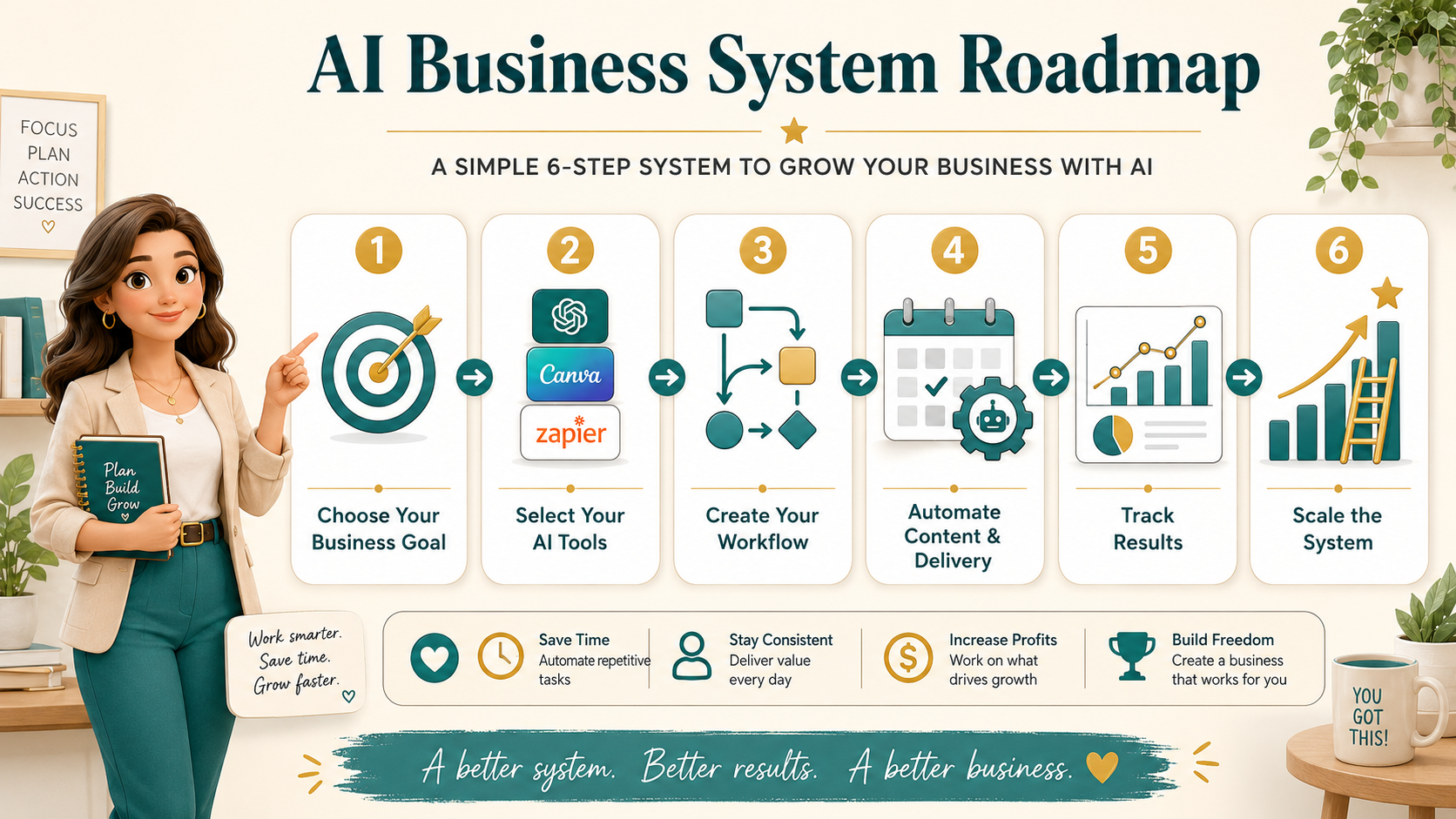
Learning how to establish an AI business system can feel overwhelming at first, but it becomes much easier when you break it down into simple steps. You do not need to automate your entire business overnight. You only need to start with one process that is taking too much time or energy.
Begin with a clear goal. Choose one area of your business to improve. Select the right tools. Build a simple workflow. Test it. Track the results. Then refine and scale as you go.
The real power of an AI business system is not just speed. It is freedom. It gives you more time to think, create, connect, and make better decisions. It helps you move from constant busywork to a more structured and sustainable way of working.
AI can write drafts, organize information, schedule content, summarize meetings, analyse data, and automate repetitive tasks. But you still bring the vision, the strategy, the experience, and the human connection.
Start small. Keep your system simple. Build one workflow at a time.
Before long, you will have an AI-powered business system that supports your goals, saves you time, and helps you build online income with more clarity and confidence.
To see the full system:
 Read:
Read:
Systeme.io Review: All-in-One Business Platform
How to Start and Grow an Online Business Using AI
A Comprehensive Guide to Implementing AI-Powered Online Business Models
5 Easy AI Business Models for New Entrepreneurs
Top 7 Must-Have AI Tools for Successful Entrepreneurs
Top 10 Innovative AI Business Ideas to Kickstart Today
📅 Last updated:
